
Curious stories
The mobile phone embedded in a pavement in a Malaga village
Four local residents left the Nokia as a joke while roadworks were being carried out in January 2008 and it is still in the same place today
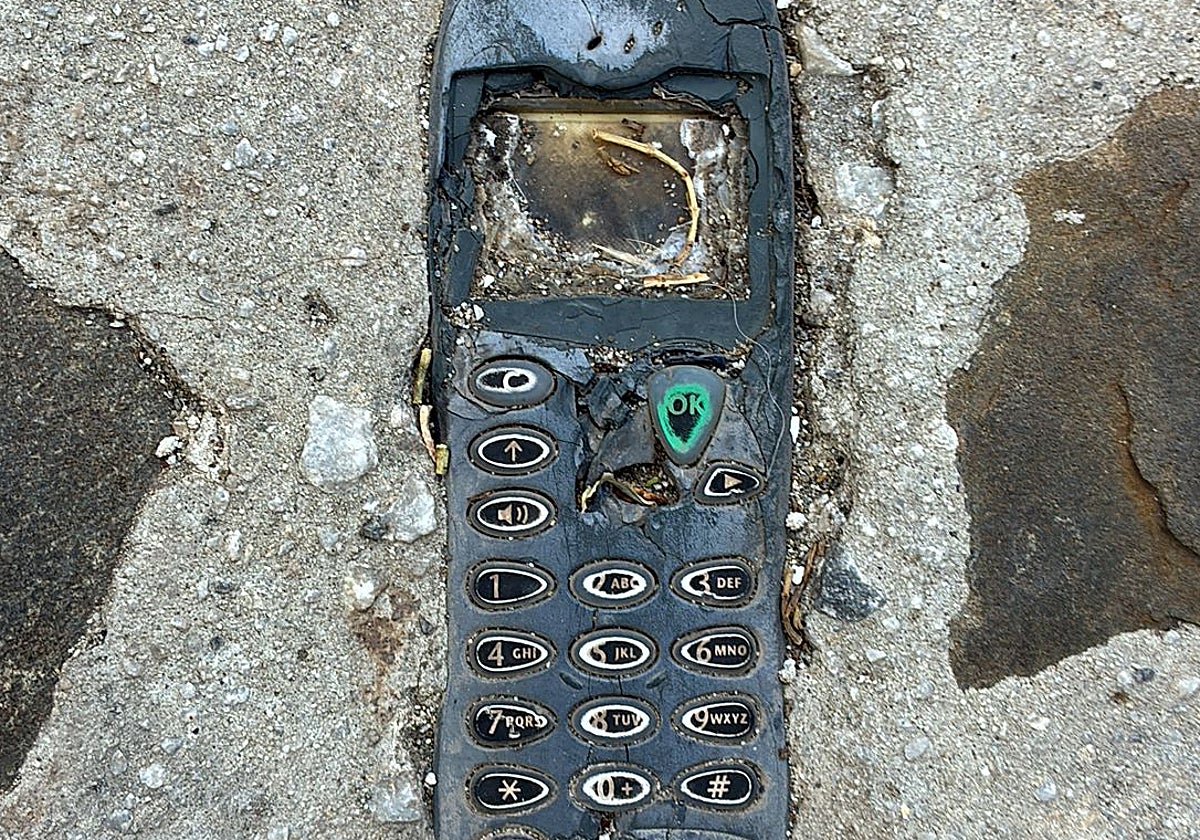

In the village of El Borge in the Axarquía area of Malaga province, an old Nokia mobile phone remains embedded into a street, 18 years years after if was placed there, as a joke, by four local residents who were employed by the town hall to carry out roadworks at the time.
Permanently embedded into Calle Guillermo Pérez, next to El Lugá butchers, the phone is now part of the ground, the landscape and the small memory of the Axarquia village that is mainly known for its Alejandría muscatel grapes and the bandit museum, which opened in 2020.
The curious story goes back to January 2008, when the street was being renovated. Salvador Alarcón 'Xavare', Salvador Palomo 'El Zuri', Salvador Moya and José Antonio Fernández 'El Nono', were working on the site. It was Moya, now 67 years old and retired after a working in construction all of his working life, who brought the mobile phone from his house. It hadn't worked for some years and mobile phone signal was scarce in El Borge back then: "It was a joke, I took it to work and told the councillor 'we are going to set up a telephone switchboard here in the street'," recalls Moya.
"It was a joke, I took it to work and said to the councillor 'let's set up a telephone switchboard in the street'".
"It was no longer useful for making phone calls, which was what people did back then, or sending text messages," recalls Salvador Alarcón. 18 years later, he points to the exact spot where it was placed. "El Nono said to Salvador Moya, half-jokingly, 'Leave it there' and that's where it stayed".
"I remember that I bought it in Malaga when I was working in Huelin market, around the year 2000 and that it lasted me quite a few years, unlike the smartphones of today, whose screen breaks every now and then," says Moya, who adds that in the early 2000s, mobile phone coverage in the village was scarce.
He admits that he didn't really think about what he was doing at the time and that it was just a laugh about the lack of coverage. Nobody thought that that phone, useless even then, would still be there after almost two decades under the sun, the rain and the constant passing of residents and visitors. "Those mobiles were really tough," he says, smiling. "You used to play snake with them", he adds, clearly someone who remembers a childhood without smartphones and touchscreens.
A curiosity
Since then, the Nokia has seen village festivals, winters, summers, new work and overheard countless conversations. It has survived changing fashions, the advent of smartphones and the accelerated speed of life. No one has ripped it out. No one has complained. In a village of under a thousand inhabitants, the mobile phone has been accepted as part of the charm.
"It always gets mentioned when someone passes by and notices," say the locals. It is a curiosity, an anecdote, a nod to the past and the result of a prank that team of bricklayers who were repairing the road in El Borge in 2008.
![[]](http://static.vocstatic.com/voc26/latest/assets/images/favicon/surinenglish/apple-touch-icon-57x57.png)