
History
The day the floods brought a miracle to a Malaga village
The unexpected discovery of a painting of the Virgin Mary in the middle of a river in Riogordo today continues to attract visitors who pray to the image and leave flowers

Malaga
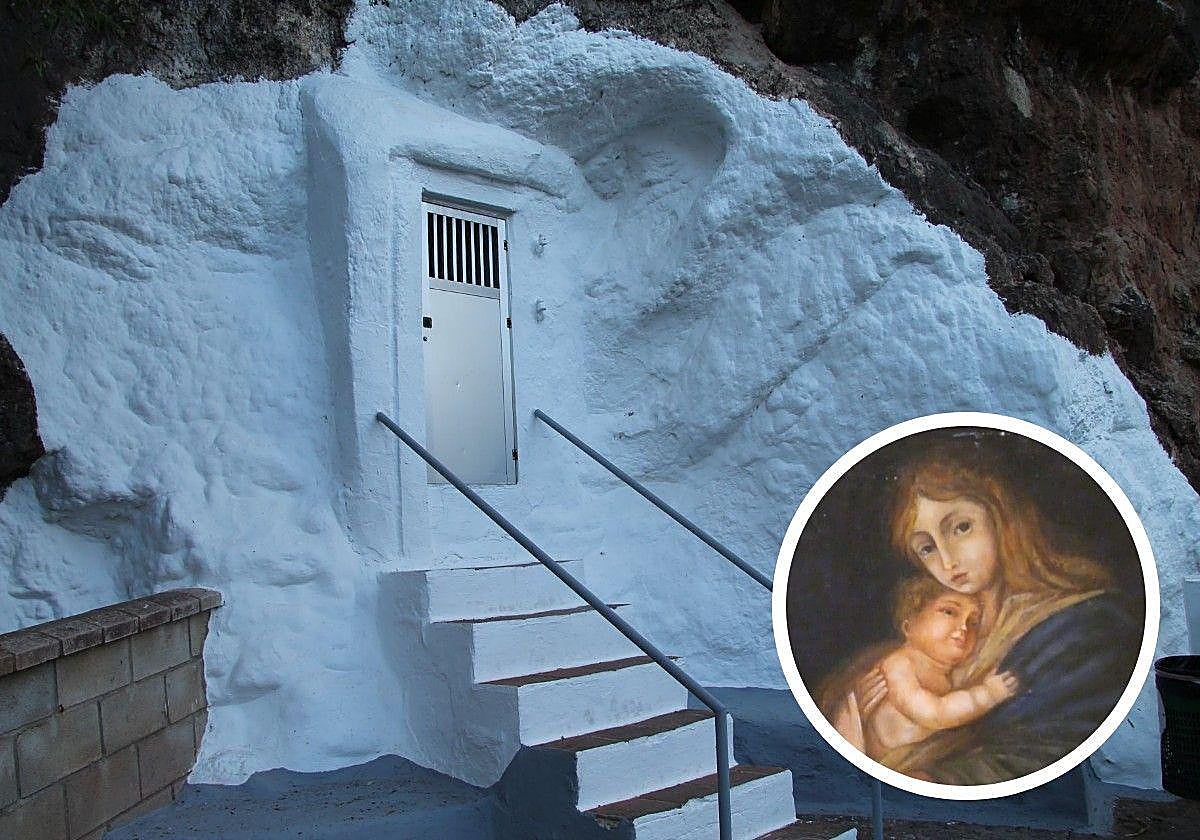
In the early hours of September 1907 a flood swept away a mill in the town of Riogordo in the east of Malaga province. The water came down with force, but it brought with it an unexpected gift: a painting of La Virgen de Belén (Our Lady of Bethlehem) which became embedded among the rocks. Even as the flooding continued the painting stayed put and the waters never washed it away again. Thus begins the curious story of the small sanctuary that surprises those who visit the town's Paseo de los Ríos.
The families who lived around the old Molino (mill) de Belén were the first to see the scene. María Conejo, who spent part of her life living in the area, tells the story as she heard it as a child from her parents and grandparents: "The painting was wedged between the rocks in the same place where it is now and according to what they told me, the water never washed it away. That improbable find, in the midst of chaos, changed everything."
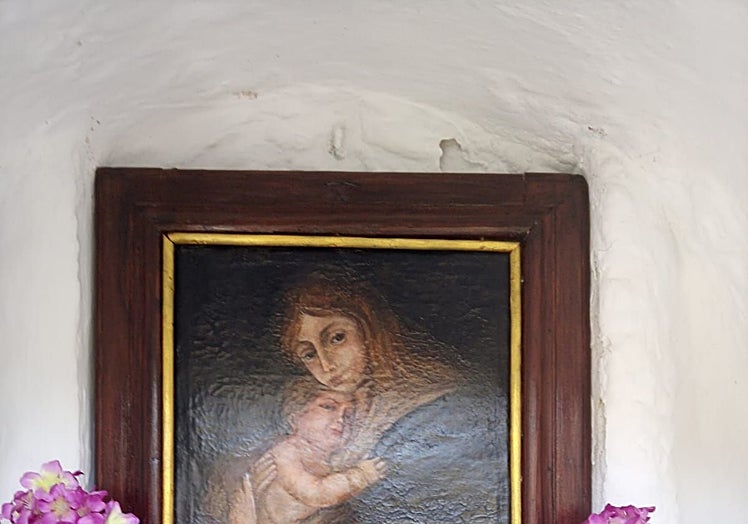
The locals were convinced that it was no coincidence. Juan José Ortiz, a local resident who today is in charge of lighting the light and maintaining the shrine, confirms what he heard from his grandparents. "The canvas was wedged right in a natural hole," he explains. "And seeing that the water did not move it, the inhabitants decided to build a sanctuary." His story, passed down through generations, coincides with the version that appears on the information panel on the Paseo de los Ríos.
María completes the scene: "A stonecutter made the hole," she explains. That hand-carved hole would become the foundation of the small sanctuary that still remains today, hidden among stones and moss. The Molino de Belén, known as Fuxcar in the Islamic Al-Andalus period and active until 1962, gave life to the surrounding area and reinforced the feeling that this place had something special. The area suffered another flood in 1929, after which a small bridge was built and part of the riverbed was reinforced.
The devotion to the Virgen de Belén was for decades one of the most intense in Riogordo. "In the old days people used to go there to light a candle," says María. "There were those who promised a carafe of oil if Our Lady helped them in any way. The canvas became very black, you could hardly see the images", says Juan José. Eventually it had to be restored. "We were advised not to use real candles any more, so now we use battery-operated ones," he explains.
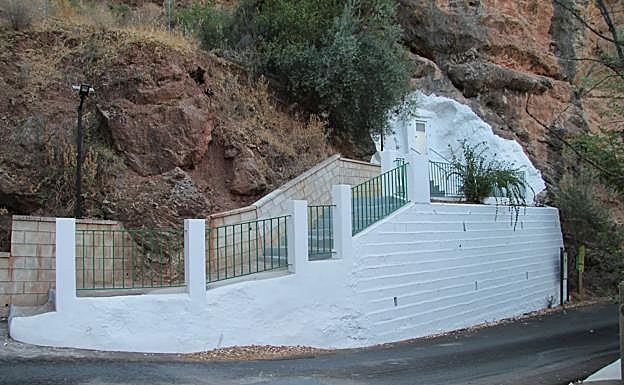
Juan José sees people pass by who continue to come to leave flowers, candles and pray to Our Lady every day . "The painting has no great artistic value," he admits. "But the devotion is enormous. And in view of what happened, it is hard to question it.
The Civil War
María provides another episode that demonstrates the extent to which this image has been important to the village. During the Civil War, a local family hid it so that it would not be burnt. "The son wanted to destroy it, but the mother hid it very well," she explains. When the young man was arrested for breaking another religious image, he claimed that the painting of the Virgen de Belén was safe in his house. That gesture - according to local tradition - saved his life. After his release from prison, the story goes, he went to visit the sanctuary.
Today, more than a century later, the shrine is still there, embedded in the same rock where it all began. The sound of the water, the moss in the pond, the bridge of the path and the light that never goes out keep intact the scene of a story that could have been lost. But it did not because the painting canvas not only survived two floods, but the Civil War as well.
![[]](http://static.vocstatic.com/voc26/latest/assets/images/favicon/surinenglish/apple-touch-icon-57x57.png)