
Storm Leonardo
Storm Leonardo topples last remains of 16th-century Nerja watchtower
The Molino de Papel fortification located in the Maro-Cerro Gordo cliifs on the eastern Costa del Sol was listed as a site of cultural interest and local groups had been calling for intervention to prevent its complete disappearance
Eugenio Cabezas
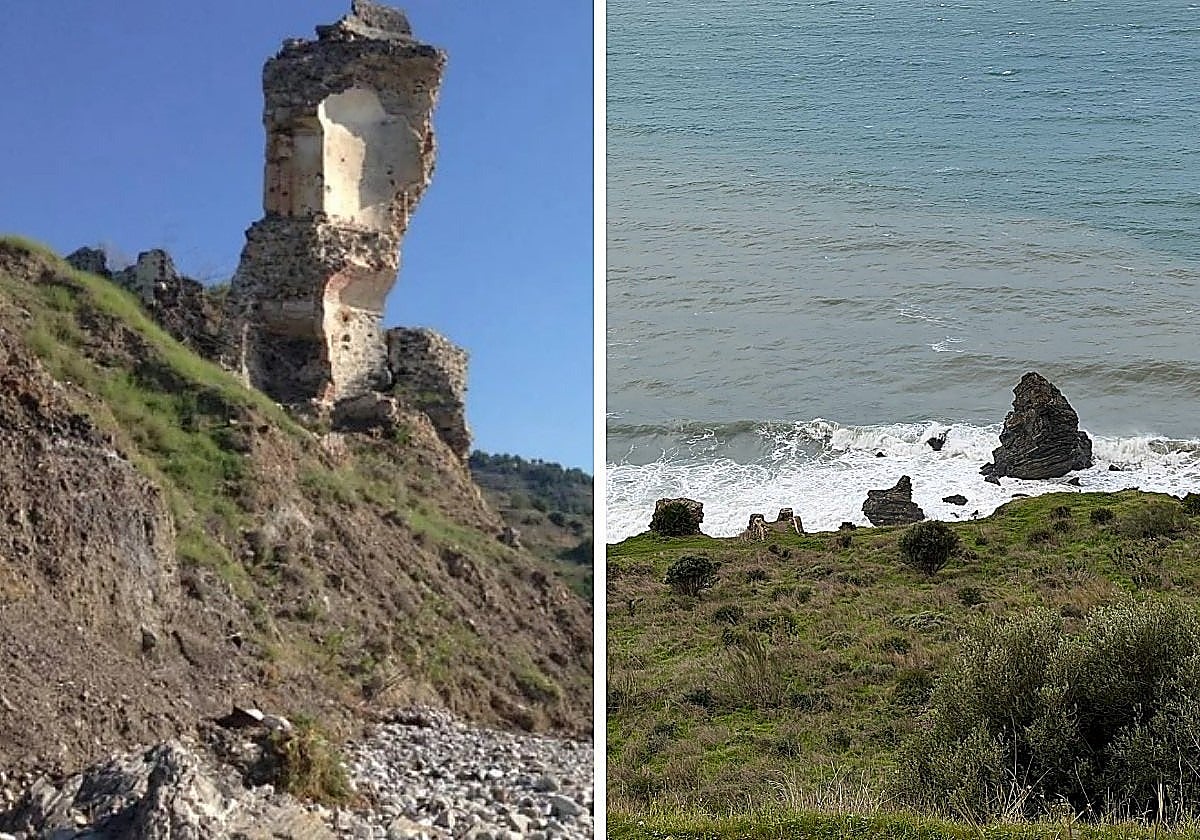
Storm Leonardo has toppled the last remains of the Molino de Papel watchtower, also known as the Río de la Miel tower, located in the Maro-Cerro Gordo cliffs on the eastern Costa del Sol.
Dating back to 1751, the structure, which had been badly deteriorated for decades, collapsed after several days of strong waves and winds. The Río de la Miel watchtower, rebuilt in the eighteenth century on top of an sixteenth-century fortification, was part of the coastal defence system against piracy.It was declared a site of cultural interest (BIC) and on the red list of endangered heritage in 2022 due to its critical state of conservation.
Local conservation group Entre Cañas has lamented the loss of this historical landmark on their social media pages: "What was long feared has happened. The watchtower on the Río de la Miel has disappeared. The neglect of authorities regarding its conservation and protection, coupled with the recent storm, has led to the loss of this unique watchtower."
From the scientific and conservation community, biologist and researcher Miguel Bueno Jiménez expressed his sorrow at the monument's disappearance. "A great loss. My beloved landscape of Maro will never be the same," he said, adding that its collapse "has forever changed the landscape of the Maro Cliffs."
The Río de la Miel watchtower's history and evolution have been extensively documented by researchers such as Francisco Capilla, who years ago warned of its dilapidated state and the need for intervention to prevent its complete disappearance.
The loss of the tower comes just weeks after Axarquía environment and nature group, GENA- Ecologistas en Acción, warned of the improper recreational use of the tower for activities such as tightrope walking and zipwires, activities they considered "absolutely incompatible" with a protected natural area a BIC in a critical condition.
GENA warned at the time that the deterioration of the site was not an isolated incident, but rather "structural," and had called for increased monitoring and urgent conservation measures, noting that the natural area is protected by regional legislation, forms part of the Natura 2000 network, and is designated as a Specially Protected Area of Mediterranean Importance (SPAMI).
The tower's collapse represents the physical disappearance of one of the historical landmarks of the Nerja coastline and reopens the debate on heritage conservation in protected natural areas such as the Maro-Cerro Gordo Cliffs.
The fall of the tower now leaves only its documentary and photographic memory as evidence, while citizen and environmental groups demand that the loss serve at least as a warning to prevent other historical sites in the Nerja area from suffering the same fate.
![[]](http://static.vocstatic.com/voc26/latest/assets/images/favicon/surinenglish/apple-touch-icon-57x57.png)