
Heritage
One of the most unique prehistoric sites in Andalucía keeps revealing its secrets in Teba
The discovery of a well-preserved dolmen in the north of Malaga province offers a unique window into life and the burial rituals of the third millennium BC

Teba
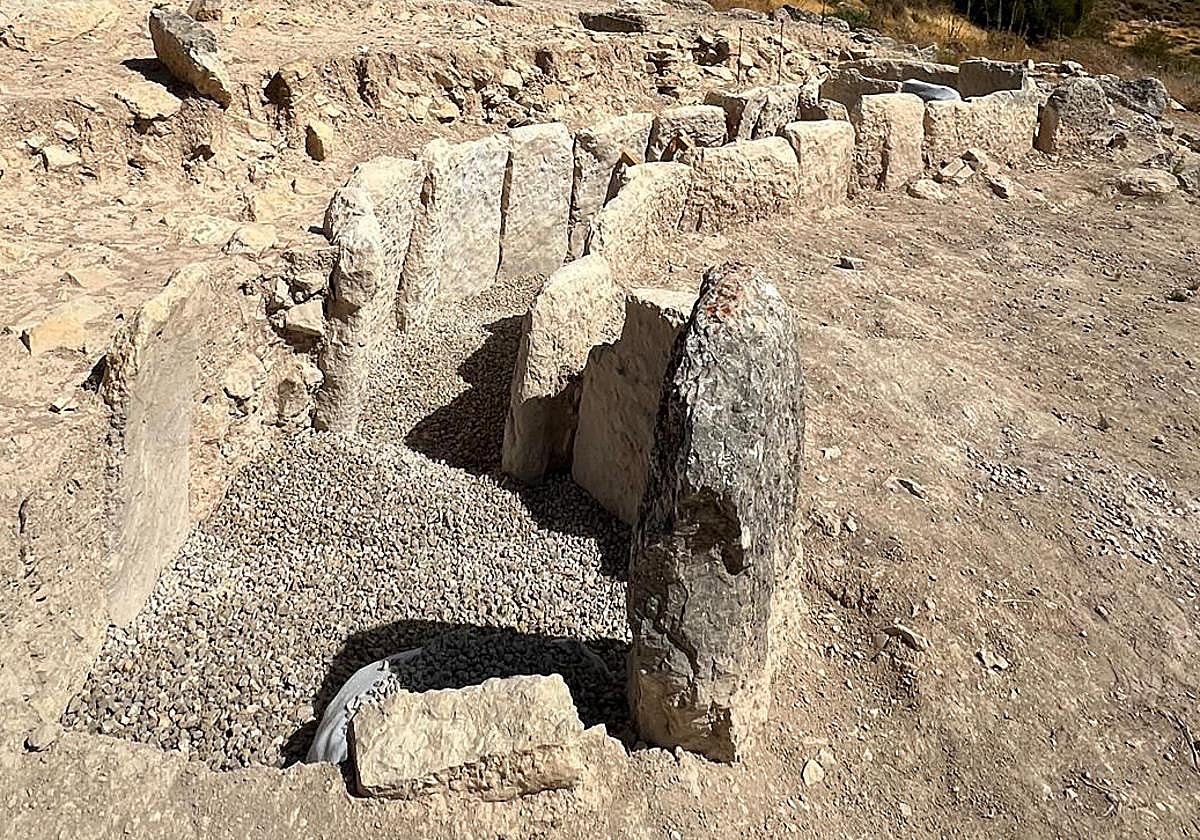
A long time ago, there was a special place we now know as Teba in the north of Malagaprovince. But to learn more about it we need to wind the clock back some 5,000 years, all the way back to the third millennium BC, coinciding with the Copper Age. Researchers, all archaeology experts, have been able to travel back to that period thanks to a very special time machine built of stone: a dolmen burial chamber. It is one of the best preserved in Spain's Andalucía region - and located in the Malaga municipality.
Its monumental proportions and excellent state of preservation allow us to discover something that, until now, could only be guessed at: to truly get to know the funerary practices of that period. The necropolis of La Lentejuela, as the area where this dolmen is located was known, will provide a better understanding of the megalithic phenomenon not only at the local level for Teba, but additionally getting us acquainted with the funerary practices that would also have taken place at the time in the large town of Antequera nearby.
7
people found buried in the dolmen
The seven people (although there may be more human remains due to earth movements from earlier times) estimated to be buried in this space could provide a great deal of information about the societies of that time, from determining what diseases they suffered from through to their specific diets, including where they came from.
In fact, one of the researchers leading this project, Dr Serafín Becerra, reports that the isotopic studies will be able to reveal the foods eaten by these people: whether they ate more meat or fish, whether they included cereals in their diet or even whether there were dietary differences between men, women and children.
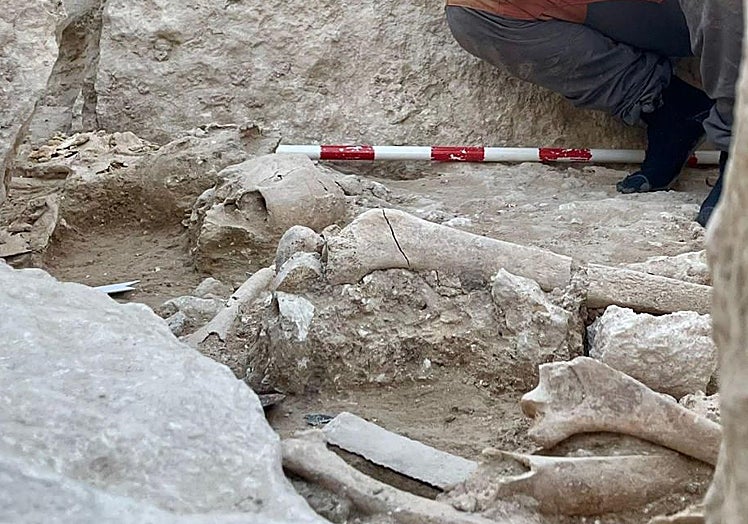
Another factor that will be investigated and clarified thanks to this dolmen will be the presence of women at the time, which, according to the Malaga researcher, was prominent. "A phalanx idol has been found, like the one in the Museum of Malaga," explains Becerra, who also hopes to find out how many women were there by studying remains of clothing.
However, one of the most important discoveries could be the one that helps to determine the origins of individual people. Becerra explains that this can be investigated through the use of strontium isotopes, which are absorbed after drinking spring water during the first years of life. This could reinforce the hypothesis that there were people who came from other areas to be buried in this necropolis.
Social status is another important factor that will be investigated in the coming months. In this case, the pathologies of bone wear may determine the role they played within the community. "Imagine that the bones have no wear and tear: perhaps we're talking about people of high status who didn't have to withstand hard labour," says the archaeologist.
The structure
Around the hill in question and in part of the surrounding land, some ten dolmens and up to 14 megalithic structures have been documented, the vast majority in a virtually immaculate state of preservation. Several other elements have also been found that have not yet been fully identified, but are currently being researched.
All these discoveries are now making the town of Teba the most important megalithic site in Malaga province and one of the most prominent in the entire region of Andalucía. This means we are talking about the whole southern area of the Iberian Peninsula and, therefore, one of the hottest spots during the third millennium BC, the period to which Dolmen I belongs.
All these structures make up the so-called La Lentejuela necropolis, which is divided into two main areas. The first of these is an area that is higher up, containing several smaller dolmens that, pending final confirmation, could be older than Dolmen I. Meanwhile, in the lower part, there are two large monuments: Dolmen I, which has been excavated over these last four years, and Dolmen II, which presently remains intact underground and which will be the focus of the next dig project.
Dolmen I, which has sparked national interest, is a 14-metre-long structure, beginning at a width of one metre at its entrance, marked by a covered step. This passageway widens to three metres, eventually exceeding by another 1.5 metres the width of the Viera dolmen, which is located in Antequera and was declared a Unesco World Heritage Site on 15 July 2016.
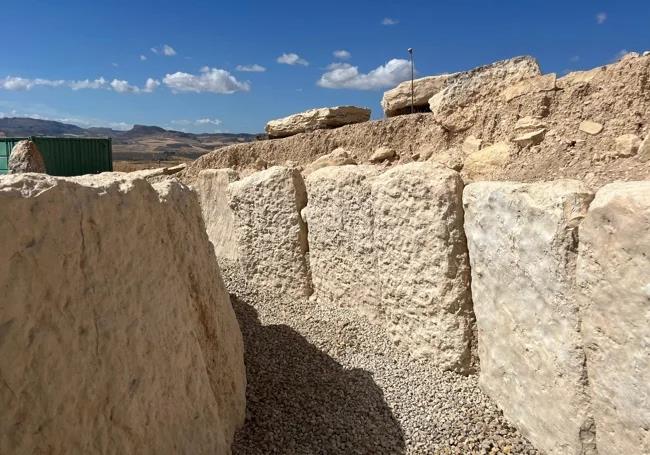
As for its height, it starts at 1.20 metres and goes up to two metres, so that, according to Serafín Becerra, "we can enter the chamber standing up". Furthermore, the structure is covered with large slabs of stone, some of which are more than three metres long, forming a mound of stone and clay. What Becerra considers to make this monument "more unique" is the double ring of stones that surrounds it, an element that probably reflects the significance of this site.
Another highlight is the entrance to the final section of the burial chamber, marked by a carved doorway, indicating that the dolmen is very much part of the earliest architecture of Europe. "Until the megalithic period, there were no large buildings on the European continent. And it is from the megalithic period, six thousand years ago, that large pieces of architecture like this began to be built", says this archaeologist who happens to also be a local, as he was born in Cuevas del Becerro.
Researchers were impressed not only by the structure itself, but also by the way in which the people of the time were able to build such a monument. It should be noted that the slabs could weigh several thousand kilos and there were no wheels. Becerra says that it is not known whether they used animal traction or exclusively human traction, nor whether pulleys were involved: "It is understandable that these are architectures built primarily by human force."
The interior
The huge dimensions and state of preservation continue to amaze inside. After analysing the human remains, the researchers have been able to identify two phases: one corresponding to the Bronze Age (2000-1800 BC), with individual burials, then, below that, an older phase of communal burials, more precisely collective ossuaries, dating between 2600 and 2500 BC.
In this second phase there appeared the grave goods catalogued by Becerra as "the most spectacular". They are estimated to be associated with the Chalcolithic period, better known as the Copper Age. These are the ones excavated in the last year and are considered to be the most significant. Elements such as amber, which at that time probably came from Sicily, and elephant ivory, from the African continent, have been found in the form of small decorated vessels, bracelets and ornamental pieces.
In addition, a collection of arrowheads and a large halberd (axe blade topped with a spike, set onto a long wooden shaft) with a blade measuring 15 centimetres long have been found. Alongside these were two large flint blades measuring over 20 centimetres, which seem to come from Loja or the Sierra de Ronda. The most peculiar thing about these blades, says Becerra, is the technical skill with which they were crafted.
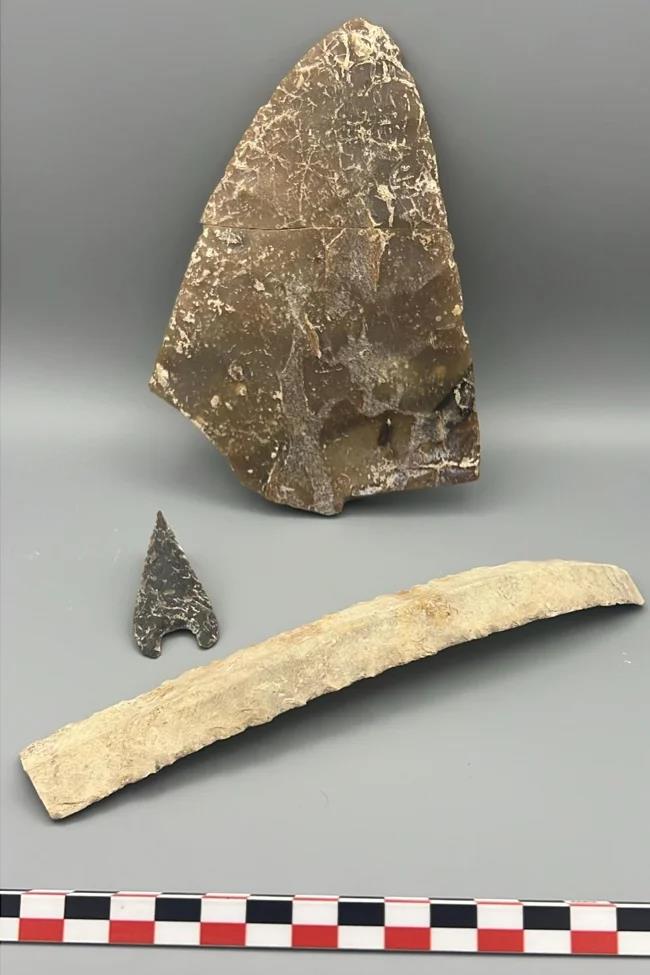
These discoveries of items from other parts of Europe and the world show that, for the first time, there is evidence of a network of exchanges, communication and even trade in the inland areas of Malaga province. "These would be the first major networks in European prehistory, connecting the central Mediterranean and North Africa with the Iberian peninsula, generating a genuine circulation of goods," he concludes.
Although there still remains a lengthy process of study and research, the ultimate goal is to convert this space into a megalithic park with a trail that runs through the entire necropolis: from the small dolmens in the upper part to the large monuments in the lower part. Researchers from the University of Cadiz have worked on this project, and funding was provided entirely by Teba town hall, which is committed to preserving and promoting one of the most unique prehistoric sites in Andalucía.
![[]](http://static.vocstatic.com/voc26/latest/assets/images/favicon/surinenglish/apple-touch-icon-57x57.png)