
Interview
Life under the anti-missile shield: a Spanish engineer's story from the Middle East conflict
-kGRF--1200x840@Diario%20Sur-DiarioSur.jpeg)

The sense of alarm in the Middle East right now is constant. Yet, far from the chaos one might imagine, the United Arab Emirates remains highly organised, according to aeronautical engineer from Malaga Ana Pérez, who was caught up in the escalation following the US and Israeli strikes on Iran while working at Abu Dhabi Airport.
She admits she has slept little and describes an experience unlike any she has faced before. Pérez works for Malaga-based engineering firm Aertec and serves as technical director of its Abu Dhabi office, overseeing projects in the UAE, Saudi Arabia, Kuwait and Bahrain.
With more than two decades of experience at major airports across the Middle East, Europe and the Americas, Pérez spoke to SUR from her home in the emirate's capital.
- How long have you been in the United Arab Emirates?
I’ve been based here for a year and a half, although before that I spent another year and a half travelling constantly between Malaga and Abu Dhabi. I used to joke that Sundays meant flying - either there or back.
- Were you at the airport when the explosions happened?
Yes. I was working with my team preparing presentations when we heard the first explosion. We even saw smoke, but at first we didn't realise it was an attack, everything just shook. Building security immediately told us to go home.
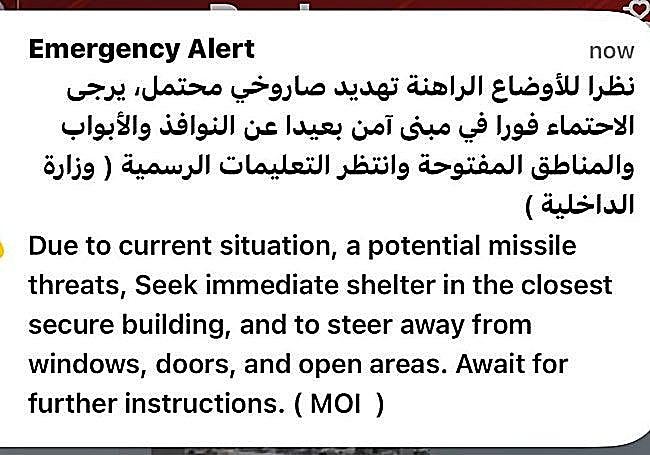
I live about seven minutes away by car. The first alert came through as soon as I arrived, warning of a missile threat and instructing us to stay indoors and away from windows.
-That must have been extremely tense.
When I got home, we could actually see the explosions. What we were witnessing was the interception of missiles. You think that sound should reassure you, missile intercepted. But honestly, it's still very unsettling.
- How are you right now?
- I would say calm, but that's not true. I'm mainly stunned. You hear a noise and the alarms go off. In Spain we receive alerts for weather events, but here your phone suddenly reads 'missile attack'. That has a very different impact.
- One might imagine chaos on the streets?
- Here in Abu Dhabi life goes on, but it is true that you don't see people in the street. They asked us to go out only for the essential. Supermarkets remain open and deliveries continue, though sometimes with delays. They've delivered me groceries and water without problems.
We've been asked to work from home. The main risk comes from debris after interceptions, everything has to fall somewhere.
- I suppose the Spanish Embassy has contacted you.
- When they didn't evacuate, I immediately went to the embassy's website and social media. They advised everyone to remain at home and later sent emails with updated information and emergency contacts, asking us not to call unless strictly necessary so lines remain open for real emergencies. They told us to leave our homes if something happened there. They told us to follow the instructions of the security services.
- Have you ever experienced anything like this?
- No, honestly, I had never experienced anything like this before. The closest situation was during Covid-19, when I happened to be in Kuwait. We began hearing reports about a possible airspace closure. I called the Spanish Embassy at the time and they told me there had been no official notification, but because I work at the airport, I was able to confirm that the airspace would indeed close at midnight.
I remember that Aertec arranged three tickets for me: one via Istanbul with a connection to Malaga, another via Doha to Madrid and a third via Dubai, from where we would later organise the onward journey. The Istanbul flight was cancelled. I boarded the Doha flight, which was delayed and I didn't know whether to try switching to the Dubai one or stay put. In the end, I wasn't allowed to disembark and it turned out to be the last flight to leave Kuwait before the airspace closed.
At the time, I don't think we were fully aware of how significant Covid would become or how long it would last. This situation, however, feels different - it has a much stronger impact because you actually see the missile and hear the explosions.
- In Spain, people might start stockpiling supplies.
- Authorities here are trying to prevent that. We've been told there will be no shortages and not to panic-buy. Everything remains open. It's a tense calm, especially when alarms sound. The last one went off at 5pm, so we've had a few quiet hours since.
- Are you there with your family?
- No, I am here alone. My children are in Malaga, which gives me peace of mind. I would have felt worse if they were here with me.
- Are you in contact with other people from Malaga or Spain?
- Yes. Colleagues from Aertec and other companies are supporting each other. Families with children are finding it harder, especially if the children are old enough to understand what's happening. Many are trying to keep routines - board games, films, just passing the time calmly.
-Do you expect airspace to reopen soon?
There's been another delay. My professional knowledge is both reassuring and worrying. On one hand, you see how capable the air-defence system is. On the other, even a simple drone has managed to strike infrastructure and cause casualties. Mankind can use technology for the best purposes, but also for the worst.
For now there are no reliable forecasts. Authorities have ordered hotels to extend stays at government expense to ensure everyone remains safe. You realise how organised the response is. In times of uncertainty, it's safer for everyone to remain grounded.
- Are you considering returning to Malaga?
- Let's hope not, but I honestly know that they are going to do everything they can to make sure we are okay here. That gives us peace of mind. Obviously, there are people who want to go back. I have a group of colleagues who are going to try to take a bus to Saudi Arabia and, from there, fly, although that's also complicated. Seeing that things are relatively under control here, I've decided it's better to stay and try to remain calm.
- Best wishes from Malaga.
- Thank you very much, let's hope this will be over soon and that Abu Dhabi will return to normal.
![[]](http://static.vocstatic.com/voc26/latest/assets/images/favicon/surinenglish/apple-touch-icon-57x57.png)