
Andalusian bird society
Long-eared owl
The Andalucía Bird Society recommends looking out for the Asio otus this month
Peter Jones
Ronda
The long-eared owl shows a preference for semi-open habitats, especially woodland margins, as they like to roost and nest within dense woodland yet prefer to hunt over open ground. It is a specialist hunter concentrating on a diet of small rodents, especially voles that comprise most of their diet. The population cycles of rodents can force these owls to diversify, and they can successfully adapt to hunting other food sources such as birds and insects. Normally they choose an old corvid's nest or a nest built by other animals as their own breeding quarters and these options are normally present most commonly in dense woodlands; their success is largely correlated with prey populations and predation risks.
Many owls are territorial and sedentary, but long-eared owls are partial migrants and often known to be nomadic. However, in my area they have been known to occupy the same nest or area for several consecutive years. Another habit of these owls is to share a roost with many of its own kind and often these communal roosts can be at traditional sites. Despite being the most widely distributed and most numerous owl species, there have been noticeable declines in several parts of its range.
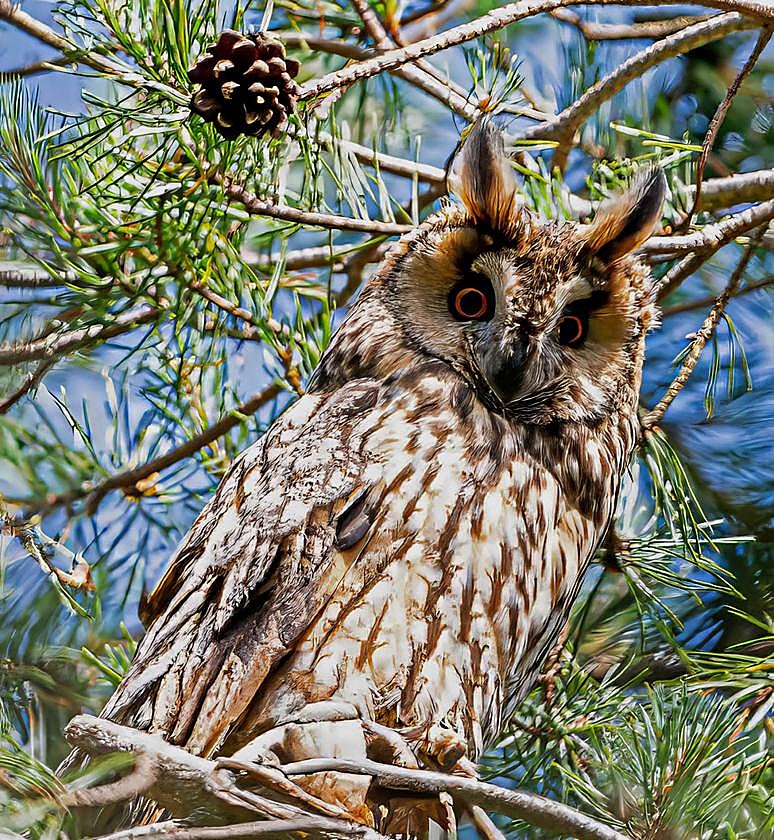
The long-eared owl is a slim and long winged owl and has distinctive erectile ear tufts, which are positioned closer to the centre of the head than many other owls.
The purpose of these ear tufts, present in many owl species, is not known presently, but one theory is that the ear tufts are used as a means to communicate intent and mood to others of its own kind.
As with most other owls, it has large ear slits placed asymmetrically on the sides of its head, with the left ear higher and the right lower allowing them to absorb sounds from above and below. It is interesting to learn that the hearing of long-eared owls is about ten times better at high and medium pitches than humans.
Our bird is also known as the northern long-eared owl or locally as the cat owl; I am not sure how the bird feels about the latter. The genus name, Asio, is the Latin for 'horned owl', the specific epithet, otus, is taken from Greek and translates to small eared owl. They breed throughout Europe and the Palearctic, as well as in North America. It belongs to the larger grouping of owls known as the family Strigidae, which covers most extant species of owl.
![[]](http://static.vocstatic.com/voc26/latest/assets/images/favicon/surinenglish/apple-touch-icon-57x57.png)