
Health
Will I lose weight? Science provides some answers about fasting
Restricting food intake is trending at the moment. Here are some keys to a practice that has been part of many of our traditions since prehistoric times
Julia Fernández
Malaga
The fasting trend never seems to go out of style. Fitness and nutrition gurus revived it a few years ago as a surefire technique for staying healthy and sculpting our figures. It was later copied by actors, singers, influencers and so on. Now there isn't a gym without a group of fanatics preaching its benefits at the top of their voice.
Faced with this avalanche of advice and buzzwords, many health professionals have decided to take matters into their own hands to try to bring some sense to a practice that seems very modern to most of us, but which has been part of many of our traditions since prehistoric times.
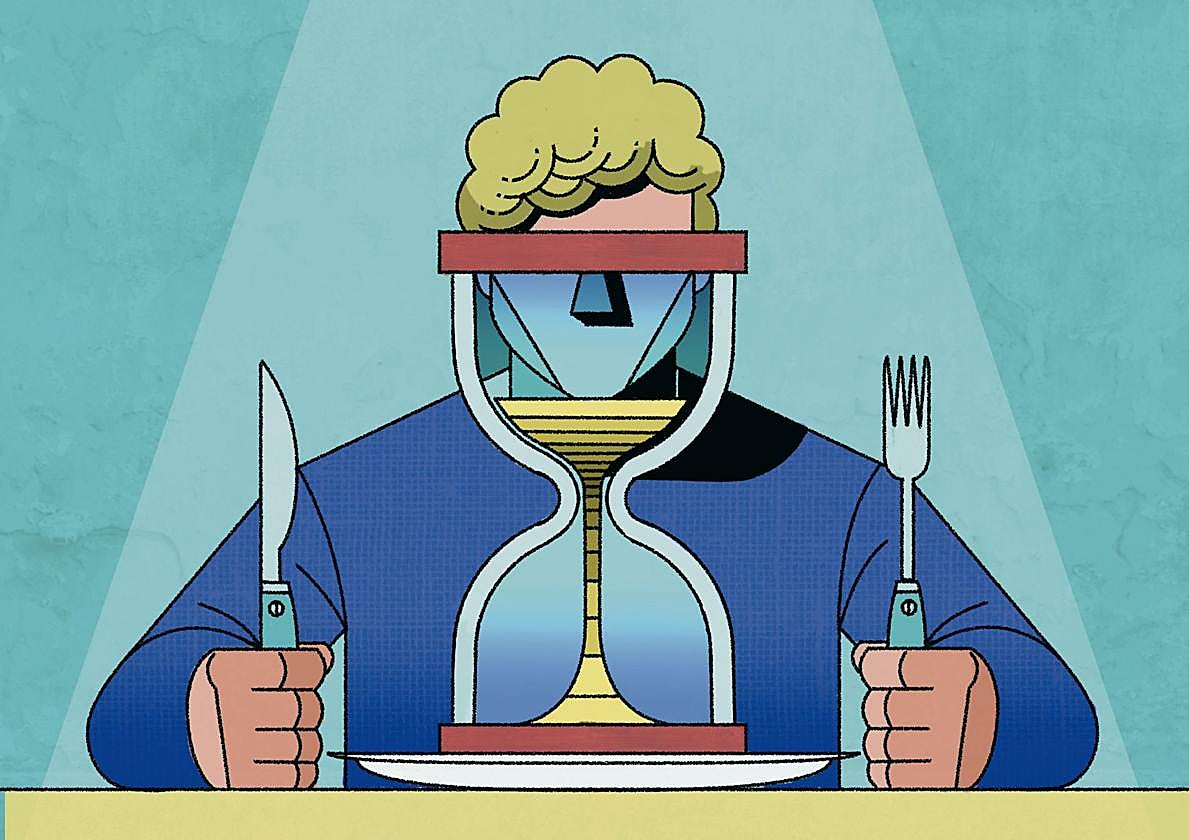
Fasting involves abstaining totally or partially from food and drink for a certain period of time. However, there are several ways of doing this: either for long periods of time, three days for example, or intermittently, like every other day.
Who can fast and who shouldn’t
-
Fasting is not something that everyone can do. It has nothing to do with your willpower not to raid the fridge, but rather your physiological characteristics. If you are pregnant or breastfeeding, fasting is not recommended. The same goes for children and adolescents. In this case, studies have shown that those who do not eat a good breakfast perform less well in class. People who suffer from migraines should also avoid going for long periods of time without eating anything because it increases the risk of them experiencing an attack, explains the Spanish Society of Neurology. Nor should people who are underweight or who have eating disorders or hormonal problems consider fasting. In any case, it is always advisable to consult a nutritionist first. Likewise, a study by the University of Illinois published in 2021 in the Annual Review of Nutrition journal added that “shift workers (because of their changing schedules) and those who have to take medication with food” should also not engage in fasting.
There is also a third way, the simplest and easiest to implement with our modern lifestyles: “This is what we call time-restricted eating,” explains Lidia Daimiel, principal researcher at the Imdea Food Institute in Madrid. It is also the one we are most familiar with: no food or drink (except water or herbal teas) for a few hours each day. This can last anywhere from eight hours, which works for almost all of us if we eat dinner early, right up to 16 hours, if we want to be very strict.
The easiest “and most advisable” thing to do is to choose the night-time fasting period because, by including the time we're asleep, it's obviously less difficult. “And it's better to have dinner earlier than to delay breakfast,” says Daimiel, who is also an associate professor at CEU San Pablo University.
Fasting in today's society is practised for various reasons. The most famous is because it is said to help you lose weight. “It's just another strategy for that.” The explanation comes from science: “The fasting period leaves cells without their main source of energy,” says Daimiel. “They go into 'idle' mode and, in addition to reducing some functions, they draw on the body's reserves to continue their work. They are 'like a factory' that puts a halt on some functions, focuses on others and seeks out energy supplies from stored sources.
This is why fasting is not recommended for children, because they and their cells are “growing” and have constant needs. “You can't apply the idea that if it's good for me as their parent, it's good for them too,” is the warning from Daimiel.
Fasting does not give us free rein to eat everything when it is time to eat again. The key is to eat healthy and balanced meals during this time. In the first meal after withholding food “you should avoid, for example, fast-releasing carbohydrates (sweet stuff, white bread...),” says Daimiel. She uses the analogy of a car engine idling to explain why, “it would be like revving the engine”.
“A good breakfast would be a slice of whole-wheat toast with hummus” because we're injecting “slow-releasing carbohydrates, fibre and protein” into our bodies. However, it is also important to pay attention to our feelings, because fasting presents difficulties that can lead to failure: it can make us feel hungrier (this should be regulated beforehand, knowing how it works, advises the expert), and it can be “difficult to maintain over time” due to our lifestyle.
Reducing our overall calorie intake does improve health and, better still, it also has positive effects on how we age. A calorie reduction of 20-30% extends life expectancy and improves fitness beyond a certain age. This was demonstrated in a study with mice a couple of years ago by researchers Iñaki Milton Laskibar and María Puy Portillo from the nutrition and obesity group at the University of the Basque Country.
However, some experts urge caution. One of them is Idoia Labayen, professor at the Public University of Navarra and researcher at the Institute for Innovation and Sustainability of the Agri-Food Chain.
The studies that have demonstrated the benefits of intermittent fasting on glucose metabolism have been conducted “on animals. If we talk about people, we only find very preliminary results.” For this reason, there are now several studies underway, including one being jointly conducted by the Navarra centre and the University of Granada. We will have to wait some more for these results.
![[]](http://static.vocstatic.com/voc26/latest/assets/images/favicon/surinenglish/apple-touch-icon-57x57.png)