
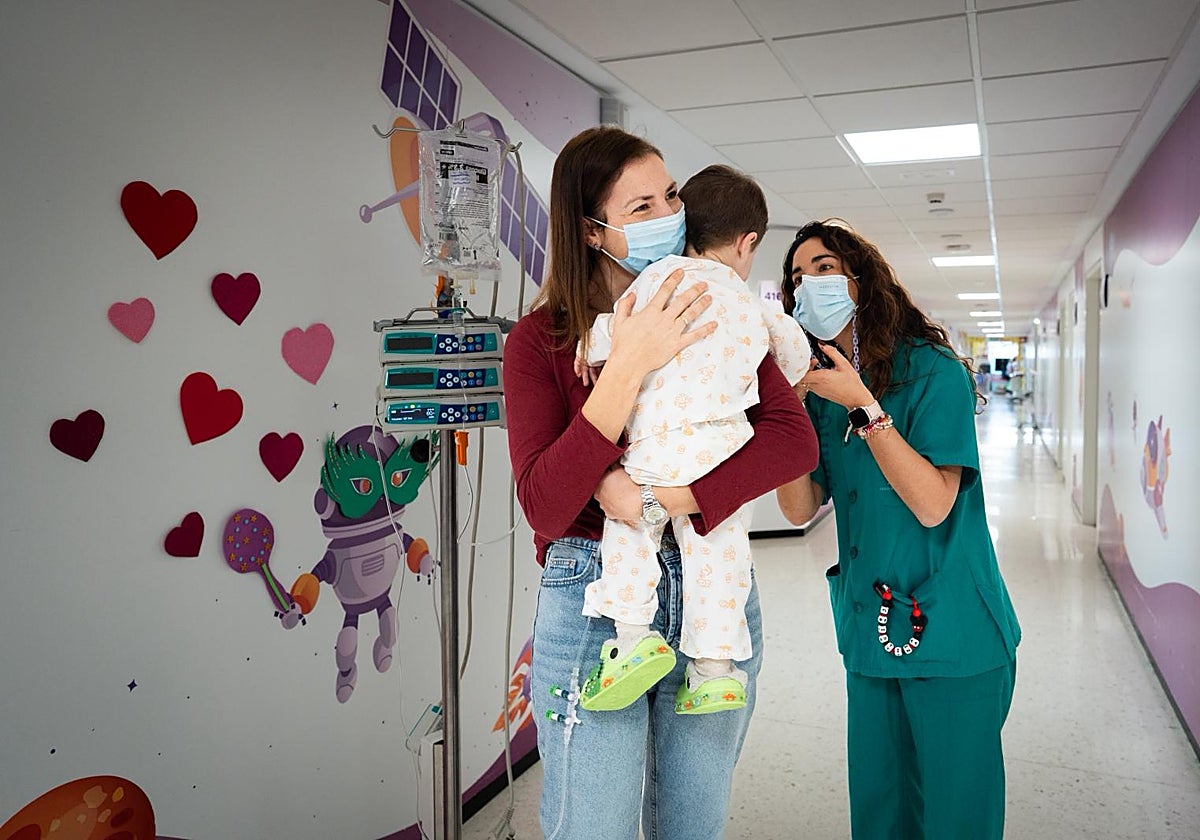

"I always compare it to our life exploding, blowing up." This is how Irene Ortega describes the summer of 2023, when her six-year-old son Eloy was diagnosed with leukaemia. Barely a year later he rang the bell after an initial phase of intensive treatment, with scheduled admissions, followed by a period of maintenance. "He went back to school, back to being a normal child. And at the end of October we had a relapse. Now we are in the process of ending the disease again," she says.
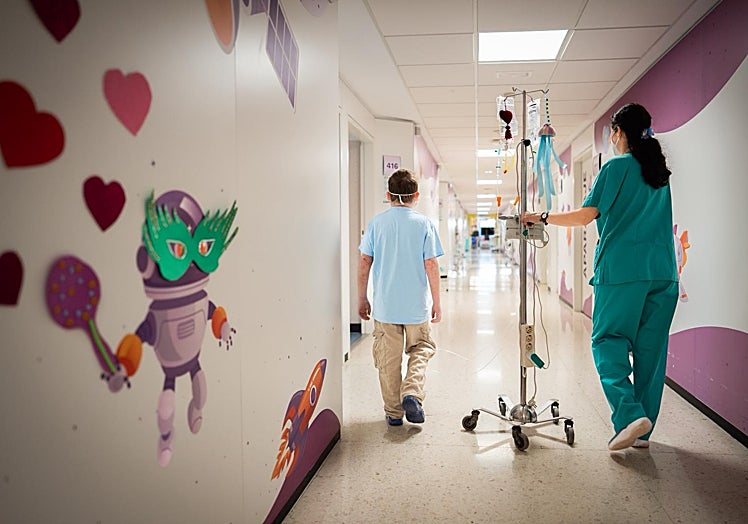
Eloy has spent several weeks on the fourth floor of the Materno Infantil Hospital in Malaga, a benchmark for the treatment of solid tumours in children. Its paediatric haematology unit is also a national centre of excellence in paediatric allogeneic transplants - when the marrow comes from a compatible donor - and treats patients from Malaga, Melilla, Ceuta, Almeria and Granada.
The fourth floor of the Materno is synonymous with hope, with many smiles and also with the occasional bad time for the 70 or so families who go through this ordeal every year. Above all, it is a place where time stands still, because when facing such a storm, the oncologists' advice is categorical: "You have to learn to live slowly. You can't expect immediate results or for it to be over now, because it takes time and it takes a long time; you have to work on your patience," adds Ortega, who explains that the initial moment of shock gives way to uncertainty and that you have to mourn.
"Your life changes completely, you have to restructure it: we are in the process of moving on."
"Eloy adapts to everything".
Ortega says that her family sees life differently now: "You complain that Monday is coming, that the routine starts again, school, work, children, extracurricular activities... and, when you are here, you say: 'I wish I had one of those Mondays again'."
Her son is a good patient: "He adapts to everything." On this path there is an essential help: that of the members of the Association of Volunteers for Children's Oncology in Malaga (AVOI).
"I made friends with Desi; she has been my psychologist, she has helped me with everything. They see many children and what you don't see is that they do well, that they grow up and become healthy adults," she stresses, recommending that parents seek professional support and share the experience with other families.
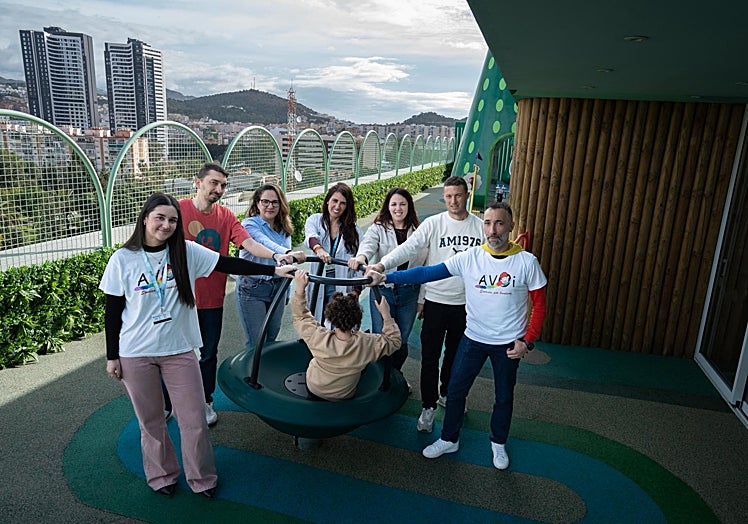
On the occasion of World Day Against Childhood Cancer, which was celebrated on 15 February, SUR brought together two families whose children have been admitted to the fourth floor, an oncologist and two volunteers from the association to talk about the current situation of the disease among children. Of the 64 cases diagnosed in 2025, 52 were solid tumours: the most frequent were brain tumours, lymphomas and neuroblastomas.
Of the liquid tumours, the most common was paediatric acute leukaemia (12 cases), of which eight were acute lymphoblastic leukaemia (ALL) and four were acute myeloblastic leukaemia (AML).
In 2024, 68 cancers were treated at the Maternity Hospital. The five-year survival rate for this type of tumour is 83 per cent in the community.
.
Of the 64 cases diagnosed in 2025, 52 were solid tumours; of the liquid tumours, the most common is paediatric acute leukaemia, with 12 children treated at the Materno last year
Diego Briales, a 44-year-old plumber, is an AVOI volunteer. "My day-to-day work consists of accompanying the children and their families to make this situation as pleasant as possible: we do handicrafts, play, read, talk, listen to them, do whatever they want and whatever the moment needs," he says, adding that "the emotional reward is the greatest, you can't explain it".
Laura García Hidalgo, paediatric oncologist, explains that "childhood cancer is quite different from adult cancer. In adults it is related to lifestyle habits; in children, most of the time it is not known why it appears".
She adds that the cell that produces the tumour in children is different and that tolerance to treatment is much better: "They have a healthy heart and lungs".
Monitoring side effects
But the challenges are greater: "When you treat an adult in their 50s or 60s, you have to watch for side effects; in children, less is more: you treat with enough to make the cancer go away, but with an eye to making sure that child grows up healthy". Thus, "the goal of paediatric oncology is to minimise long-term side effects".
Dr García Hidalgo does not like to talk too much about survival rates. "When a family enters into this fight, they must think that their child will be cured. Some tumours, unfortunately, cannot be cured, such as certain brain tumours and relapsed sarcomas. In these cases we are totally dependent on paediatric research, which is minimal because it is not profitable for such a small group".
"Children make the work of professionals much easier: a three-year-old is only afraid of the needle and separation from their parents; from 13 or 14, the fear focuses on death, but they have an extraordinary ability to stay happy. That blissful ignorance means that, as they grow up, they only remember the good part," she says.
"Parents must have confidence in medicine and progress. Survival rates are increasing. I tell them to have strength; it's a long-distance race, but with hope everything will pass: they will be happy again," she adds, reminding them that parents learn to value what is really important.
"I love that they are children".
Paula Simón, 20, an English student, became a volunteer after experiencing a case close to her: "It seemed so unfair to me that I wanted to contribute in some way and bring a smile to their faces". She explains that they draw, do handicrafts and, if they can't leave the room, they are the ones who come. "I feel very happy when they smile, because for a while they forget about the difficult situation and they are children," she says.
Lourdes Aragón, mother of eight-year-old Candela, who is in the process of recovering from leukaemia, says she has learned to "live day by day and enjoy it as much as possible".
"Candela was a child who didn't want to go to school and now she can't wait for the alarm to ring so she can get dressed and go," she says, pointing out that the doctors insist that recovery is a long-distance race.
"The volunteers try to make you smile and see the positive side, we have had little income and we missed them when we weren't there," says Lourdes Aragón, mother of eight-year-old Candela.
"When they told me, I said to the doctors: 'I give you my life, because right now my life is her and I trust that you are going to cure her'," Lourdes stresses, pointing out that the volunteers have been an asset: "They try to make you smile and see the positive side; we have missed them when we weren't there."
She describes her daughter as "very affectionate, she wins you over with her smile" and "very active", although the treatment has affected her character at times.
Candela, like many other children, is making progress in her recovery thanks to the fourth floor of the Materno, where time stands still and there is always, even in the darkest moments, a smile for them.
.
AVOI volunteers
The president of AVOI points out that the association has 170 volunteers, 85% of whom are women, and that many of them previously occupied a bed on the fourth floor of the Materno Infantil.
Juan Carmona, president of AVOI, assures us that his association is fundamentally dedicated to entertainment. "We want the time the children spend here to be as pleasant as possible, for them to be happy, but above all for them to be children," he explains to SUR, pointing out that "it is a family illness, because it affects the whole family". To overcome this medical science is necessary, of course, but also play and entertainment.
AVOI currently has 170 volunteers, most of them women (85%). "That is our function, to keep them entertained: now that it is Carnival, we do related activities, the same on Peace Day, at Christmas the whole hospital is decorated, we celebrate all birthdays, name days, summer and spring holidays: this has to be a real paediatric hospital, a hospital where not only the doctors cure, but where they can also feel like children," reflects Carmona.
They also go on excursions with the children and medical staff, offer dog therapy and attend sporting events. "On 23 March we will be 33 years old," he stresses, and assures that "the volunteers give 100% of themselves: many have gone through the disease themselves and, when they turned 18, they became volunteers", and also recalls the so-called Magic Tuesdays, so that on that day, throughout the year, magicians, clowns or Disney characters come to spend some time with the children.
![[]](http://static.vocstatic.com/voc26/latest/assets/images/favicon/surinenglish/apple-touch-icon-57x57.png)