
Art review
'Goodbye Norma Jean...'
Looking back on six decades of American photography at an exhibition at the Museo Carmen Thyssen Málaga until 13 October
Georgina Oliver
Malaga
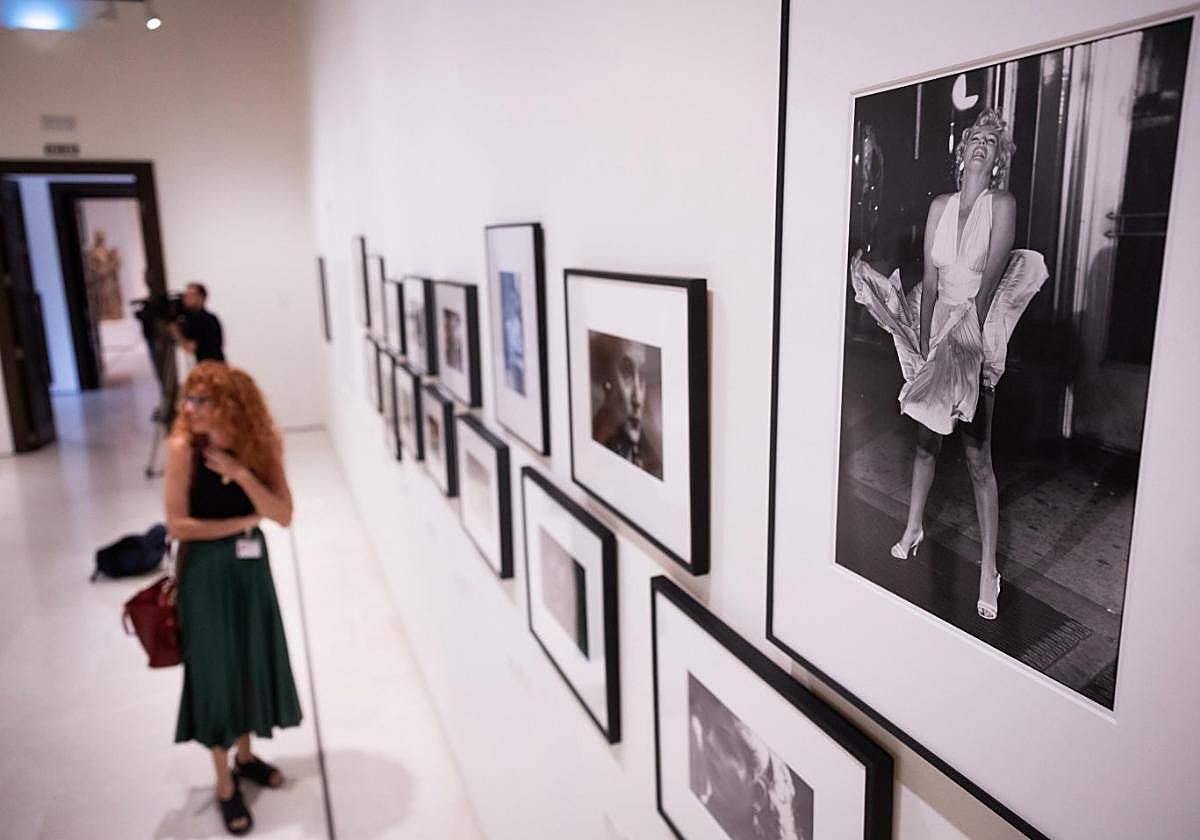
The poster featuring Garry Winogrand's iconic Seven Year Itch pic of Marilyn Monroe 'cooling off' above a subway grate, as a passing train blows her white dress up, up and away, is just the tip of the iceberg of a must-see photo show.
The full title of this exhibition to be seen at the Museo Carmen Thyssen Málaga until 13 October is American People. American Documentary Photography (1930-1980) and the main angle is social contrasts.
Don't expect a Hall of Fame. The America you'll be looking at has more in common with Norma Jeane (originally spelt with an 'e') Baker's bleak teenage years than "Happy-Birthday-Mr President" Marilyn.
Americana
More than 50 photographic images by 11 trailblazers, each telling a story, each seizing a "decisive moment", sometimes with a touch of irony, make the Museum's Sala Noble seem more spacious than it is. Our eyes and imaginations are captivated by the bigger picture; we move on from one decade to the next, from one means of reflecting reality to another.
Pioneers such as Walker Evans, Robert Frank and Louis Faurer pave the way for future socially impacting street photographers. Missouri-born Evans, who had spent a year in Paris, studying at the Sorbonne in 1926, alternated between writing and photojournalism.
Most frequently recalled for his stark frontal portraits of farm workers taken during the Great Depression, in the context of a commission from a government agency, the Farm Security Administration, he was the 'lens' behind a joint immersive project conceived with the author James Agee; the resulting landmark book, entitled Let Us Now Praise Famous Men, constitutes a fly-on-the-wall record of the plight of tenant farmers facing dire poverty.
Off-the-cuff fragments of city bustle are a recurrent aspect of this thematic display. The photo-book Walker Evans - Subway Portraits 1938-1941 heralded the emergence of a genre reinterpreted in one of the most striking pictures in the room. In the photographer's eye: a zippy white-slacked female subway passenger - legs crossed, oblivious to anything other than the James Joyce paperback she is absorbed in... (Louis Faurer, New York City, 1973).
A succession of candid shots capturing life in motion stop us in our tracks. To the left of an open sliding door, dividing an enigmatic image in two: the hazy silhouette of a socialite sporting a white fur stole, on her way to a party; inside, a younger woman in lift attendant's uniform (with an air of anxiety, or merely exhausted by her job?); behind her, to the right of the composition: the (ominous?) shadow of a portly bespectacled gentleman (bearing a smug, almost eerie smile?). (Elevator, Miami Beach, Robert Frank, 1935).
Forget the melting pot. American People is more like a patchwork, focusing on the sociodemographic complexity of the United States. From have-nots to the happy few; from sleeping rough (Man in Window, New York City, Lee Friedlander, 1964, printed in 1973) to what appear to be a couple of spoilt youngsters on a shopping spree, with their moneyed granddad in tow (Rodeo Drive, Anthony Hernández, Cibachrome print, 1984). From Susan Meiselas's in-the-raw vision of Carnival Strippers, the fruit of a five-summer behind-the-scenes investigation carried out in the mid-seventies, in rural parts of New England, Pennsylvania and South Carolina, to an "intense Manhattan moment" snapped by Tod Papageorge, back in 1966.
The Kodachrome print Papageorge picked for the cover of his Dr Blankman's New York album published in 2017 could be a still from the 1967 movie, The Graduate. The viewer is privy to what might well be a generational conflict, a sharp exchange opposing a heavily made up, fur and jewel-clad, lady of means and a blonde young girl with a ponytail (seen from the back).
Nightbirds
Further voyeuristic thrills await visitors in the Espacio ArteSonado, an intimate art space, also situated on the first floor of the museum, which overlooks a multi-arcaded central courtyard, known as the Patio de Columnas.
Beautiful People - Tod Papageorge at Studio 54 is a vicarious visual experience, spotlighting the glitzy sex, drugs 'n' rock-the-night-away, drink champagne and dance till-you-drop... atmosphere of the legendary NYC-by-night hotspot, named after its no less mythical midtown address: 254 West 54th Street.
From April 1977 to its closure in February 1980, Studio 54 and the infamous red velvet rope at its entrance raised and often dashed the hopes of international celebrities and aspiring VIPs of all ilk (film, fashion, the art world, politics...) seeking admission - and guess who was there to tell the tale? Thirty-something Tod with his Fujita camera.
The discerning eye behind both of these exhibitions is the collector José Luis Soler Vila (1956-2024), a prominent Valencian entrepreneur, with a passion for art and photography; Soler founded the Fundación Per Amor a l'Art with his wife, Susana Lloret, in 2014.
![[]](http://static.vocstatic.com/voc26/latest/assets/images/favicon/surinenglish/apple-touch-icon-57x57.png)