
Education
When finishing school earns you a star...and freedom
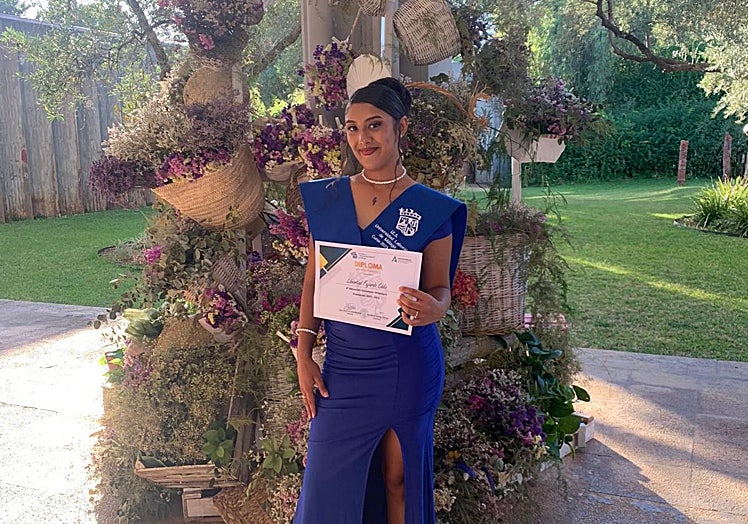
Libertad Fajardo Cádiz is the only member of her family to finish her secondary education and now has a star on the wall at the María de la O school in Los Asperones, one of Malaga's most marginalised communities
-U43214441521dFz-1200x840@Diario%20Sur.jpeg)
Rocío Nadales
On the wall of María de la O school, in the heart of Los Asperones, one of Malaga’s most marginalised neighbourhoods, there are 117 stars. Each one represents a student who has finished secondary education, each on a story of achievement in a place where the future sometimes seems to stop before it begins. One of these stars bears a name that is, in itself, a statement: Libertad Fajardo Cadiz.iz.
Libertad, or Libe, as she is known, has just turned 18 and has achieved something that few Roma girls in her neighbourhood can boast: she has finished school. She went to primary school at María de la O and finished her secondary education at the Universidad Laboral secondary school. Today she is studying to become a nursing assistant and dreams of going further. Her story is an exception in a neighbourhood that was created in 1987 and still today has no benches or street lights.
“Nobody in my family finished school. Since I was little I knew that I had to leave here, I couldn’t not study or meet more people,” she says simply.
She was born in 2007. Her mother and her great support, María, had her when she was only 14 years old. Her story and, above all, her name, Liberty, has a special meaning: “My mother was going to call me Georgina. But as my father has always been in prison but at that time he was with her and free, she said I had to be called Libertad,” says the young girl.
The name could not have been more apt. Libertad is responsible, persevering and mature: “I am very independent. I leave everything ready at night. I do my homework at home on the days when I don’t have tutoring. And when I finish, I go out for a walk, because that’s what I can do here.”
Her origins
She lives with her mother and her two younger brothers, Salvador, 13, and Francisco, 5. She is insistent with Salvador every day: “I tell him all day long to get on his feet and not play the fool. For now he’s listening to me”. She knows that in order to change things, it is not enough to just want it for yourself.
Although she speaks calmly, her childhood was not easy: “There are girls worse off than me. Would I like to change anything about my childhood? Of course, like everyone else.” She spent some time living in Santa Julia with her grandmother. She grew up seeing tough situations that helped her decide early on what kind of life she didn’t want for herself.
Los Asperones
"The neighbourhood gives you everything," she says. She reflects on being born in Los Asperones: “It makes you think and be mature. Being here, there are things that I see and I know that I don’t want in my life.” At the same time, she describes a routine that sometimes weighs heavy: “This is living day by day, very boring. It’s always the same, seeing the same faces.
She speaks clearly about the reality of her surroundings. “The girls here are drinking all day long. There is nothing. People don’t understand, but a person who lives here has nothing to do. Where do you go? There’s not even a place to sit and chat.”
What really made a difference for her was the school: “María de la O is what has made me what I am now. If I had been at another school I wouldn’t be like this.”
In its corridors, in its teachers, she found something that is not always found: support. That is why, when she was given her star she felt that it was not just a plaque on the wall: “I was very happy, I really wanted to have my star.”
The mural initiative started a decade ago. Every time a pupil in the neighbourhood finishes school, his or her name is painted on a star. It is a simple but powerful gesture: to show, with deeds, that it is possible. That there is a way, and that it can be done. Libertad is one of the last to join. And also a role model for other children. Her star points the way and shows that it is possible.
After finishing primary school Libe went on to do her secondary education at the Universidad Laboral school.
“It wasn’t hard for me,“ she recalls. There she made friends she still has today. Now she has just finished the first year of training to be a nursing assistant, something she has had inside her since she was a child: “I always knew I wanted to help others.”
-U02843875466cew-748x524@Diario%20Sur.jpeg)
After finishing primary school Libe went on to do her secondary education at the Universidad Laboral school.
"It wasn't hard for me," she recalls. There she made friends she still has today. Now she has just finished the first year of training to be a nursing assistant, something she has had inside her since she was a child: "I always knew I wanted to help others."
Her aim
But her goal does not stop there. She wants to continue studying and do a degree in early childhood education. She would like to do an internship in the neighbourhood nursery. She has a plan: job, house and her own car.
"I'm learning to drive," she says with enthusiasm. And although getting married young is common in her environment, she has other priorities: "I don't want to get married so quickly. I'd like to get to know a person well, not do it in a hurry. My mother doesn't want me to get married either."
Despite all she has achieved, Libertad cannot forget the barriers. The isolation of the neighbourhood weighs heavily: "The bus takes 40 minutes. Things are far away. Some time ago, streetlights were installed, but the people tore them down. "I don't understand it. It makes sense that they don't care about us."
She also confesses that she has felt the stigma of being from Los Asperones: "For being a Gypsy and saying you are from Los Asperones, people stare at you. They have to know you well. There are people who still believe that families here force you to get married or that they don't let you study."
When she goes out with her friends, she usually takes the initiative. "I don't mind; the others are kind of scared. When we go out to dinner in Teatinos, I'm the one who has to order."
It hurts her to see that many girls like her don't take the step to study, even though they could: "They have had the opportunity and they still have it. I am the same as them. The thing is that they would like to but they don't. When I tell them my grades they seem motivated, but they don't take the step forward."
For Libertad, it all starts with the will: "If you want to do something, you ask questions, get information, seek help. You can't do anything in life if you're lazy. Even if sometimes it's hard. "Sometimes I don't like getting up early, but that's what you have to do. You have to want to and sometimes you have to sacrifice things."
A different life
She often dreams of a different life: "Sometimes I think I wish they would get rid of the neighbourhood, but I would miss it. I'd like us to have a different life. To be able to walk down to the park or to the supermarket. I wish they would put in lights and that things were in good condition."
For the time being, she is still there. For her brothers and sisters, for her friends, for a whole neighbourhood that is watching her. Her star shines on the wall of María de la O school. And it is not just a symbol. It is a sign that another life is possible. Because Libertad is not just her name. It is also what she has chosen to be.
![[]](http://static.vocstatic.com/voc26/latest/assets/images/favicon/surinenglish/apple-touch-icon-57x57.png)