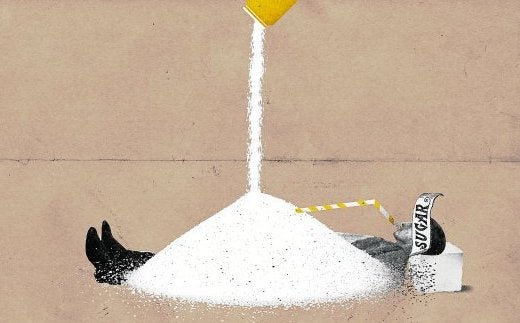
The battle against sugar gets fiercer
After warnings from specialists and worldwide organisations such as the WHO, the Spanish tax authority plans to go into battle against sugar due to its negative effects on health and contribution to the increase in obesity
ALEJANDRA RODRÍGUEZ
Lunes, 23 de enero 2017, 11:21
Last month the Minister of Finance, Cristóbal Montoro, announced a package of measures which are designed to raise around eight billion dollars this year. Of this cascade of cash, the Minister calculates that 200 million will come from soft drinks. Not many details are known yet, because Montoro has only said that the tax on drinks which contain an excessive amount of sugar is in line with the demands of the World Health Organisation (WHO) and will be implemented in a similar way to countries which already have this type of tax or are considering it, such as the UK and Portugal.
EXPERT ADVICE TO WEAN OURSELVES OFF SUGAR
-
More market and less supermarket shopping
-
In other words, we should reduce as much as possible the presence of processed products (which are normally full of sugar, fats and salt) in our shopping basket and include as much fresh food, especially fruit and vegetables, as we can.
-
Get cooking!
-
This is a consequence of the point above. Cooking the food we have bought in the supermarket gives us a more nutritious and balanced diet, and corresponds more to the Mediterranean lifestyle. It also means we can control not only the cooking method, but also the quality of the ingredients and the amount of sugars, fats and salt we add. By cooking at home we can become more versatile and replace additives which are not recommended with others that are much healthier.
-
Give it up little by little
-
Palates and brains which are accustomed to an excessively sugary reward find it difficult to give up something which can actually be addictive. Therefore, it is best to reduce the amount of sweet foods which we eat every day progressively, to re-educate our palate. When we least expect it, we will start to become used to eating less sugar.
-
Look for substitutes
-
Stevia and xylitol are natural sweeteners which are as efficient or more so than refined sugar and are not as damaging to our health. Also, xylitol protects teeth against caries. However, we need to be careful with ready-prepared foods which are normally sold in supermarkets because, for example, the amount of stevia may be very small and could be accompanied by other artificial sweeteners which are also being studied by scientists for their possible implication in weight gain and Type 2 diabetes. In addition, many commercial products substitute fat or refined sugar with fructose, an ingredient which wreaks havoc on blood glucose.
-
Read the labels
-
Nobody should be fooled by labels such as "low in sugar" or "no added sugar". In the first case, these are products with a lower amount of sugar, but they are not completely free of it. In the other, not adding sugar doesn't mean that the product doesn't contain any, and it could have a great deal. As a general rule, these types of message give consumers a false sense of security and makes us consume the same amount or more of the ingredient we are trying to avoid.
-
Other products to bear in mind
-
In addition to the soft drinks, there is a long list of products which people believe are healthy but which, nevertheless, contain as much or even more sugar. These include milk shakes, non-carbonated drinks, cartons of juice, energy drinks and sports drinks. The latter two are formulated to replace carbohydrates and electrolytes after training sessions of a certain intensity. People whose physical activity is not demanding or who only exercise occasionally don't need products of this type. Recently, flavoured waters have also appeared on the market. These contain water, flavouring and sugar. In this case, although the amount of sugar may be relatively low, it should not be there at all.
-
Conscious eating
-
If we were to increase people's awareness of nutrition, include this as a subject taught in schools, carry out independent informative campaigns and, in general, know exactly what we are eating and the real effects our diet has on our health, we would then be able to enjoy truly free and responible form of consumption.
However, despite the lack of detail, manufacturers of this type of product are already criticising the measure as "regressive, discriminatory and ineffective in changing lifestyle habits," according to a statement issued by ANFABRA (the Soft Drinks Association), a collective which will be directly affected by this new tax. Another nine entities related to the production of drinks and foods have expressed similar concerns. In the opinion of this sector of the food industry, this regulation will be a blow to the poorest families and will not reduce the consumption of sugary drinks. They also insist that the companies which produce soft drinks have already shown great commitment to health by reducing the amount of sugar in some of their products during the past decade, and they argue that sugary drinks are not as bad as they are reputed to be.
Does added sugar kill?
Not directly, but it can be a contributing factor to people's deaths. That is the general conclusion by specialists in health and nutrition, who say that the present situation regarding sugar is similar to that of tobacco in the past.
With the exception of investigations financed by soft drink manufacturers or where there is a conflict of interest by the authors, all the research published in scientific journals o far has revealed startling data against these products, accusing them of being directly responsible for the increase in obesity and Type 2 diabetes, two worldwide public health problems, as well as dental caries and even certain tumors.
One study, published in April 2015 in Circulation magazine, attributes sugary drinks to no fewer than 184,000 deaths a year in the world. Of these, 133,000 are due to Type 2 diabetes, 4,000 from cardiovascular illnesses and 6,400 to different types of cancer.
Meanwhile, another research project published in The New England Journal of Medicine carried out by scientists from the Public Health School at Harvard University, indicated that sugary drinks are closely related with a genetic disposition to adiposity and increased weight, and act as an important trigger.
Numerous pieces of research have shown, too, that the light (with less sugar) and zero (no artificial sweeteners) versions do not compensate for the negative effect of their full versions. This is either because the user consumes more of the product, or because they complement it with other sugary foods, but it is certain that the 'light' drinks are not as healthy as people might believe.
Juana María González Prada, the technical director of Alimmenta, agrees. She also points out that "just one tin of drink contains more than the daily recommended amount of sugar, but the sugar in these drinks is especially dangerous because it contains calories but has no other nutrient or valuable element. This has nothing to do with the sugars we obtain from the other foods in our diet, because those do contain minerals, vitamins and fibre," she says.
Juana María also explains that sugary drinks are replacing others such as water or milk which are necessary or recommended in the diet, especially where children are concerned.
Do such taxes work?
"Sugary drinks are a unique and modifiable dietetic factor which directly affects preventable death and disability in adults in countries with high, medium and low income, which suggests an urgent need for solid preventive programmes on a world level," conclude the authors of the article in Circulation.
And that is precisely what the WHO is calling for in its report Fiscal Policies for Diet and the Prevention of Noncommunicable Diseases. "Appropriately designed fiscal policies which add at least 20 per cent onto the sale price of sugary drinks could result in a proportional reduction in the consumption of these products," it says.
Meanwhile, Douglas Bettcher, the Director of the WHO's Department of Prevention of Noncommunicable Diseases, says that "the ingestion of free sugars, including those in products such as soft drinks, is one of the main factors which are leading to more obesity and diabetes in the world. If the governments were to tax products such as sugary drinks, it could prevent the suffering of many people and save lives. It would also reduce health costs and increase tax income, which could be invested in health services," he explains.
Juan Revenga, author of the blog ' El nutricionista de la General', welcomes the WHO report as well as the decision by the Spanish authorities, because "for the first time, independently of the aim of raising money, there is sufficient clear and objective data to classify these products as real enemies of public health," he says.
"As professionals, we can confirm how much our patients improve when they stop using these products; not only because they tell us that they feel better, but because their blood tests and clinical data show it as well. However, reports like the one from the WHO support what Science has been demonstrating for years: free sugar is an element which is damaging for the health, and sugary drinks are one of the principal vehicles," says Laura Kohan, who runs The Food Therapy.
Nevertheless, the specialists warn of some aspects which have to be taken into account in order for the measure to be effective in terms of public health. "The World Health Organisation says the tax has to increase the cost to the public by at least 20 per cent. If the companies absorb this cost and users don't notice any difference in the price they pay, the measure will not be effective," says Juan Revenga.
Not only soft drinks...
Experts believe that the new measure announced by Cristóbal Montoro doesn't go far enough because it only refers to fizzy drinks. In other words, it basically affects soft drinks but not others which also contain a large amount of added sugar, such as milk shakes, non-carbonated drinks and industrially-produced juices.
"Some of these products contain more than 12 per cent of recommended sugar levels, when they shouldn't have more than seven per cent. They are not healthy either, but they appear to be better," argues Juana María González Prada, who says consumers feel confident in using them and giving them to children.
Juan Revenga points out that "the WHO has also warned that industrially produced juices contribute to the increase in obesity, especially in children, and various research projects (one of which was published in the BMJ Open magazine last March) have reported that most of these products contain unacceptably high levels of sugar."
On the other hand, juices contain another trick: they confuse people into thinking they are a substitute for fruit, and one which bears a 'no added sugar' label. The fact that no sugar is added does not mean that the juice doesn't already contain a large amount, even if it is present naturally. Also, juice contains the same amount of sugar as several pieces of fruit (something which is not really recommended to maintain glucaemia at a stable level and prevent caries and weight gain), but not the vitamins or fibre.
Finally, in addition to drinks, experts in health and nutrition are calling for equally punitive measures to be imposed on other products such as biscuits, soluble cocoa, prepared sauces, snacks, ready meals, breakfast cereals and a long list of other foods which contain large amounts of harmful fats, free sugars and salt.
The industry reaction
Experts in health and nutrition fear that the industry reaction will not just be limited to the publication of the statement mentioned above, and that the producers will do everything they can to delay this type of measure being put into effect or stop it being applied in full.
Research published in October in the revealed that the world's two largest soft drinks manufacturers have financed nearly 100 entities, including Cruz Roja, the American Diabetes Association, several prestigious universities, the American Medical Association (AMA), the American Cancer Society and the Centre for the Control of Illness, to improve the image of soft drinks by reducing their support for laws which aim to lower their consumption.
In the opinion of the authors of the report, by accepting financing from these two soft drinks giants, the health organisations have become collaborators in their commerical strategies, and are taking part in their marketing plans without realising it.
"Sponsorship, corporate social responsibility campaigns... this is a widespread phenomenon which makes them look good, but all it really does is increases their income", says Juan Revenga. "In Spain there are codes of self-regulation of publicity which are not complied with, and are drawn up by the manufacturers of products which should not be given directly to children; there are ministerial campaigns in which a product which is not recommendable bears a message which is so tiny it is almost illegible... it's all a fraud. It means the consumer is not free to choose what they are really consuming."
Healthier products
The question has to be asked: why don't companies just make healthier products? The answer, according to the experts, is financial.
"If there was a real, unanimous commitment by the manufacturers, it would pay them to do that. But while some continue doing things badly, with no negative consequences and in addition they are making good money from it, I fear there is little to be done," says Juan Revenga.
"Companies aren't given prizes or incentives to do things well, and that is a mistake," adds González Prada.
The author of the blog 'Mi dieta Cojea', Aitor Sánchez, says that "in all the years of my career many companies in this industry have asked me how to improve their market share. Only one asked me how it could make better products."