
Infrastructure
High-speed rail (AVE) upgrade to Andalucía now complete? It's a Yes/No argument
FRANCISCO J. POYATO
Cordoba
The "comprehensive renovation" of the Madrid-Andalucía high-speed rail link that Transport Minister Óscar Puente has been talking about in recent weeks, following the tragic accident in Adamuz that killed 46 people, has even more work to do than one might think, based on the minister's recent statements, which have already declared the project as complete.
Note that the overall budget for the project is valued at up to 780 million euros, involving 89 public contracts. Keep in mind that this rail link was inaugurated back in 1992 at a cost of 2.7 billion euros.
Even before the tragic accident happened in the Sierra Morena mountains on 18 January, in an appearance on 4 September before the Congress of Deputies, Puente himself defended the link as a completed project worth 750 million euros, claiming hardly any disruption to rail services.
The same message was then reiterated during the critical moments following the tragedy. Last Wednesday, Prime Minister Pedro Sánchez, in his appearance before the Congress of Deputies, alluded to the 'complete renovation' of the railway line to Andalucía, emphatically stating that point.
Yet his own government has now detailed a list of projects as still underway and some even not yet started on this nearly 500-kilometre line, shrouding it in doubt and user distrust (not to mention the fact that the route still has no reopening date).
Seven projects yet to be completed
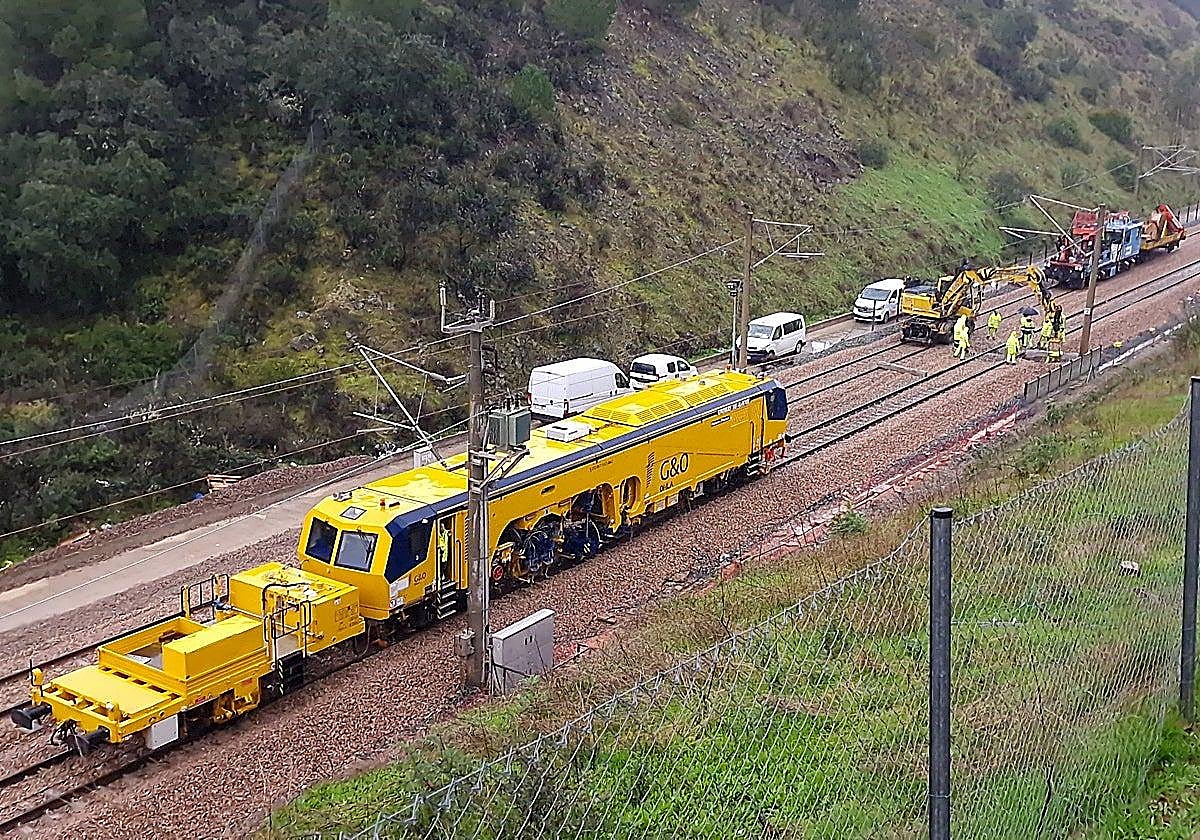
The Ministry of Transport admitted in a recent response to a senator group regarding these improvements that there are seven projects needing to be completed during 2026, including the well-known reinforcement of the infrastructure (platform, structure and tunnels) of the so-called 'southern rail corridor', as well as the laying of turnouts (switches) and up to 124,000 sleepers, among other major interventions. Not is all as it seems regarding 'completion'.
Initially, the transport ministry stated that this total investment had been "mobilised" in 2025 and "more than 94 per cent of the work has been completed or is at an advanced stage of completion ". However, no further details were provided about the outstanding funds, the scope of the projects still underway or what is included in the remaining six per cent not yet spent.
What the Ministry of Transport claims to have been completed by 2025 is the renewal of the overhead contact line "with the replacement of some of its components". Minister Puente argued that this is the constant practice of partial overhauling of the railway infrastructure rather than a comprehensive overhaul. Also included is the replacement of lighting in 17 tunnels with LED ones and the installation of new, better-performing track circuits . The latter monitor the presence of trains on different line sections, precisely what has been called into question by the Alvia accident, which took at least 45 minutes for rescue services to attend. The ministry adds that the installation of noise barriers in several sections (34 screens across eight locations) and the renewal of the data backbone network and electronic interlocking systems are also underway.
At this juncture, the ministry points out in its response to the PP senators, to which ABC has had access, that the reinforcement of the entire line's infrastructure (tunnels, bridges, viaducts, drainage systems, retaining walls, cuttings, slopes and so on) is still pending. It estimates an average completion rate of 86 per cent across the four contracts into which the project is divided. This corresponds to the four sections into which the 470-kilometre route from Madrid to Seville are divided, with over 90 per cent completion in two of them. This is one of the largest projects in terms of both spending and scope along the entire route.
Defective sleepers remain unreplaced
Similarly, the implementation of the ERTMS signalling system, "the most advanced in the world", has its first phase now complete. This is the system used in Europe for rail traffic management. This is in addition to a mobile rail telecommunications system (GSM-R) and a fibre optic network for the line. A third project is also underway: the construction of a third high-speed track for Puertollano station in Ciudad Real, as well as the remodelling of the track layout.
The Spanish government has thus extended completion of these important line upgrades related to crucial elements such as safety, durability , signalling and traffic infrastructure throughout 2026. To this must be added significant superstructure work, such as the installation of 47 new turnouts (switches) and replacement of the much-touted 123,732 defective sleepers that were left unreplaced on a section Line of D between Cordoba and Seville (Almodóvar del Río and Guadajoz). It should be remembered that 34,000 of these defective sleepers had not been replaced on the Adamuz section.
These seven projects are pending even before traffic on the southern rail corridor has reopened, creating a crisis of confidence in the system.
Also included in this package is the renovation of the electrical substations that serve the line and the video surveillance andsecurity systems on the high-speed line. These, among other things, enable monitoring of any cable thefts , an ongoing issue that has caused service disruptions, affecting thousands of passengers.
The ministry concluded its clarification on the question posed by the senator group by arguing that all this work is compatible with maintaining a rail service that is currently experiencing low demand, while not entirely ruling out the possibility of having to reduce speeds or cut traffic altogether.
"The scale and volume of some of the work sometimes requires extending the [night-time] stretches undergoing maintenance, temporarily suspending traffic on one line while maintaining traffic flow on the other, or temporarily limiting speeds on certain stretches."
![[]](http://static.vocstatic.com/voc26/latest/assets/images/favicon/surinenglish/apple-touch-icon-57x57.png)