
Adamuz train crash
'Broken' tracks ordered to be taken to lab to determine whether they caused Iryo derailment
The CIAF investigation commission has also agreed to inspect the wheels of the trains, suspecting that the "interaction" of the axles and damaged rails could have triggered the accident
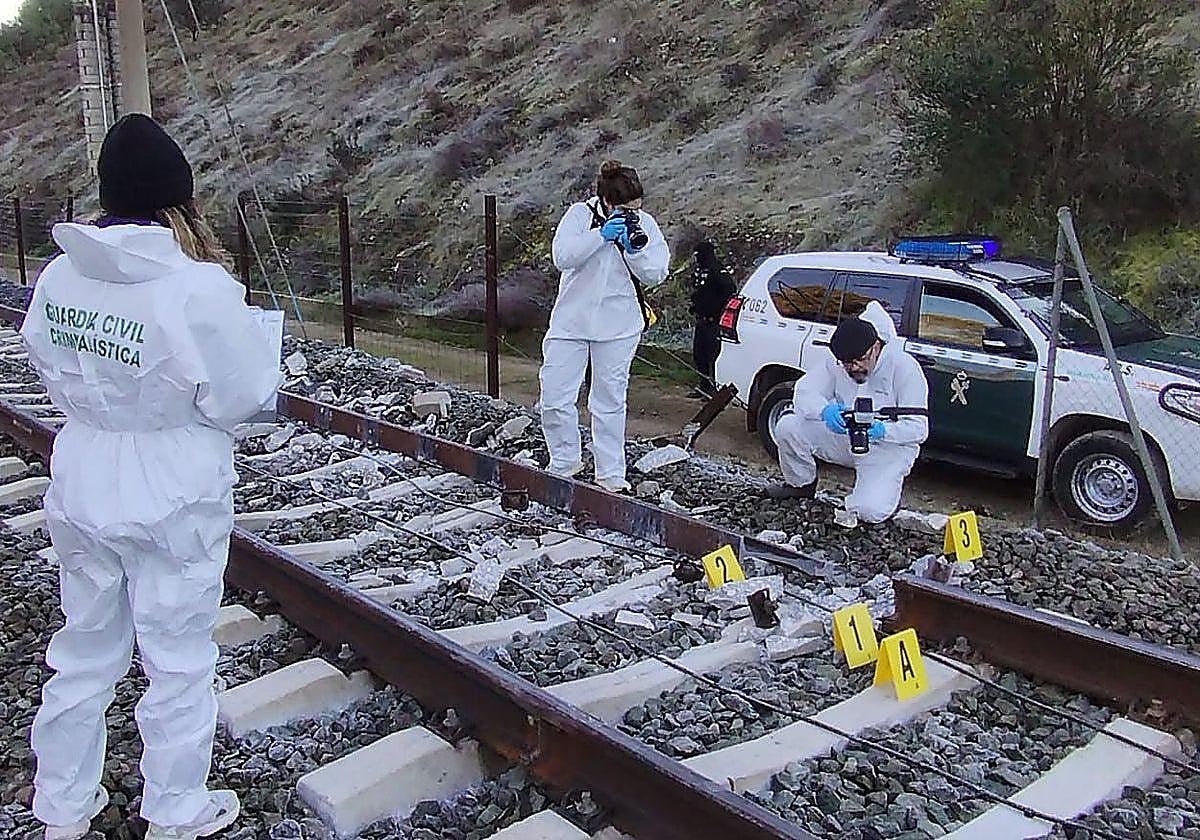

The team investigating the causes of the Adamuz accident has ordered the immediate transfer to a laboratory in Madrid of "the rails at the starting point of the derailment" of the Iryo train 6189 Malaga-Madrid. The train partially left the track, which, according to the first investigations, caused the collision with the Renfe Alvia 2384 Madrid-Huelva.
The technicians, according to sources close to the CIAF (Spain's rail accident investigation commission), believe it is essential to analyse the tracks in a controlled space and without interference; the tracks - according to initial investigations by the Guardia Civil - had "breaks" and/or "alterations". The aim is to determine whether this damage was present before the accident and, above all, to establish whether they were the cause of the Madrid-bound train leaving the track and being hit on Sunday 18 January at 7.45pm by the oncoming Alvia train, in an accident which, for the moment, has resulted in 40 deaths, 29 seriously injured and 123 with minor injuries.
The section of track will be provisionally transferred to CIAF's premises in Madrid, before being taken to the laboratory where it will be analysed.
Those responsible for the investigation have revealed to this newspaper that the CIAF's idea is to take sections of at least half a kilometre of track 1 (Madrid-bound) to the laboratory, from kilometre point 318.2, which is - according to Transportes - the exact place where the carriages of both trains collided, to kilometre point 318.7, which is where the "clean break" of almost a metre in length has been located (the gap that appears in the photograph distributed by the Guardia Civil and which illustrates this article).
Other "earlier" trains
This breakage, for the moment, is the focus of the CIAF's investigations, but it is not the only line of inquiry. The department headed by minister Óscar Puente has also confirmed in the last few hours that the team of the Commission for the Investigation of Railway Accidents has already given orders to inspect the wheels of the Iryo train and "other trains that ran previously" through the point of the accident in the workshop. This is an "advanced technical" process which, using, among other technologies, ultrasound and cameras, detects defects, wear and tear and cracks in the wheels and axles.
The CIAF, which is going to mobilise two additional investigators for these track checks, has also asked Adif for information on the records of traffic through Adamuz in the two days prior to the incident to see if there had been any specific warnings of problems on that section from train drivers or other staff.
While awaiting the results of all these tests, CIAF technicians, who have been working on the ground since 1.30am on Monday morning, already have some preliminary data confirmed, as reported in the last few hours by the transport ministry and confirmed by sources from the investigation. The accident was caused by the "derailment, at 7.45pm, of the last three carriages of the Iryo high-speed train", which was travelling on track 1 towards Madrid, at the entrance of Adamuz station, on the 010 Madrid-Seville line. "The derailed carriages of the train bound for Atocha moved sideways, invading the gauge of track 2, on which at that moment the Renfe Alvia train was arriving in the opposite direction." The number of passengers on board the two trains, according to the companies, was 300 on the Iryo train and 186 on the Alvia.
"200 kilometres per hour".
"Both trains were travelling at speeds of around 200 kilometres per hour (the exact figure is still to be confirmed), producing a violent collision between the derailed carriages of the Iryo train's tail and the head of the Alvia train, approximately at kilometre point 318.2," said the transport department.
"As a result of the collision, the first two carriages of the Alvia train fell down a four-metre embankment." As a result of "the derailment and subsequent collision", in addition to personal injuries, "there is also considerable damage to the infrastructure and rolling stock of both trains."
The ministry headed by Puente has insisted in recent hours on the provisional nature of the data and that the investigation is still in an embryonic phase.
"The CIAF is currently in the phase of collecting information in situ and compiling documentation and data from the different registers. In the following phases of the investigation, laboratory analysis of the material is planned and, depending on how the investigation progresses, other actions will be carried out as necessary (such as interviews, inspections of other facilities or rolling stock, etc.)," said the transport ministry. "At the moment, as we are at an early stage, all hypotheses regarding the possible causes of the incident are open," the ministry reiterated, while recalling that, according to the regulations, the CIAF has, in principle, a period of one year to publish the final report of the investigation.
The CIAF - as required by the procedure - has also published on its website the investigation initiation form (file 08/2026 for "derailment"), with the basic details of the event and the contact form so that those affected and interested parties in this event can be informed of the progress of the investigation.
![[]](http://static.vocstatic.com/voc26/latest/assets/images/favicon/surinenglish/apple-touch-icon-57x57.png)