Suffering from pandemic fatigue
The WHO warns that people are tired of the restrictions which have gone on for so long, and with Christmas almost upon us this could result in a third wave of the virus
ÁLVARO SOTO
Lunes, 21 de diciembre 2020, 18:00
Apathy, tiredness, a lack of motivation, reluctance to comply with the messages from the health authorities ... the World Health Organisation (WHO) has now given a name to such feelings, which according to its latest report are shared by 60 per cent of Europeans.
'Pandemic fatigue' is what experts have called the "natural and expected" reaction to the inconveniences caused by the restrictions in the nine months since the pandemic began, when the light at the end of the tunnel still feels so far away.
People lack hope and this makes them reluctant to follow the safety recommendations. This is something that increases over time, and experts say it could ruin the efforts made by most of society so far. With Christmas almost upon us, it could lead to a third wave of the virus.
"At the start of the pandemic in March, people were suddenly hit by anxiety and the restrictions established by the authorities transmitted a message of danger and risk. That's why all of us, not only health professionals but people in general, realised that we had to do whatever it took to save lives, even if it meant a complete lockdown," says María Fe Bravo, head of the psychiatry and mental health unit at La Paz university hospital. "We made ourselves comply with the measures; it wore us out, but we understood it. In general people were aware. But now, the situation is different."
That 'now' has a starting date. "In summer it started to feel as if the situation was no longer as bad. The measures couldn't go on for ever and, as the restrictions began to be eased, some people thought there was no longer any danger," says Dr Bravo.
Everyone complied with the first restrictions but afterwards, when some were enforced again, people became "tired out". This is something she has noticed in her own line of work.
"In the first wave, people coped quite well because they were aware, but now we are seeing more patients with mental health problems. Humans are social beings, we need contact with other people, especially in cases where someone is suffering from depression and anxiety, because their therapy partly involves contact with others."
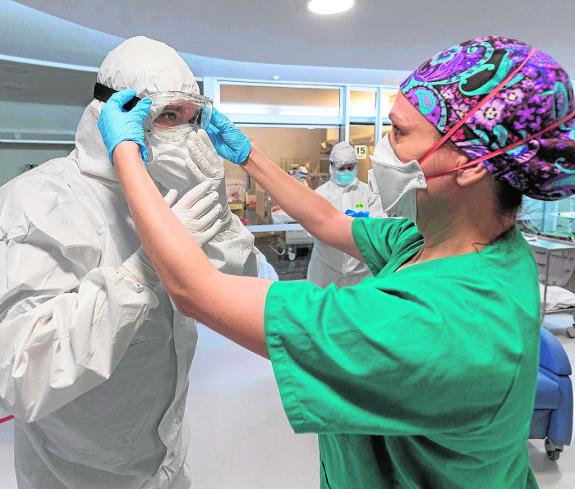
However, if society in general is suffering from pandemic fatigue, health professionals are even more affected.
The Spanish Epidemiology Society has warned that doctors and nurses are at their limit "because they are overloaded with work, and because of the conditions in which they have to work. There is also a lack of understanding about what they do and certain people and institutions, because it suits their own interests, have placed responsibility for the pandemic on those whose work involves monitoring and controlling it. This has been going on for a long time now, without any mechanisms being put in place to reduce their effects."
In a public letter, epidemiologists have explained that they are directly suffering from the tiredness which is affecting part of society. "The frustration among part of the population is understandable in a situation as uncertain and complicated as this one, and one which has shown little positive result," they admit. "However, people should not assume that they can just take out that frustration on some of those who are trying precisely to reverse the situation, and are doing so with the tools and resources they have available, which are not always the most suitable or sufficient."
Solutions
The document from the WHO which analyses pandemic fatigue also provides some solutions to try to mitigate its effects. It suggests that governments need to understand people, make citizens feel part of the solution, enable the population to live their lives but reduce the risks, and manage the experience of adversity which people have had. It also asks for transparency in information, equality and justice, coordination and predictability; in other words if restrictions have to be put in place they should not be unexpected and arbitrary.
The text explains measures taken by some countries to reduce social discontent, and in the case of Spain, highlights the introduction of the Minimum Living Income, which enables the most disadvantaged in society "to cover their needs until the situation improves". The implicit idea is clear: the worse somebody's living conditions are, the more pandemic fatigue they suffer and the less likely they are to follow the health recommendations.
Dr Bravo says something needs to be done to combat pandemic fatigue. "There is a feeling that the second wave has been less dramatic, but in fact 20,000 people have died," she points out.
"At Christmas we all have to make an effort, and hopefully this will be the last time, because otherwise when the festive season is over, we will see a third wave. We have to remind ourselves that everything passes and this will as well, if we all keep that in mind and behave the way we need to."