
Exhibition
Sniper Eduardo Gruber takes an ironic shot at the human factor at the CAC Málaga
The artist from Santander brings together his work over the last decade in the city to humorously denounce dehumanisation and war
Ver 16 fotos Ver 16 fotos

Malaga
Upon entering, to the right, we are greeted by the multicoloured display of a large mural on which Tiffany & Co. can be read. However, the memory of Breakfast at Tiffany’s and the immortal Audrey Hepburn transforms into criticism, irony, and even a twinge in the stomach with the image of meat in a slaughterhouse depicting “exquisite corpses.”The work stages “two opposing worlds” and tells us that “the most promising job is that of a slaughterhouse worker,” humorously illustrated the artist Eduardo Gruber (Santander, 1949) at the opening of his exhibition at the CAC Málaga at the beginning of December, titled ‘Nadie es Nada’ (Nobody is Anything). The exhibition, which runs until 3 March, showcases the same sarcasm, provocation, metaphor, and nonconformity that encapsulate the words of this sniper who turns current events into the inspiration for his work.
-U24343451227PiE-650x455@Diario%20Sur.jpg)
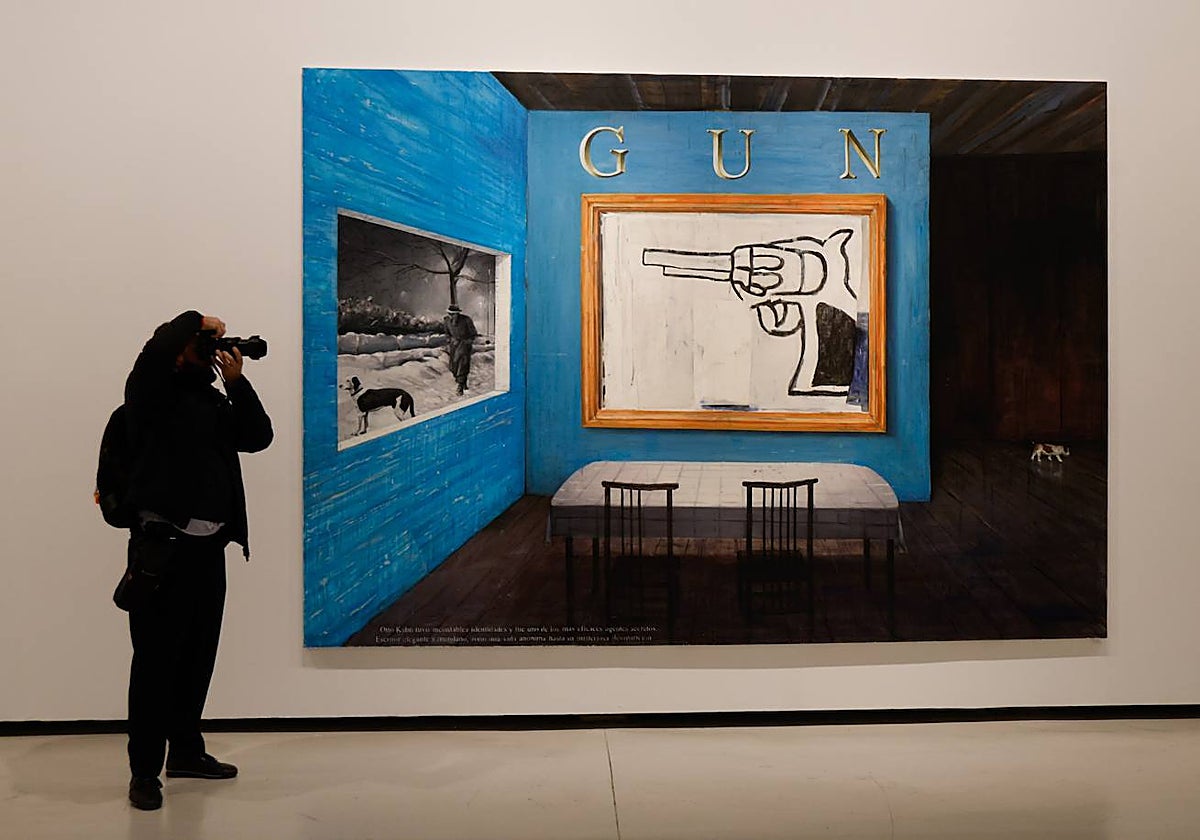
“I think too much, which is exciting but exhausting,“ confessed the artist about his tireless activity. And one only needs to take a stroll through the extensive space occupied by his 86 works - many of them large format - in the exhibition curated by Fernando Francés, to confirm his biting sincerity and his penchant for “poking in the eye.” His own and others’. Starting with the self-criticism of the Human Factor series, of which the mentioned work ‘Tiffany’ is a part, the threatening weapons in Gun and Mk, or the arrow pointing at the apples in Is Not a Circus, accompanied by the phrase ‘The world cannot live half enslaved and half free'.
And there is no work without a motto or words in this exhibition by this multidisciplinary artist who not only experiments with all kinds of materials and techniques - watercolour, oil, ink and even pen on paper, canvas, photography - but is also a writer - he has published four novels - and is winner of the National Prize for Scenography. In fact, to the impact of the works is added the staging with this still life of almost forty works that serves as a portico to the exhibition and in which irony overflows in these dozens of black and white works that seem to have come out of newspaper debates or from a news programme.
-U87266640851YjZ-650x455@Diario%20Sur.jpg)
On this wall hangs the anti-bullfighting El Olvido que Seremos (The oblivion we will be) with hanging heads of cattle, which tells us that life passes “even if you are the king of the pasture, so you have to take advantage of it”; No es tan Fácil ser Ateo (It’s not so easy to be an atheist) which speaks of the profound contradiction that “you reach a moment in life when you say you are already over everything, but then your body asks you for something more” or the child who says “Estoy solo” (I am alone) and which the author refers to the “images of the children in Gaza with their faces white” due to the explosions, although the work dates from before the conflict.
In love with femmes fatales
The small and recent work Ni Tú ni yo Somos Nada (2022) inspires the main title of this exhibition, Nadie es Nada, a double negation that contains an optimistic message: this play on words “is the redundancy of a void and tells us that we are all something and that each human being, with his or her personal experiences, is impressive”. This appeal goes directly to the spectator who visits the work of Eduardo Gruber, who does not hide the “provocative nature” and his desire for “the spectator to stand still” in front of his paintings. “Managing to stop time with the exhibition is a pleasure”, confessed the multidisciplinary artist, who was accompanied by the Director of Culture of Malaga City Council, Susana Martín, and the artistic director of the CAC, Helena Juncosa.
Photo gallery
-kmt-U210111537488667E-366x256@Diario%20Sur.jpg)
On the social and personal criticism of the exhibition, the artist has rejected the idea that his works are discouraging. “I have good humour and I try to say things with hope, although that might seem naïve with the images you see these days and it’s like shooting yourself”, lamented the artist about the situation in Palestine and the Ukraine, to which his anti-war series ‘The War’ also refers and which includes parodic works such as the scene of a bombing under the title Homo Sapiens.
Nadie es Nada, which brings together for the first time the work produced by Gruber over the last decade and whose installation at the CAC Málaga has been highly applauded by the author himself, also includes the series ‘Femme fatale’, a collection of photos and police records of Australian women arrested in the 1920s for whom the author and writer invents a positive parallel life that did not lead them to prison and with whom the artist has confessed to having a platonic relationship. “It is the series that has most marked me and the story that turned my stomach was that of a prostitute who killed her pimp, but her file added the comment that she had support from some of Sydney’s society, which was at odds with the coldness of police language”, said Eduardo Gruber, who has not hidden the fact that he has ended up “in love” with these femme fatales.
![[]](http://static.vocstatic.com/voc26/latest/assets/images/favicon/surinenglish/apple-touch-icon-57x57.png)