
112 incident
Three dead in two weeks in Galicia after Asian hornet attacks
One of the victims stepped on a nest while hunting and the other two were attacked while clearing land

Jon Garay
Javier I.P., 55, died on Sunday afternoon after an attack by Asian hornets. He had gone out to hunt in Galicia, when he accidentally stepped on a nest, which prompted the insects to attack him. Knowing he was allergic, he called his brother and asked him to bring an adrenaline shot. Despite his brother's rapid action and the two ambulances that were sent to the scene, he died. Mayor of Cospeito, where the accident happened, said that everything had developed too fast.
Two other residents of the region of Galicia died this October. On 15 October, 76-year-old councillor of Irixoa Ramón José Dopico Martínez was attacked by hornets while clearing land with a tractor in Teixeiro. They stung his head and neck, causing a fatal anaphylactic shock. Just some hours before that, on 14 October, a 79-year-old resident of the town of Dozón was carrying out agricultural work when he came across a nest of hornets on the ground. The man's screams alerted neighbours, who went to the scene to help him, but it was too late.
"Asian hornet attacks are relatively common and they have happened a few times over the years. However, it is more likely that you win a first, second, third, fourth or fifth prize in the lottery than be stung to death by an insect such as a wasp, a bee or a hornet," entomologist Mikel Bengoa says. Nonetheless, he acknowledges that the Asian hornet is more aggressive compared to other wasps, such as the European paper wasp that makes small combs and the German wasp that makes bigger ones. He adds that Asian hornets "are more violent", "their venom is more potent and they can squirt acid to defend themselves. That is why firefighters' or beekeepers' suits have a protective screen".
The attacks happen when the insects feel threatened. "Unlike mosquitoes, which need us to survive, hornets don't usually attack," Bengoa says. According to this expert, Asian hornets might attack when they get trapped in a car, for example, and cannot find a way out. In such cases, they simply sting once. However, they become truly vengeful and aggressive when they feel that their nest is under a threat. In such cases, they attack as one, continuously stinging the body of the threat.
Little room for reaction
The sting of this invasive species is not dangerous, as long as you are not allergic. It causes pain and inflammation. If the person is allergic, however, "there is hardly any reaction time". According to president of the association for bee defence of Asturias (Adapas) Félix Mújica, allergic persons have around 30 minutes to react and even less if several hornets have stung them.
Asian hornets arrived in Europe in 2004, in containers from China with either gardening material or wood. From Bordeaux, they spread across the continent. "In Spain, they were first detected in Navarre in 2010. A year later, they arrived in Pontevedra and northern Portugal. Their expansion is immense and nests have been detected in Cadiz and Malaga, where they arrived on ships," Mújica says. According to him, the hornets prefer more humid areas.
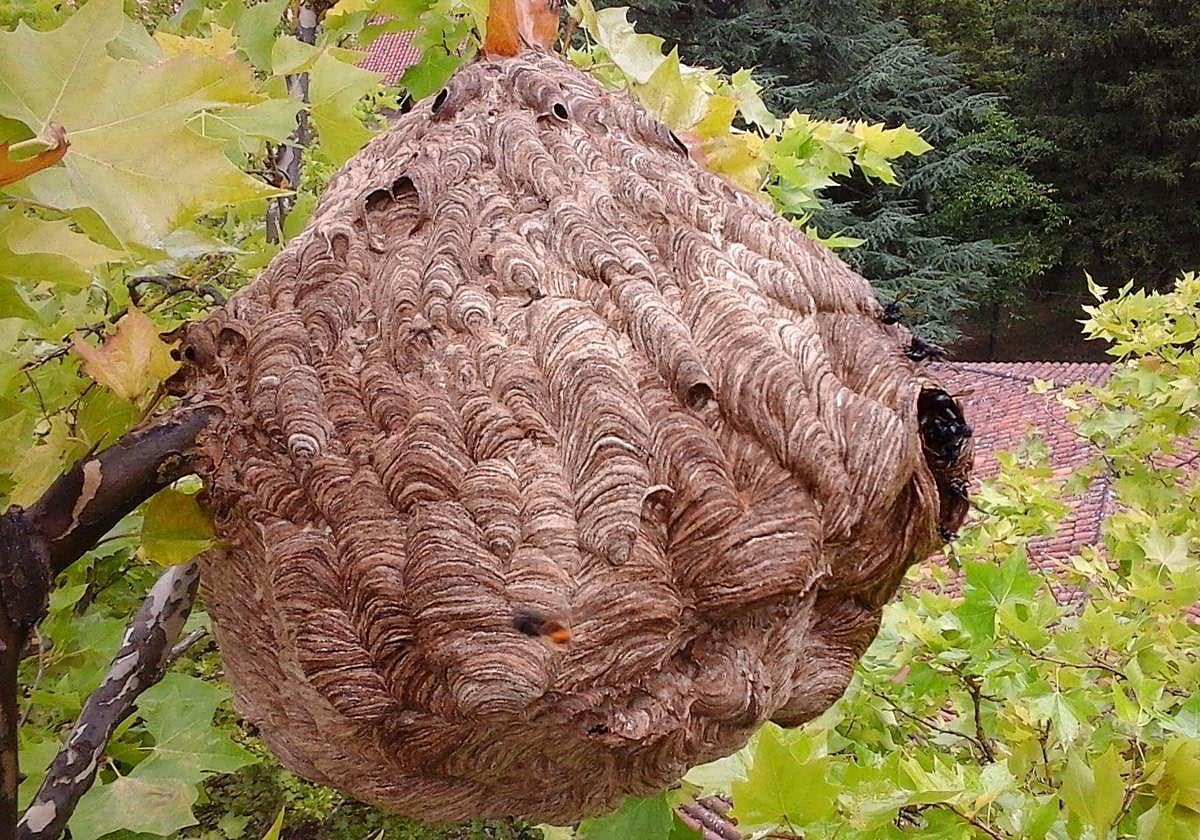
Mújica explains that these insects, which are twice the size of wasps native to Spain, "can settle practically anywhere, which is why they are so dangerous". They have been found in attics, on roofs, electricity meters, bee hives, trees and, as in Galicia, on the ground or at low altitudes. "After hibernating, queen wasps come out in February or March to feed. They begin to build themselves a primary nest - an embryonic nest - which grows to the size of a tennis ball. When it has about 150 worker wasps, it stops growing and moves to another location, where it builds a secondary nest, which can reach 60 centimetres in diameter. In some cases, if they are not disturbed, they can remain in their original location," Mújica says.
![[]](http://static.vocstatic.com/voc26/latest/assets/images/favicon/surinenglish/apple-touch-icon-57x57.png)