
Road safety
The V-16 safety beacon that will become compulsory for 30 million vehicles in Spain in six weeks
A motoring expert explains the key points for using the new warning system that replaces reflective triangles on the roads from January
José Antonio Guerrero
Madrid
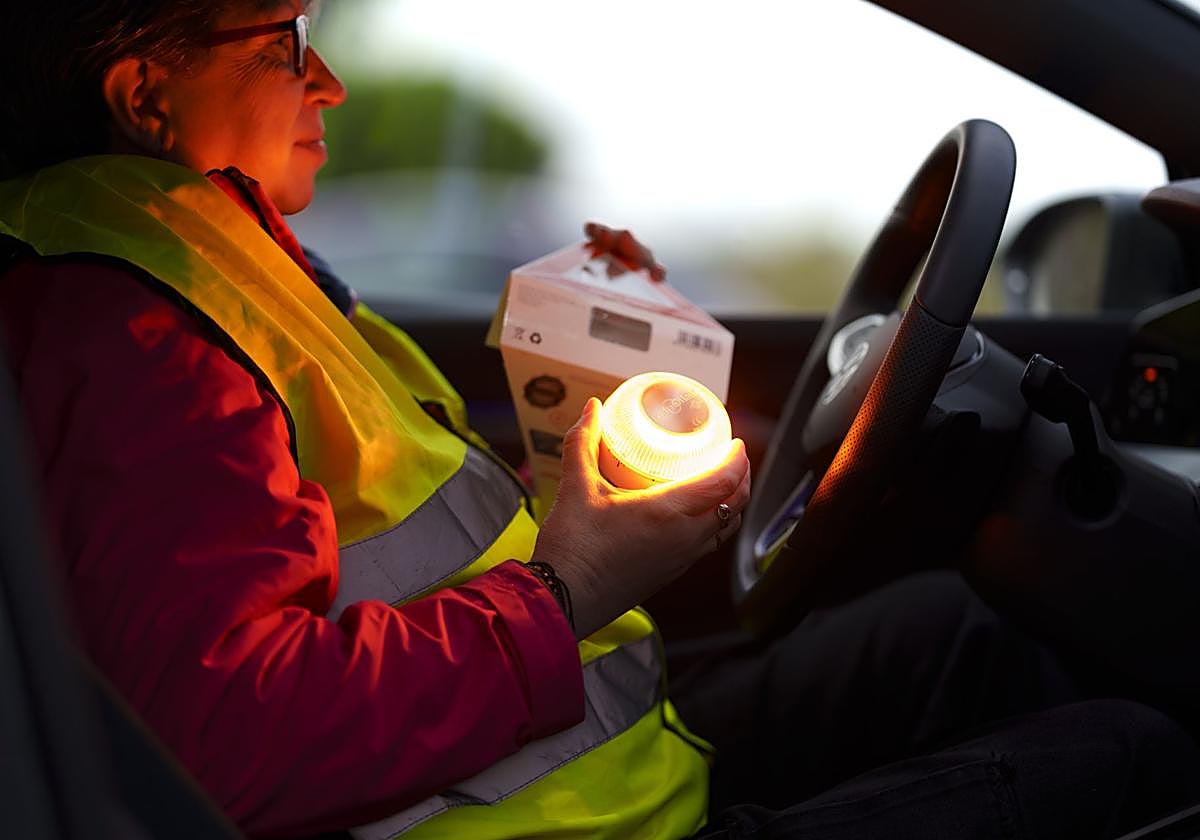
The owwners of 30 million vehicles - including cars, vans, trucks and buses - have just six weeks to purchase connected V-16 safety beacon devices, which will become mandatory on 1 January 2026. These new lights replace traditional reflective triangles and are designed to better protect drivers, making stationary vehicles more visible both physically, with bright flashes visible from a distance, and digitally, through alerts to navigation systems and traffic information panels.
Each year, 25 pedestrians are killed on Spanish roads, and the DGT national traffic authority hopes the V-16s - which can be activated without leaving the car - will help reduce these numbers. Authorities are urging drivers not to wait until the last minute, as sales are expected to peak in December.
Montse Estaca, head of telematics for mobility at the DGT, explained that the device will integrate with the DGT 3.0 platform, providing the precise location of stopped vehicles. The new system will officially come into effect on New Year's Day, requiring all drivers to comply.
When will the V-16 beacons be compulsory, what functions do they have and what penalties apply for not carrying them?
They will be obligatory from 1 January 2026. They will allow a vehicle immobilised by a breakdown or accident to be clearly marked. It is important to stress the V-16 is not a call to 112 or for a tow truck. Its functions are the same as reflective triangles but with connectivity and greater safety. The beacon does not notify emergency services - that responsibility remains with the driver. Its role is strictly informational, aimed at traffic management and preventing secondary accidents. The penalty for not carrying a certified V-16 is 80 euros, and it may be required during routine vehicle inspections (ITV).
How does it work?
The beacon is switched on and placed inside the vehicle or on its roof, the highest point for visibility. For buses and trucks, if the roof cannot be reached, it can be placed on the driver's door. No further action is needed, as it is magnetic and adheres securely. Once activated, the V-16 emits a 360-degree light signal, with brightness equal to or greater than that of indicators, and, thanks to its built-in SIM card, automatically transmits the vehicle's exact location to the platform DGT 3.0. This connectivity gives a virtual visibility and informs the rest of drivers on the same road through navigation systems or variable message signs that there is a stationary vehicle, and to take safety measures when approaching the incident.
How much does this connectivity cost?
Nothing. The cost is included in the price of the device for a minimum period of twelve years.
How much are the beacons and how can you tell if they are certified?
There are as many models as prices and offers (ranging from 7 to 40 euros), with prices set by the market. There are over 200 certified models, and the DGT website can be checked to see if the V-16 purchased appears on the list of certified V-16 devices.
Are motorcycles and mopeds obliged to carry a V-16?
No. They are exempt. It is obligatory for cars, vans, buses and lorries up to 3,500kgs, as vehicles exceeding that weight already have their own light devices.
What do you have to do once you have activated the beacon?
You should assess whether it is safe to exit the vehicle, but always on the side opposite to traffic, without stepping onto the road, and position yourself behind the guardrails. However, if it doesn't seem safe, it is better to stay inside the vehicle with seatbelt fastened until conditions allow you to exit.
Why are reflective triangles being replaced by the connected V-16?
Reflective triangles have served their purpose of warning other drivers about a stopped vehicle. However, placing them requires walking about 100 metres on duel carriageways and twice that on single-lane roads in each direction (where they must be placed in front and behind the vehicle). This exposes the driver to risk and is a major cause of fatal road accidents. The new beacons are expected to help reduce these accidents.
What type of battery does the V-16 use?
They operate with regular batteries, which are usually included, or with a 9-volt block battery, or they can be rechargeable via the car's cigarette lighter or USB.
Does connectivity imply monitoring or control over drivers?
No, the device does not transmit personal data or vehicle information. The data is anonymous. The only information the DGT receives is the location of the stopped vehicle to alert other road users, and only when the beacon is switched on.
Can you use it outside Spain?
It is valid for Spanish vehicles travelling in countries that are signatories to the Vienna Convention on Road Traffic, including Portugal, France, Germany, Italy and the United Kingdom.
With the V-16 do you also have to have the hazard lights on'?
Yes, these have to be on.
Is there expected to be a surge in demand?
Without a doubt. There are drivers and vehicle fleets that still don't have them and there is only a month and a half left to get them. It is best not to wait until 31 December. They will be a top purchase for Black Friday or a gift for Secret Santa or Christmas.
Will there be a grace period?
No. From 1 January, we will be required to carry them. The DGT's priority is not to issue fines, but to ensure that drivers obtain the device, as it will improve their own safety and that of other road users.
Are there any exceptions for the use of conventional triangles?
Only vehicles with foreign number plates travelling in Spain or on international trips can use them. Everyone else must use the V-16.
![[]](http://static.vocstatic.com/voc26/latest/assets/images/favicon/surinenglish/apple-touch-icon-57x57.png)