
Health
A pioneering therapy born out of research at a hospital in Spain gives new life to eight children with leukaemia
The Cris foundation against cancer has published encouraging results after applying CAR-T cells in tandem to patients with no therapeutic alternative

Madrid
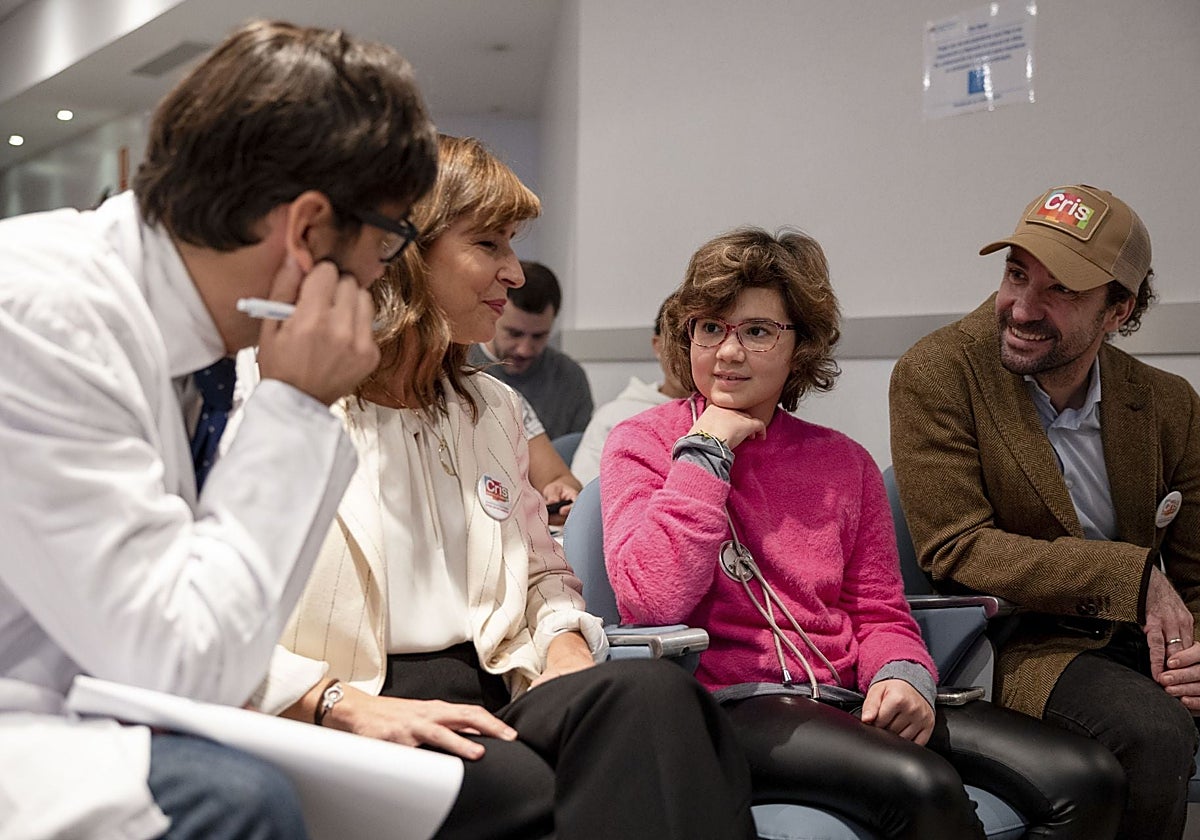
Lucía Álvarez was diagnosed with type B lymphoblastic leukaemia, the most common childhood cancer, when she was just 17 months old. Now, at the age of 15, Lucía, who is from Cadiz, says that for the first time she feels like she's been cured. After spending all her childhood trying different treatments that were not effective after a year and after a journey with her family through four Spanish hospitals, from Cadiz to Madrid, passing through Barcelona and Valencia, now she says she feels "great".
She is one of eight children whose has been given respite by a new cell therapy developed by the team of the Unidad CRIS de Terapias Avanzadas en Cáncer Infantil, (Cris unit of advanced therapies in childhood cancer), located in the Hospital Universitario La Paz in Madrid. The unit is led by paediatrician Antonio Pérez and has clocked up several years of successful work in the application of innovative CAR-T treatments in childhood oncology.
Pérez announced on Wednesday 29 October this latest achievement using the therapy, which, in a very summarised form, consists of 'injecting' the leukaemia patient with lymphocytes modified in a laboratory so that they are capable of detecting and destroying tumour cells.
These treatments, together with immunotherapy, are successful in childhood leukaemia, with a survival rate of 90 per cent. But also around half of the children treated relapse over time. As Lucía, who participated with her father José Alvarez in the public presentation of the new therapy, explained that the disease returned every year. It is no surprise then that in front of a packed auditorium, she received a standing ovation from the audience when she said: "I am very happy to be here".
Success and relapses
The CAR-Ts obtained by the researchers work in tandem to simultaneously recognise two different molecules. This means that if the tumour hides one of them, the cells can detect the other, making it more difficult for the disease to come back.
To test whether this innovation was effective, the La Paz team selected 12 patients - all under the age of 24 - whose leukaemia had come back after receiving CAR-T and other conventional treatments. All were included in the programme as they had no other alternatives to try to cure the disease.
The results were, in Perez's words, very encouraging. Of the twelve children who were given the enhanced cells, eight are now disease-free. Within a month, the presence of the disease was so reduced that it was undetectable. Today they enjoy a good quality of life, like Lucía.
Five of them were able to receive a bone marrow transplant that added to the successful treatment and after an average of 20 months of follow-up, eight are still alive, which means an overall survival of around 70 per cent in patients who were terminally ill.
"We were able to get many of them to maintain their response over time. We know that the treatment is short-lived, as it is a bridging treatment to another strategy and needs to be consolidated with another individualised transplant," Pérez explained.
Despite the initial achievement, which was published in the scientific journal eBiomedicine last August, tandem CAR-Ts will need to be further tested and developed beyond the confines of the Madrid unit.
This is the wish expressed by Lucía and her father: "I want this to spread to other hospitals so that other children don't have to spend 15 years trying things until they get to the good stuff. I want them to spend as little time as possible in hospitals."
![[]](http://static.vocstatic.com/voc26/latest/assets/images/favicon/surinenglish/apple-touch-icon-57x57.png)