
Employment
Shortage of lorry drivers threatens the consumer boom in Spain
Some 30,000 drivers are required to meet the shortfall, but no one wants to get behind the wheel, so central government is offering 3,000 euros to help would-be truckers obtain their licence

Madrid
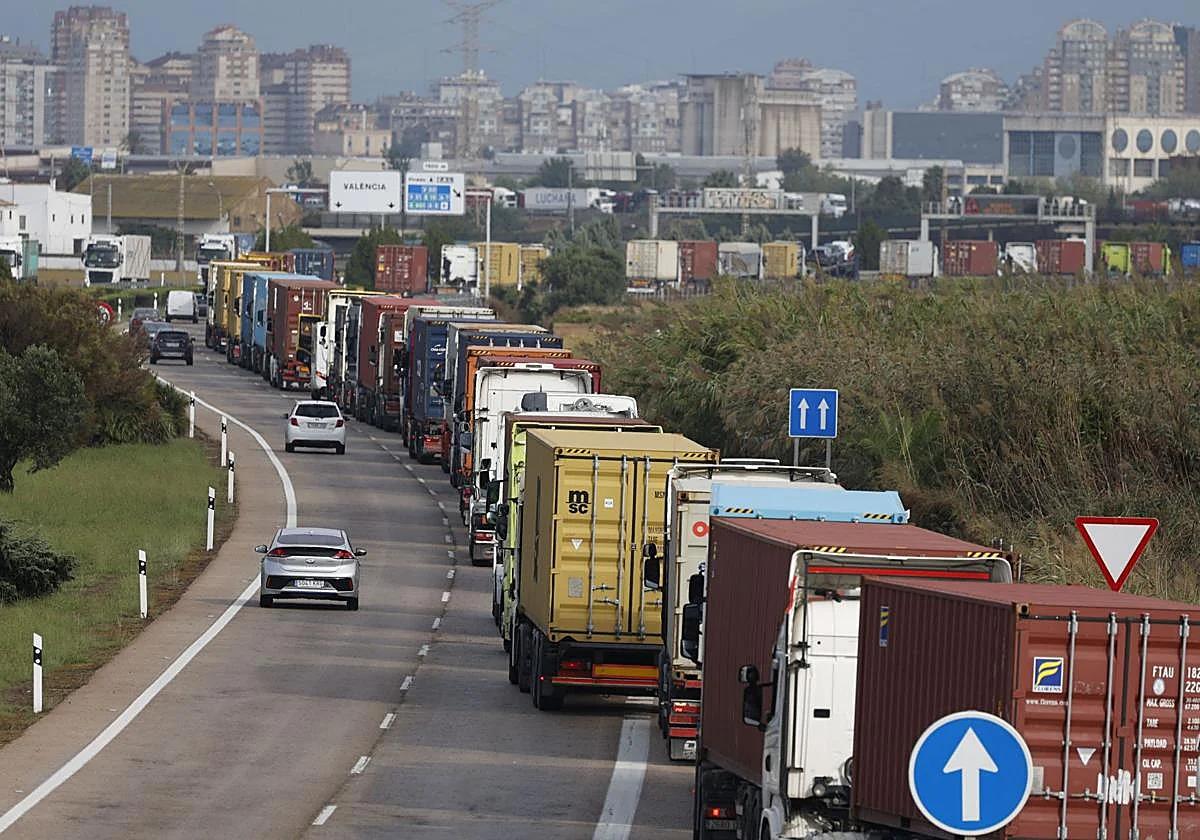
Forty years after Loquillo and Los Trogloditas' hit song in the Spanish charts "Yo para ser feliz, quiero un camión" (To Be Happy, I Want a Lorry), the problem today is that there is no one to drive them. At a time when online retail has driven parcel delivery to record levels and lorries remain the most important mode of freight transport in Europe, there are 426,000 vacancies across the continent, according to data from the IRU (international road transport union). Worldwide, the figures are staggering - 3.6 million unfilled positions, a number expected to double by 2028, according to industry estimates. Spain is not far behind, with a shortage of 30,000 lorry drivers needed to meet demand, a problem that, without short-term solutions, will worsen with the wave of retirements expected over the next decade, given that half of the workforce is over 55 years old.
"If nobody wants to be a lorry driver, there must be a reason. This job is hard and should be rewarded with a good salary and good working conditions, but that's just not the case. You have to work yourself to the bone because, if you don't do overtime, the wages are very low." Manuel, a 43-year-old lorry driver from Toledo, is clear that this is a profession that is "not at all attractive to young people". Moreover, he is one of the youngest for the type of worker in the sector. Data from Astic (the international road transport employers' association in Spain) indicates that the typical profile of the professional lorry driver is a man, around 50 years old and with a school-leaver level of education.
Some headline figures
50 years
The average age
of lorry drivers while bus drivers have an average age of 49.
Salaried workers depend on the hours set by their companies, with morning, afternoon or night shifts. However, the self-employed work "12 to 14 hours to earn a decent wage", says Manuel. Also focusing on pay is Fernando, a senior driver with 20 years of experience behind the wheel of a delivery truck: "If it costs more than 4,000 euros to get your licence and then you go looking for work and they don't pay you more than 1,500 or 1,800 euros per month, not many people want to get into this," he states.

Pay is one of the main complaints from the drivers, who would earn less than 2,000 euros per month without overtime. This is an unattractive salary considering the demanding schedules - often involving nights away from home - and then weekend and holiday work on top.
Likewise, the barrier posed by the cost of obtaining a category C (lorry driver) or D (bus driver) licence is what the Spanish government is trying to alleviate with the announcement, made a few weeks ago, of a new line of public aid of up to 3,000 euros per person to cover a good portion of that cost.
One of the reasons cited by central government is that the ageing of professional lorry and bus drivers has led the sector into a critical situation, especially given the long hours required in this line of work. Even so, the Ministry of Transport points out that this shortage of haulage drivers is "common throughout the European Union". The planned budget amounts to 500,000 euros and the subsidies will be compatible with other aid for obtaining these licences.
Vocational training
Business leaders consider this a positive measure, but call for more action in the medium and long term. From the CETM (Spain's freight transport confederation), its president Carmelo González explained to SUR that the lack of drivers is a "structural" problem that the sector has been denouncing for many years. "Our goal is to make attractive a profession that young people just don't want to get into", he says. Yet how can it be made attractive, beyond improving the pay? González points out that they have proposed to the different layers of government to create an intermediate-level vocational training option that includes a lorry-driving licence and work experience (internships) in companies within the sector, so that young people can enter the workforce as soon as they finish their studies. Furthermore, he demands that the procedures for regularising the status of workers coming from other countries be expedited, given that at present it is taking 12 to 18 months to complete. In this regard, central government is considering including this group in the catalogue of professions with labour shortages, which facilitates the hiring of workers from overseas to fill vacancies.
Staff shortages: the sector is demanding that the more than one-year-long process for licensing foreign drivers be expedited
Executive vice-president of Astic, Ramón Valdivia, acknowledges that this shortage of professionals "puts the supply chain at risk" and, in the specific case of Spain, even hinders foreign trade: "Approximately 75% of what we export to the EU is transported by road," he says. Currently, more than two-thirds of companies report having serious or very serious difficulties in recruiting new drivers.
More packages than ever
In addition to the reasons already mentioned, Valdivia highlights the mismatch between supply and demand as another factor behind this serious problem. "The increase in online sales and the overall economy has generated a greater need for goods that require transporting and, therefore, more drivers, but there is a clear lack of generational replacement," he says.
The figures are far from encouraging: 50% of lorry drivers in Spain are over 55 years old, a figure higher than the European average of 32%. Those under 25 account for only 3% of the total and only one in four drivers under 45 is Spanish. This means that, in five years, one in three lorry drivers will retire and young people in Spain do not want to work driving a lorry, according to figures from Astic. "The situation is very serious, as it jeopardises the functioning of supply chains," says Valdivia.
The government aid is not only for would-be drivers of lorries, but also of buses, as they are also seriously understaffed. Specifically, the employers' association Confebus estimates that some 4,700 professionals are needed to fill vacancies in Spain alone. Their average age is 49, with only 10% of bus drivers being under 40, making generational replacement a significant challenge.
Buses are the most popular means of public transport in Spain. Its main advantage over rail is its extensive network, connecting more than 8,000 towns and cities on a daily basis. The sector is made up of some 2,700 companies that generate 95,000 jobs, making Spain the third largest EU country in terms of the number of bus transport workers, behind only Germany and France, according to Eurostat data. Still, these figures are not enough to meet demand. Confebus asserts that 5,000 more drivers are needed for the sector to be profitable and operate to its full potential. "The shortage of bus drivers is a significant and worsening problem, affecting passenger road transport operations, harming population movement networks and impacting the people, communities and economies that depend on these services," states this employers' association.
The association's final point is that, while there is aid at regional and local level to obtain a bus driving licence or the CAP (certificate of professional competence), it is "very varied and uncoordinated between different governing bodies". In this context, it is very difficult to attract young talent. In Confebus' opinion, young people are currently looking for greater job flexibility, a better work-life balance and "less physically demanding environments".
Only 2% of drivers are women in a highly male-dominated sector
An additional professional challenge in the sector is the marked masculinisation of the sector. The percentage of female lorry drivers barely reaches 2%, around 10,000 nationwide. The difficulty of balancing work with family life is behind this shortfall, according to industry leaders.
In the case of buses, the percentage is somewhat higher, at 14% by the end of 2024, representing a 27% increase on 2023, but still two points below the EU average. In total, there are approximately 9,500 female bus drivers across Spain. Before the pandemic, the sector had a female employment rate of 19%, three points above the EU average, but the health crisis drastically reduced the percentage to 11%, but with only a steady recovery to the current 14%.
![[]](http://static.vocstatic.com/voc26/latest/assets/images/favicon/surinenglish/apple-touch-icon-57x57.png)