Photowise
The Picasso Museum's new artistic director spotlights star street photographer Joel Meyerowitz: a Malaga-struck New Yorker
Georgina Oliver
Malaga
Friday, 4 October 2024, 14:43
Under the captainship of its freshly appointed artistic director, Miguel López-Remiro Forcada, Museo Picasso Málaga (Palacio de Buenavista, Calle San Agustín, 8) plans to ... schedule temporary exhibitions spotlighting contemporary creative sparks with a Picassian edge, along with living artists whose work reflects a special connection with the universal maestro's birthplace. Hence, the present photo show entitled Joel Meyerowitz Europa 1966-1967, to be seen and reseen until 15 December.
Grand Tour
Born and raised in the Bronx, Joel Meyerowitz studied art, art history and medical illustration at Ohio State University, from which he graduated in 1959, before returning to his native New York, where he branched out into advertising. His flash in the pan career as an ad man turned out to be a spring board for his true vocation: street photography with a unique twist.
Famous for his authorised photographic opus documenting the post-apocalyptic aura of Ground Zero (Aftermath: World Trade Center Archive, Phaidon, 2006), Meyerowitz is a major figure in his field.
A keen swimmer, picked for his university's top-level team, young Joel "missed going to the Olympics by 3 tenths of a second", and the camera champ he blossomed into appears to have been chasing after that lost split second ever since.
Swimming metaphors are a recurrent theme of this highly articulate mainstreamer's exchanges with interviewers and admirers. During one such encounter with Picasso Museum visitors, he described the streetwise eye-blink process he developed during his stay in Malaga - the highlight of the Grand Tour of Europe he embarked on after quitting his job - as a question of timing and speed: "The stuff of life was right there. I felt like I was fully immersed in 'The Stream'; I was swimming in the streets."
Further comparisons spring to mind when observing his subtle-toned compositions in which people, animals and objects appear to interact, stopped in their tracks before the next instant happens. What now? They seem to be frozen in an invisible choreography.
While studying the fine arts, the future Leica-wielder honed his skills as a painter, and this transpires in his visual vocabulary. Both the influence of Cubism (which urges the onlooker to look again) and Action Painting are part of the subtext. The former artist defines picture-taking as "a sporting game (...) physical, muscular (...)": "It's a dance with a partner that doesn't acknowledge you."
Purely physical? Hardly. This professional bystander has a hypercerebral rapport with invisibility, vital to his creativity. The writing is on his 'inner wall': "Over the years, I've learnt to read the 'text' of the street."
Did he really see that boy standing out from the crowd? Or was it just in his mind's eye? Who knows? The mysteries of the unconscious are unfathomable. "The photograph is the proof."
Gypsy family
At the heart of Europa 1966-1967 is a true-life story, set in the 26 de Febrero quarter of Malaga city. After crossing the Atlantic aboard SS France, Joel Meyerowitz and his then wife Vivian (an accomplished guitarist and ceramist), acquired a car and ventured into the Old World, visiting the UK (Southampton, London, Wales, Ireland, Scotland), Paris and other French towns, as well as Central-Eastern Europe, in the course of a 30,000-kilometre 'road movie'.
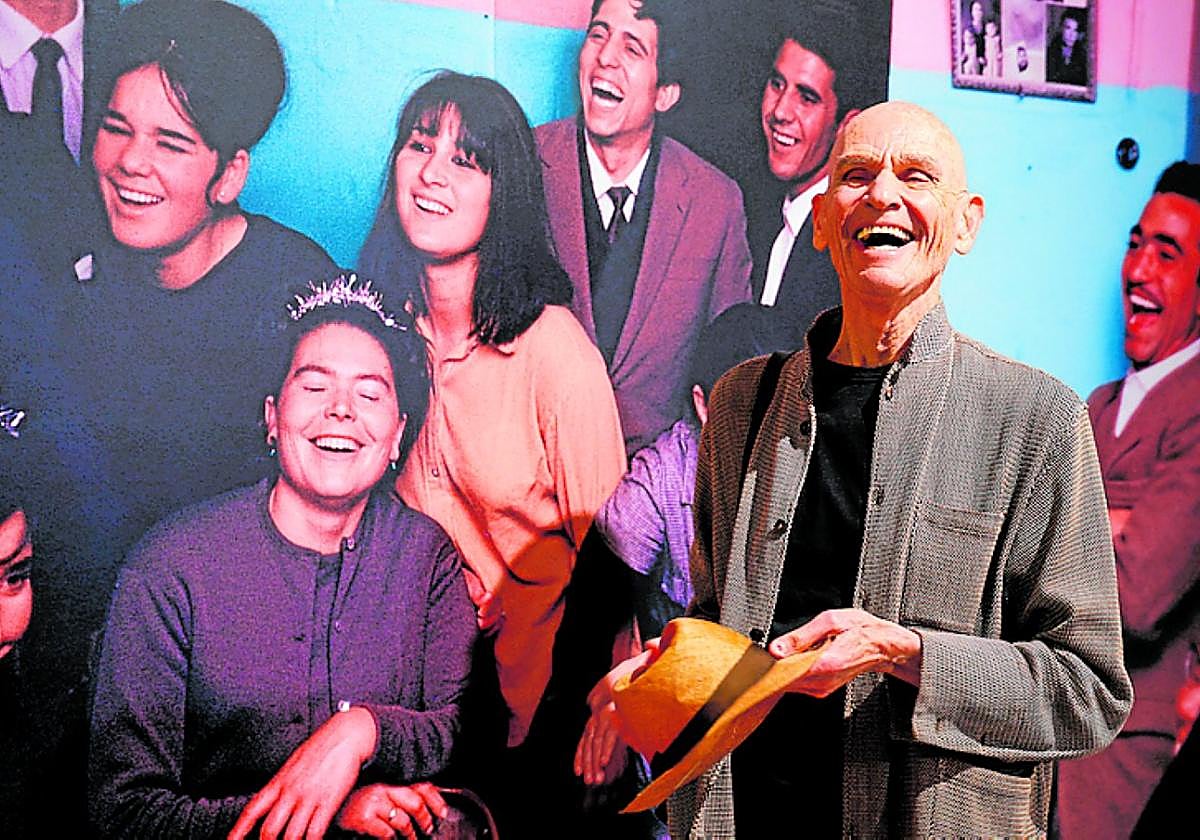
Husband and spouse took turns driving, which enabled Joel to snap up off-the-windscreen stills of roadside situations that struck him. However, beyond a shadow of a doubt, the climax of their trip was their "total immersion" in mid-sixties Malaga, where they rented a house and were immediately adopted by the Escalona family, who shared their gypsy fare and flamenco culture with them over a period of six months.
Upon returning from his European sojourn, the metamorphosed 28-year-old clinched a solo photo presentation at MoMa (Museum of Modern Art), featuring 40 of the 25,000 hitherto undeveloped images he had accumulated. More than half a century later, the Picasso Museum's replica of that first NYC accolade has the aroma of a homecoming.
Only a handful of surviving Escalonas attended the opening, but "Pepe" (as he was known to the 19 'souls' living under that family's roof) has fond memories of deeply moving "cante hondo" sessions, with Antonio (the "fierce and elegant" patriarch), Pedro (a gifted guitar player, "Tomatito's first teacher") and a regular bunch of "aficionados" forever egging them on ("They couldn't do it, but they knew everything...").
Fast-rewinding to those precious sessions, some of which he recorded for posterity, Joel aka "Pepe" recalls that it took him ages to dare to utter his first "¡Olé!" and establishes a parallel between flamenco and photography, seeing himself as his own "aficionado", 'self-wising up' to the pictorial potential of each everyday occurrence. He spots it and "talks himself" through successive imaginary frames, waiting for the prospective event to evolve, then hits the shutter: "The photograph is the ¡Olé!"
¿Tienes una suscripción? Inicia sesión