
Exhibitions in the stables and artists in the house: a Marbella country house reinvents itself as an art space
Reiners Contemporary Art connects international and Andalusian artists in a creative haven that unites tradition and the avant-garde

Marbella
From the outside it looks like an ordinary country estate, a white house on the outskirts of Marbella surrounded by greenery. But inside, everything changes. There is art in the old stables, and even in what used to be the chapel, and the rooms are home to the artists who create it.
Marbella is expanding its place on the contemporary art map with Reiners Contemporary Art, a hybrid project between gallery, artist residency and think tank that was installed a year ago at Finca Las Tinajas. A model that shuns the traditional concept of the "white cube" art gallery and instead champions long processes, curatorial support and close relationships between artists, curators and collectors.
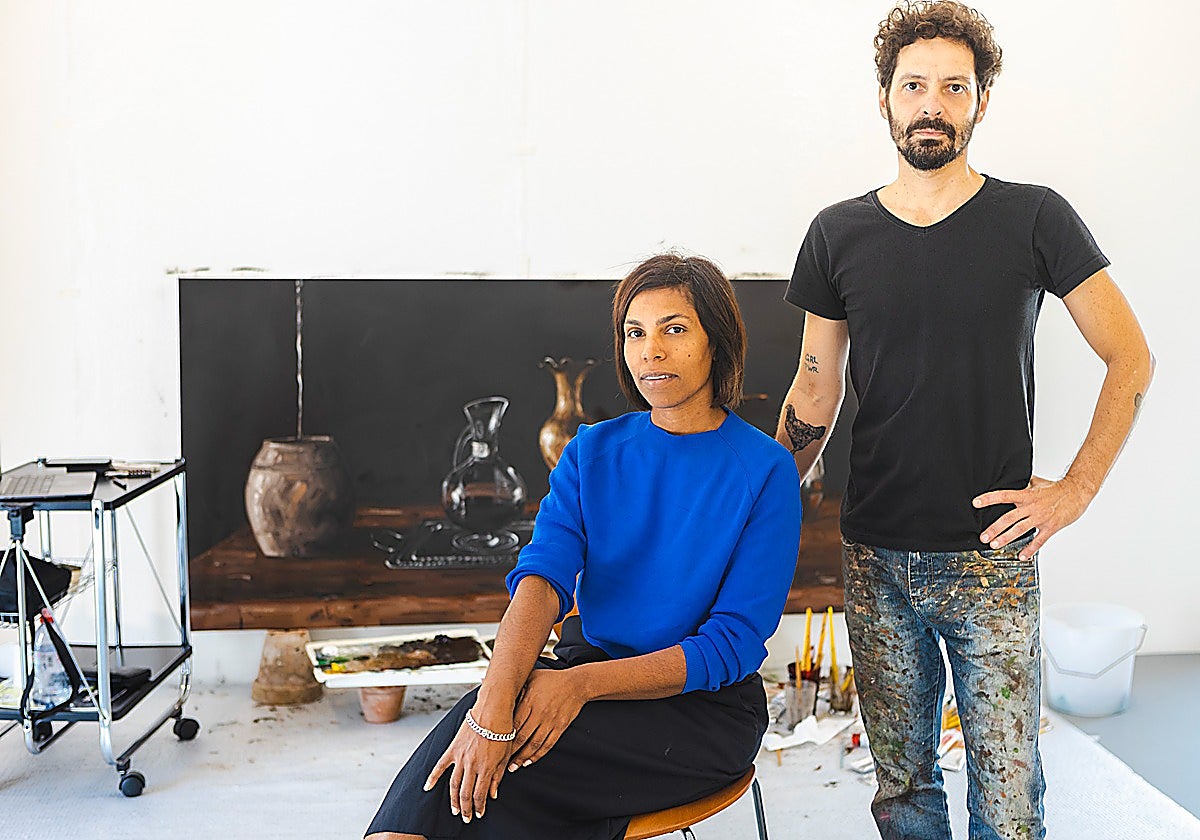
Flor Reiners, a Brazilian art historian and entrepreneur who developed her career in Germany and Brazil advising museums and private collections, leads this project. She came to Marbella for family reasons. "Having just settled in, advising museums from here was difficult. I thought that, with my contacts, opening an exhibition space and working with residencies could make sense," she explains.
Its aim is twofold: to strengthen cultural exchange between Andalucía, Europe and Latin America, and to offer artists an environment in which to develop their work with time, calm and dialogue.
The gallery-residence works by appointment only. Visitors, collectors, decorators, curators and art lovers can access a guided and personalised tour. "I needed a peculiar, intimate space. The collector wants to study the work, understand it and talk about it. This is part of the project," Reiners points out.
Exchange as the axis
The estate, self-sufficient in water and energy, has become an ecosystem for creation. The building that used to be the stables now serves as the main exhibition hall; the chapel, reinterpreted with elements of Brazilian baroque and Andalusian details, houses more experimental exhibitions. Mediterranean gardens, earthenware urns, cypress trees and dense vegetation complete a landscape that also acts as a source of inspiration.
The artists live on the estate itself or in a flat in Monda, depending on the nature of their project. Reiners finances the stay, provides materials and activates a network of contacts that allows the creators to dialogue with curators, teachers, gallery owners and other artists in the region.
Reiners is in residence with Fabio Baroli, at the time of writing this report, a Brazilian artist who is developing his second series on Andalucía in Marbella. He first worked on local vegetation mixed with the Amazonian forest, and now he is delving into a more intellectual investigation: still lifes, light and shadows inspired by the Andalusian baroque, but with contemporary elements. The first pieces will travel to Düsseldorf and São Paulo.
The exchange works both ways. Reiners also accompanies her Andalusian artists, such as the Estepona artist Quiñones, one of the most outstanding in his programme. "His work speaks of the Costa del Sol, the architecture of pleasure, time and nostalgia," she explains. Together with an external curator, Mariela Franzoni, the gallery owner has worked on conceptualising her trajectory and placing it in new markets. She explains that "Quiñones will soon be presented at fairs in New York, Miami and, foreseeably, Arco Lisbon".
A new form of relationship
For Reiners, the traditional gallery model has been left behind. "The pandemic accelerated a global trend: longer residencies, hybrid spaces and collectors seeking to accompany the creative process. Today, buying is no longer impulsive. The collector wants to talk, to understand and to feel advised. It is necessary to explain, to accompany and to reassure. A work of art is for life," she says.
Her advice to buyers is clear: "Choose artists of the same generation to grow with them because the relationship is a long-term one. My artists are my partners. The gallery expands with them and they expand with the gallery. It's a partnership," she adds.
The international trend is towards multiplicity: no longer an exclusive representative for each artist, but artists with several representatives, occasional collaborations and works that travel less in order to minimise wear and tear and guarantee sustainability. In this scenario, Reiners defends "a standard of technical and conceptual excellence". "Only excellent pieces come out of my hands or from my artists. Quality is the basis for a collector to be able to identify with them," she claims.
Reiners' personal story began by selling the work of fellow students at a German university; she later ran a company that revitalised museums in Brazil and has worked to bring art to young people.
Reiners Contemporary Art has participated in fairs such as Arco Lisboa and SWAB Barcelona, and has presented institutional exhibitions and maintains a stable programme of Brazilian and Andalusian artists.
Her greatest satisfaction, she says, comes "when an artist comes to Andalucía, is inspired by the region and that work attracts attention in other markets". "I feel like a representative of this region. On my website and Instagram I always show Andalusian objects. I am proud to open this space to collectors and democratise access to art," she concludes.
![[]](http://static.vocstatic.com/voc26/latest/assets/images/favicon/surinenglish/apple-touch-icon-57x57.png)