
Education
Andalucía's first private online university opens initial academic year from its Malaga base
Utamed's opening ceremony reflected on the challenges of higher education in a technologically-driven and fast-changing world, with 1,500 students already enrolled and the objective of "being a driving force" for educational innovation

Malaga
Higher education in the Andalucía region of southern Spain reached a milestone on Tuesday with the Atlantic-Mediterranean Technological University (Utamed) opening for business with its first academic year. It launches online with 1,500 students and some 100 academic staff (65% with PhDs). It holds the aim of "being the driving force" of innovation in higher education with the use of new technologies to adapt training to the real needs of businesses and the current productive fabric.
The students enrolled in the 11 bachelors degrees and five masters degrees that will begin this academic year have an average age of 32 years. There are more women (55%) than men, 30% live in municipalities of under 10,000 inhabitants and more than a third live in towns far from a provincial capital, which would have meant having to take on a "high" cost of living (accommodation, food and transport) if they had opted for a university that required attendance in person.
"The average cost of an academic year for a student who studies away from their regular place of residence is usually more than double the cost of the average enrolment fee at Utamed," said the rector, Juan de Dios Jiménez, during the opening of the academic year for this new university based in Malaga.
Hallmarks
At this opening ceremony, Jiménez highlighted the three hallmarks that define and differentiate Utamed: its vision and collaboration with companies to train technically qualified professionals, the application of new methodologies and technologies necessary to adapt students to current disruptive changes and the "democratisation" of higher education as it aims to "break down all barriers, whether geographical or personal, to accessing a university education, regardless of where the student lives or their situation. Being 100% online allows you to study wherever and whenever you want, eliminating fixed schedules and commuting. Furthermore, our educational model represents an improvement in social mobility, the so-called 'social elevator', training people who, until now, had no access to university education."
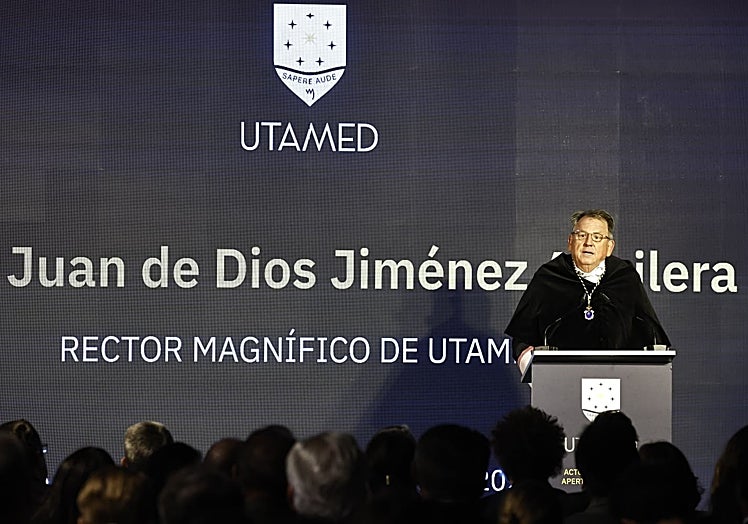
The university rector also praised the "titanic" effort made over the last two years, following authorisation from the regional government, to set up the educational processes, creating a faculty that combines academic backgrounds with business experience, creating "proven" content with active professionals and incorporating innovative teaching methodologies and technologies that foster more personalised and motivating learning systems. "We have developed an internal quality assurance system so that our procedures ensure a high-quality educational service," he added.
55%
of the students are female
Juan de Dios Jiménez emphasised the "very firm and decisive" commitment to research with initiatives such as the creation of the scientific journal Joinetech, the organising of the ACIEK International Conference in 2026, participation with eight European universities in an entrepreneurship project and Utamed's incorporation into the European doctoral programmes in international economic relations and education and communication sciences.
"We aim to break down all barriers, whether geographical or personal, to accessing a university education, no matter where the student lives or their situation," says Utamed's rector, Juan de Dios Jiménez.
The opening ceremony for the academic year provided a framework for reflecting on the challenges of higher education in a technologically-driven and fast-changing world. Thus, the president of Utamed's board of trustees, Bernardino León Gross, maintained that, in the face of a situation of uncertainty about which academic model will prevail in the academic world in the future, "we do know how we should prepare ourselves to face it". "In this institution, we are committed to ambition and enthusiasm, a willingness to change and a demand for quality to consolidate a university model that is useful for students and society," he stressed.
In this regard, León Gross emphasised the role that the board of trustees must play as a bridge between the university and society to address challenges such as responding to technology and artificial intelligence, strengthening relationships with the productive fabric and business community and making study programmes more targeted to attract talent. "The university is and must continue to be a pillar of equal opportunity and meritocracy", said the Spanish diplomat, expressing his confidence that Utamed will be "an example of innovation, a space for critical thinking and a guarantor of social cohesion".
"The university is and must continue to be a pillar of equal opportunity and meritocracy," said Bernardino León Gross
For his part, Utamed president Paco Ávila reviewed the road travelled, where they have had to endure "a lot of criticism", to which they responded by staying the course because "we knew where we wanted to go and we did what we know how to do: work to move our project forward." "Don't live your dreams, make them come true", he stressed.
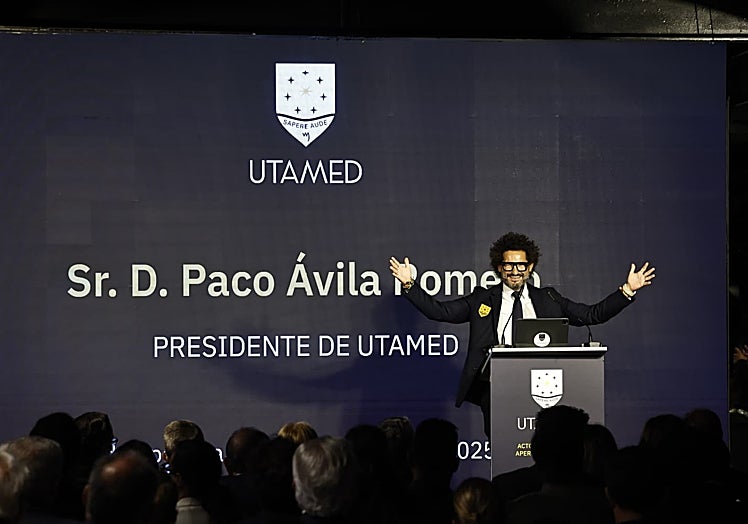
Ávila made it clear that Utamed has come "to compete, to improve our land, to enhance talent and human capital" and has extended a hand to other universities to collaborate in a time marked by competitiveness. "Compete, compete... what a wonderful and healthy word. And we do so with an outstretched hand to all universities, public and private, to cooperate and raise the level of education together," he stressed. He also encouraged fellow universities to compete "against the real threats" which, in his opinion, are nationalism and authoritarian regimes that want to eliminate the values of the Western world.
"We come to compete and we do so with an outstretched hand to all universities, public and private, to cooperate and raise the level of education together," said Paco Ávila
Meanwhile, the president of Malaga's provincial authority, Francisco Salado, and the Junta's secretary-general for universities, Ramón Herrera de las Heras, agreed that the coexistence between public and private universities is "good and necessary".
Salado noted that Utamed is here to "meet the demands of students and the labour market" and to help "a lot of undiscovered talent" to gain training opportunities that they otherwise would not have. Meanwhile, Herrera praised Utamed's "enthusiasm and quality", pointing out that the true university reform in Andalucía has been to give universities the tools - in the form of degrees - to adapt to the realities of the labour market.
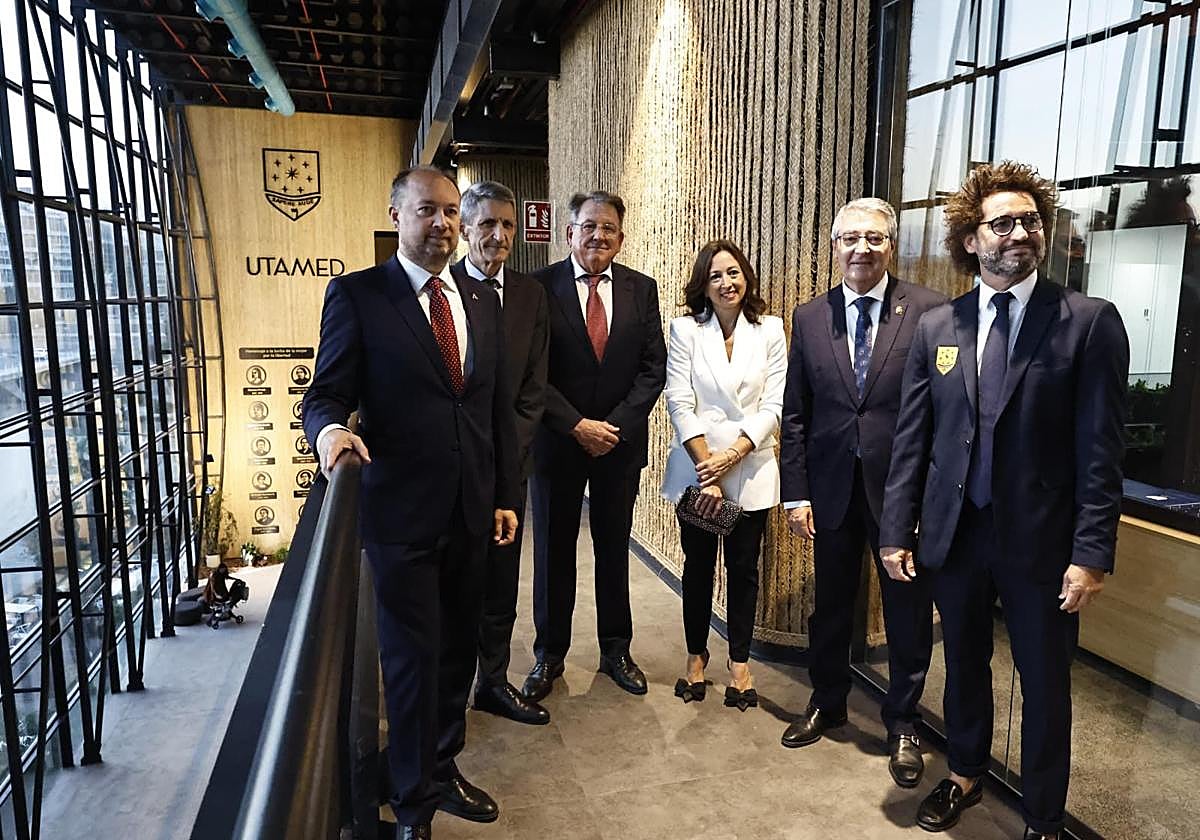
Some 500 attendees participated in the opening ceremony for the academic year, which also served as the setting for the inauguration of Utamed's headquarters, located on Malaga's technology park. This building, with more than 7,000 square metres, was designed as an integrated campus and renovated by the Flow81 architectural firm.
The opening ceremony, hosted by TV presenter Toñi Moreno, began with a performance of Gaudeamus Igitur by the Malagaharmonía string trio, featuring soprano Elena Alcaide, who also closed proceedings with the regional anthem, the Hymn of Andalucía. The musical segment was completed with a performance by the duo Javipablo, formed by Malaga-born brothers Javier and Pablo Imbroda. During the ceremony, Utamed's CEO, Miguel Reinoso, presented awards to the building's architectural team, led by Ignacio Merino and to representatives from Utamed's various departments. The event concluded with a catering service provided by Derraiz.
![[]](http://static.vocstatic.com/voc26/latest/assets/images/favicon/surinenglish/apple-touch-icon-57x57.png)