
Motoring
When will Malaga start issuing fines for polluting vehicles entering the city's low emission zone?
As the one-year "period of grace" nears its end, ZBE controls will soon be tightened up for vehicles registered outside the capital of the Costa del Sol
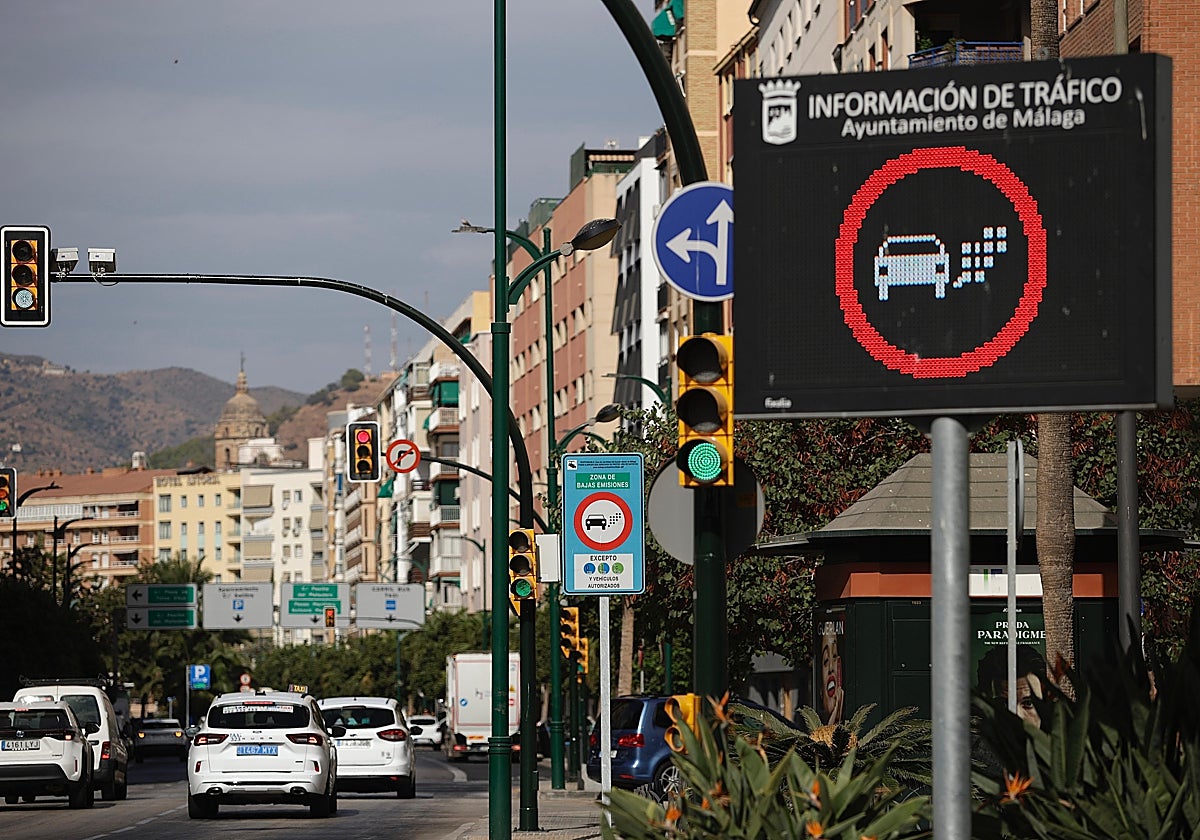

The entry into operation of the low emission zone (ZBE) for traffic in Malaga city, following a double consultation process, is one of the issues that has raised the most questions among drivers. Motorists ask when and who will be fined, what are the possible scenarios for fines, how does the vehicle's licence plate affect the decision and what does your place of residence have to do with it? All of these questions have already been answered but, first and foremost, it must be made clear that this restricted area has actually been in operation since the end of last year. However, the first 12 months have been a period of grace, meaning zero fines have been issued - up to now. This will begin to change shortly, albeit in a gradual and staggered manner.
Not to be confused with Malaga city's restricted traffic zones
The first thing to point out, as it generates some confusion, is that the ZBE is not the same as the traffic-restricted zones resulting from the semi-pedestrianisation of the historic centre, Soho and the Álamos-Carretería intersection. Only expressly authorised vehicles can access these areas. This is not merely an environmental issue. In recent months these three areas, especially around Carretería, have haemorrhaged fines. As SUR reported in July, up to 157,500 fines were imposed in just one year. One of the keys is that the byelaw is complex, cumbersome and loaded with assumptions. Also, it is just as important to prevent improper access, marked in fluorescent yellow, as it is to prevent improper exits, marked with grey signs and a crossed band.
Exhausting the vehicle's useful life
With this caveat, the low emission zone will begin issuing fines on 30 November this year, according to municipal sources. The philosophy behind this approach is that those who pay road tax in the provincial capital can exhaust the useful life of their older vehicle without having to spend money on a more environmentally friendly one. However, those with a B sticker or lower cannot be transferred when sold on and the buyer would lose the right to unrestricted ZBE access. To summarise, for at least the first five years, there is no problem for Malaga city residents.
No car sticker and from outside Malaga city
Fines imposed between 30 November this year and the same date next year will focus on cars and motorcycles without an environmental sticker that are registered outside Malaga city. Vans have a three-year reprieve once the first year of this regulatory framework, still in effect, has almost expired.
The definitions are somewhat broader, but it can be summarised as follows: petrol vehicles registered before 1 January 2000 and diesel vehicles registered before January 2006 have no sticker. In any case, it is very easy to find out about a vehicle's applicable sticker. Simply go to the website of Spain's Directorate General of Traffic (DGT) and type in the registration number. It is automatic and free of charge. It is also important to note that it is not mandatory to physically display the sticker on the vehicle, as the systems operate through cameras and number plate readings. All municipalities that apply these ZBEs are connected to the national DGT database.
Which streets are affected?
The boundaries of the ZBE in Malaga are the following streets: Paseo Marítimo Antonio Machado, Avenida Ingeniero José María Garnica, Calle Explanada de la Estación, Plaza de la Solidaridad, Avenida de las Américas, Avenida de la Aurora, Jardines de Picasso, Avenida de Andalucía, Calle Compositor Lehmberg Ruiz, Calle Hilera, Calle Santa Elena, Calle Honduras, Calle Arango, Calle Martínez Maldonado, Avenida de Barcelona, Plaza del Hospital Civil, Avenida Doctor Gálvez Ginachero, Calle Mazarredo, Avenida del Arroyo de los Ángeles, Paseo de Martiricos, Calle Huerto de los Claveles, Calle Marqués de Cádiz, Calle Juan del Encina, Calle Empecinado, Plaza Capuchinos, Alameda de Capuchinos, Plaza Olletas, Calle Toquero, Calle Obispo González García, Calle Amargura, Calle Ferrándiz, Paseo Salvador Rueda, Calle Rafael Pérez Estrada and Paseo Marítimo Pablo Ruiz Picasso.
However, public passenger transport services, taxis and VTCs (prebooked vehicles with driver - private taxis, limos and so forth), vehicles classified as historic in accordance with Royal Decree 1247/1995 and lorries all have free access across the ZBE. The same applies, subject to prior notification and verification, to healthcare services, all emergency services (police, fire, state security and so on), municipal services and private services of special need (private security, removal services, funeral homes, cash-in-transit services and so on).
Previous data
According to the municipal studies that accompanied the ZBE byelaw, the aim is to remove more than 26,000 vehicles from the central area of Malaga city. In the long term, 15 years, it is estimated that some 40,000 vehicles per day would be removed from these streets, meaning 20% less through-traffic.
Around a quarter of the vehicles circulating in this area come from outside the city of Malaga. They are undoubtedly the most affected by these regulations. It is estimated that there are more than 50,000 daily movements, of which a quarter would not be eligible for a sticker and thus would be directly affected by the changes on 30 November.
What is the breakdown of vehicle types that currently circulate these streets? The most common sticker is the C one (40.4%), followed by the B category (31.1%). Almost one in four cars has no sticker. As for eco and zero-emission cars, they only account for 3% and less than 1% respectively.
![[]](http://static.vocstatic.com/voc26/latest/assets/images/favicon/surinenglish/apple-touch-icon-57x57.png)