
Spain 11-N strike
Spain's general strike has little impact in Malaga: shops and bars remain open and public services operate at almost 100%
The trade unions estimated that over 60% had taken part in the strike, while the CEM employers' organisation said that participation had been "minor"
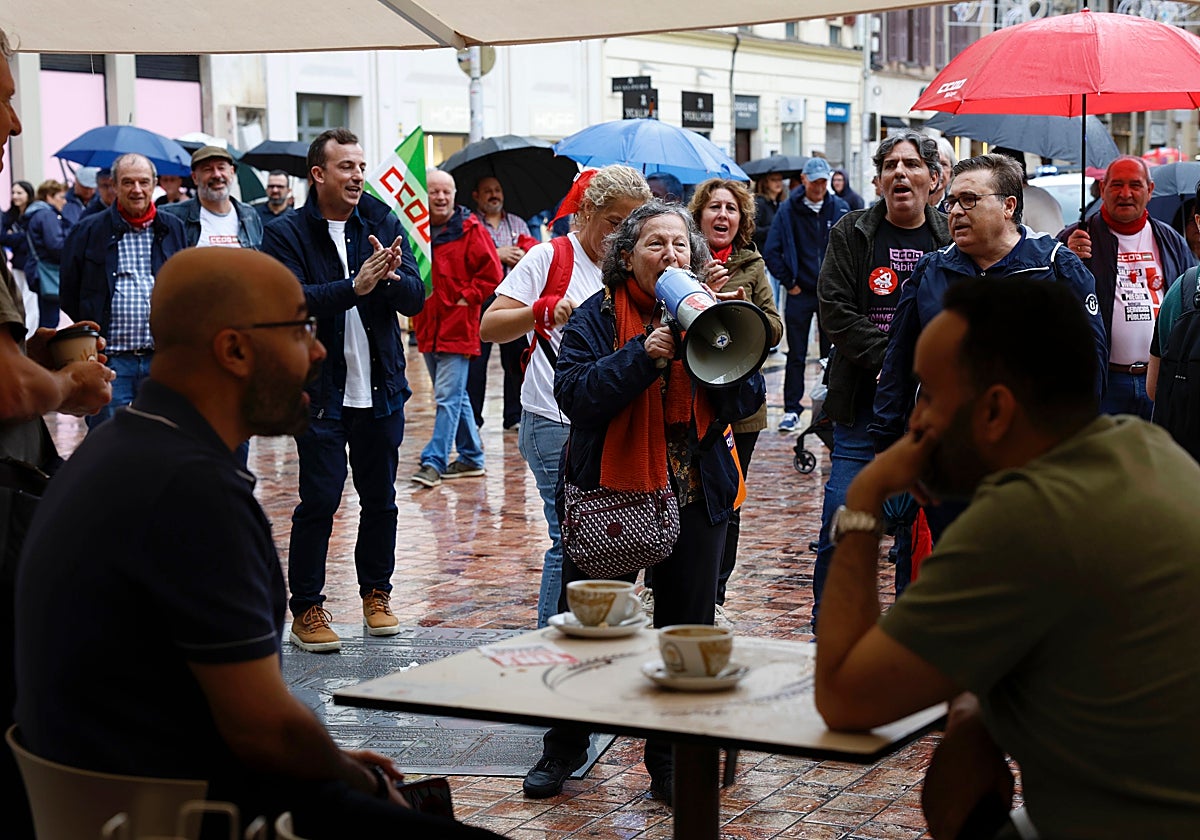

The general strike over the housing price and cost of living crisis has not had much impact in Malaga city and province. The majority ... of shops, bars and restaurants were open, although they closed temporarily as information picket lines passed by, only to reopen shortly afterwards, and civil servants from various public services were working remotely from home or in the office and carrying out their duties as normal.
There was little disruption to healthcare and education, transport running almost as usual, the cultural sector operating at half-capacity and a 10% drop in the number of workers travelling to industrial areas, as well as just 14 flights cancelled at the Costa del Sol Airport.
As is the case on every day of a general strike, trade unions and employers' organisations disagreed over the turnout figures. The CCOO and UGT put the turnout in the province at over 60%.
By contrast, the CEM employers' organisation said that participation was "minor across all sectors, as the normal functioning of economic activity in the province, particularly within the private sector showed". It based its observations on electricity demand for Andalucía, which on Wednesday morning showed a 6.5% fall compared with the same day the previous week and a 0.9% fall compared with Tuesday.

Electricity demand in Spain, which is one of the indicators commonly used to measure the success of strikes, fell by 2.6% compared with 12pm the previous day. Demand also fell short of Red Eléctrica's forecasts: by 5.35% at midday and by 2.37% at 2pm. Although these figures are national, they can be extrapolated to the situation in Malaga.
At a press conference in Plaza de la Constitución at 11am on Wednesday, CCOO general secretary Fernando Cubillo and UGT general secretary Antonio González explained that participation in the strike varies by workplace and by sector.
Cubillo noted that in the hospitality sector participation stood at over 75%, while in the education sector it was 52%. González highlighted that there was strong support for the strike in the public sector, as well as at Mercamálaga and the transport hub. Furthermore, González mentioned that the trade unions' nighttime action had led to the closure of most leisure venues.
The CEM employers' organisation explained that the follow-up analysis must take into account the impact of working from home and the bringing forward of logistics and freight transport operations, which helped reduce the usual number of journeys to workplaces, as well as the general caution the weather forecast had prompted.
CCOO condemned the minimum service requirements that the authorities had imposed, particularly in certain sectors, and announced that it would take legal action to overturn what it described as excessive measures that curtail the right to strike.
There were isolated incidents of tension with picket lines on the streets of the city centre, at Mercamálaga, on Avenida Juan XXIII and on the Carretera de Cádiz. The Local Police have confirmed four arrests, although the government sub-delegation has denied links to the strike in the case of three of these arrests.
Tourism
The impact on tourism was minimal. The most notable development was the cancellation of 14 flights at Malaga Airport, on a day when the airlines had scheduled 324.
The Aena airport operator highlighted the absence of incidents at the airport, where airlines had rescheduled operations in the days leading up to the event to rebook passengers affected by these cancellations.
In hotels and travel agencies, the general strike passed without any disruption. Aehcos (the Costa del Sol hoteliers' association) stated that the strike had had "no" impact whatsoever.
Similarly, president of the Malaga travel agents' association Sergio García stated that the general strike had "failed" in this sector, where offices opened as normal and staff dealt with customers' enquiries.
Retail
The main shops and businesses in Malaga and the shopping centres across the province opened, although many of them were forced to close their premises as the picket line passed by.
The news crew focused on reporting from Calle Larios and Plaza de la Constitución, where there were moments of some tension. In that area, the vast majority of shops were forced to close their shutters temporarily, although they subsequently resumed business as usual.
The El Corte Inglés shops and the province's main shopping centres also operated as normal.
Hospitality
Bars and restaurants in Malaga also operated almost as if it were a normal day, with outdoor seating areas open and no incidents or pressure from the picket lines. There were few customers, however, and they were mainly foreign tourists, although the bar and restaurant owners interviewed said they were able to carry on with business without any problems and that they were not put under any pressure.
Some establishments even chose to operate behind closed doors or give their staff time off to avoid any potential incidents. According to business owners in the sector, the cancellations of table bookings and the lower footfall appeared to be due more to the rain than to the strike.
Public services
Support for the strike in the public sector was very low. In the regional government of Andalucía, it barely reached 0.5%, with 27 staff members failing to provide a valid reason for their absence out of a provincial workforce of 5,474.
In the city council, the rate stood at 5.31% (428 employees out of a total of 8,048), while in municipal companies it was 4.56%, with 198 participants out of 4,339 workers.
Healthcare
The strike was supported by 3.81% of staff in Malaga's healthcare sector during the morning shift, with 540 workers taking part in the industrial action, according to figures from the SAS (Andalusian health system).
Hospitals and health centres operated as usual, with no notable incidents in Malaga city. Apart from a few incidents in Benalmádena and Ronda, the Clínico hospital maintained all its scheduled, emergency and priority surgical procedures, as well as outpatient consultations and oncohaematological treatments, while Hospital Regional did the same and reported hardly any problems.
During the afternoon shift, the monitoring rate in the province stood at 3.14%.
Education
State primary and secondary schools also opened on Wednesday without any problems. According to figures the schools' management recorded, 1,205 teachers went on strike out of a total workforce of 19,443 in nursery, primary and secondary schools in Malaga. In other words, 6.2% of them took part in the strike.
Schools saw a slight drop in attendance, not only because of the strike but also due to the threat of rain. The schools informed parents that they would not be covering any new material.
The lecture theatres at the UMA (Malaga University) were empty on Wednesday morning. There was also a rally, which students and lecturers had organised.
Transport
The public transport network operated smoothly, even exceeding the minimum service levels the authorities had set, with the EMT and the metro operating at 100% of their capacity, intercity buses reaching 90% and the commuter rail service experiencing occasional delays.
Taxi associations reported no incidents. According to the regional government, there was no strike action at the metro construction sites.
Business parks
The general strike barely had any impact on the city's business parks, as president of Apoma (association of industrial and commercial areas in Malaga) Sergio Cuberos confirmed.
He put the level of staff absenteeism at approximately 10%. Large distribution companies remained open, although there were picket lines in the Guadalhorce area.
Culture
Before 10am, the queue outside the Picasso Museum was already stretching towards the church of San Agustín, just like every day. At the same time, at La Aduana, a group of tourists was passing through the gate to visit the province's archaeological and art collection.
The city's art galleries and cultural centres operated as normal, with the streets full of tourists oblivious to the protest. Only one sector of the cultural scene largely joined the strike: Malaga's main bookshops.
