
Technology
Nasa hackathon in Malaga: a 48-hour space mission with its feet firmly on the ground
Nearly one hundred people competed in the Nasa Space Apps Challenge from Campus 42 Málaga, which was held simultaneously in 350 cities around the world

Malaga
A 'hangover' atmosphere lingered in the ultra-modern campus of the Campus 42 programming school in Malaga on Sunday, 5 October. Empty bottles of juice and milkshakes, boxes of biscuits with only some crumbs and sugar left inside were piled on the tables of the Tabacalera building. Sheets, pillows and sleeping bags were left in disarray on top of the beds of the campus that is open 24/7. Groups of young people could be seen walking around with sleepy faces, but they had not been partying. Instead, the campus had just hosted an almost sleepless weekend and 48 hours of the Nasa Space Apps Challenge. Every year, thousands of 'astrohackers', as the organisation calls them, from all over the world gather for this hackathon and this was the third consecutive year that the challenge also took place in Malaga, with 89 contestants.
Nasa Space Apps Challenge is the largest Stem hackathon in the world, with 250 events taking place in 80 countries. The American space agency has a special power of attraction for lovers of technology, science and space. "Who hasn't dreamt of being an astronaut when they were a child," says Román, a member of one of the 18 teams that took part in the challenge in Malaga. He and the four other young people - Candela, Macorís, Eulogio and Javi - are software engineering graduates and students at Malaga University. They were very focused on finishing their project - Stellar Mind AI - before 4pm. The proposal they were working on responds to the challenge of creating a functional web application that uses AI, knowledge graphs, or other tools to summarise Nasa's 608 life sciences publications and allows users to explore the results of the experiments described in those publications.
19 challenges to choose from
This was only one of the challenges, but there were 19 from which contestants could choose, among them searching for exoplanets with artificial intelligence, developing a mathematical framework to track shark life in the ocean or creating recycling systems for Mars. The competition offers participants the opportunity to directly access Nasa data, as well as data from its partner space agencies.
It is an engaging experience that brings back participants from previous years. One of the winners of last year's competition - Leia - was participating with another team this year. They chose the Data Pathways to Healthy Cities challenge. "Using data from Nasa satellites, we analyse different parameters within the map of the city that can affect the health and safety of its inhabitants: from heat to the risk of flooding, pollution, proximity to green areas...," Leia explained. She and her classmates are, like many of the participants in the hackathon, students from the Campus 42 Málaga academy.
There are some familiar faces among the volunteering mentors too. Fernando Borrego, who was a contestant in Seville two years ago, participated as a mentor there last year. This year, he came to Malaga. "They are very young and have a lot of initiative and an incredible technical level. It's amazing how some of them, being only 13 or 14 years old, ask me questions I don't know how to answer," the computer engineer said.
Among his partners during this year's hackathon in Malaga was Celeste Sánchez, who was part of one of the ten teams at the Nasa Space Apps Challenger world final last year. Her team designed a suit for astronauts travelling to Mars and she is still working on it. Sánchez praised the concentration and efforts that the contestants put into their projects this year.
The winners
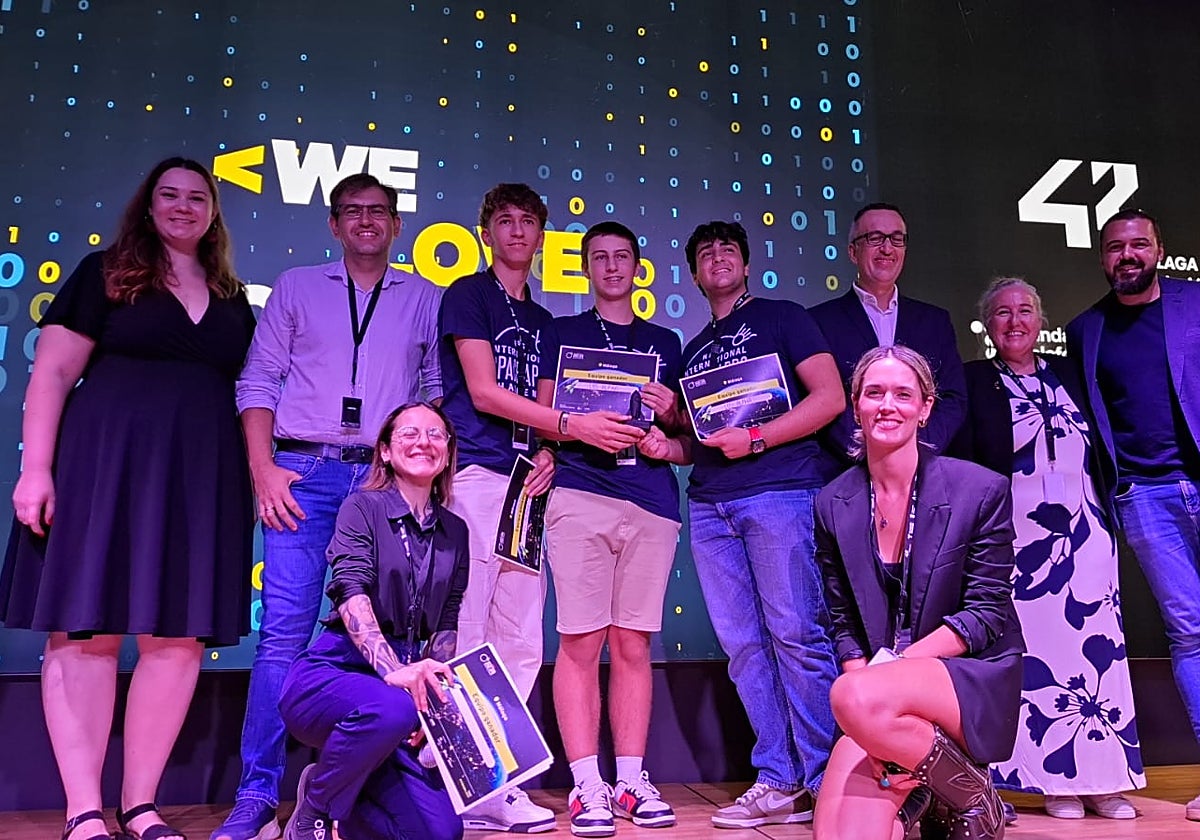
The 48 hours of programming, nerves, research and debate culminated on Sunday with the presentation of the projects. All teams made a pitch and showed a video of their proposal. The first of the two winning teams was announced around 7pm: Los Alpha, formed by Gonzalo García, Jesús Pérez and Emilio Domínguez. All three are 15-year-old students at the La Asunción school. Their proposal presents an app that consults small farmers on soil analysis, incorporating AI and satellite data to replace conventional sensors. The other winners will be announced in a week. Both teams will move on to the next phase of the competition, where they will compete with others to go to the final.
![[]](http://static.vocstatic.com/voc26/latest/assets/images/favicon/surinenglish/apple-touch-icon-57x57.png)