
25 November: International Day for the Elimination of Violence Against Women
Malaga raises its voice against gender-based violence and denialism
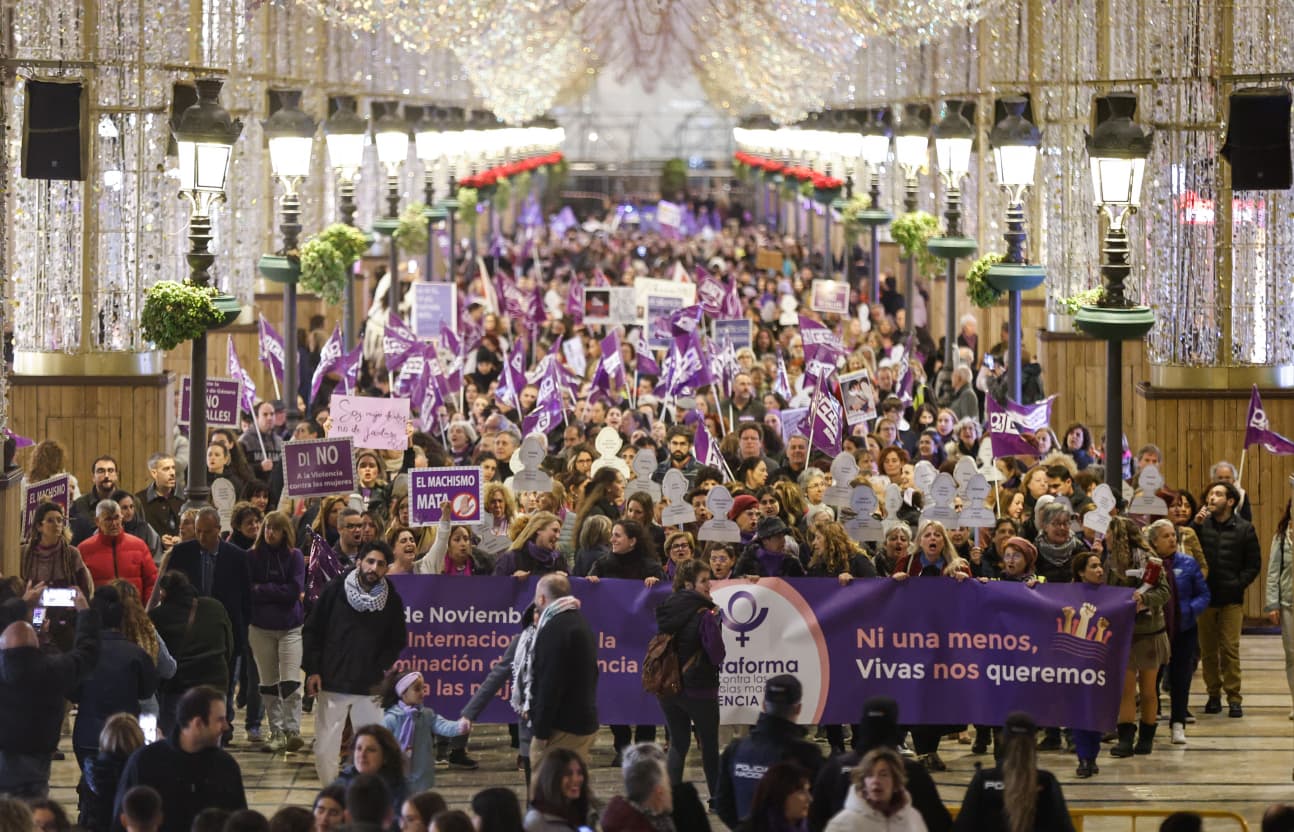
Thousands of people took part in the commemorative march in the city to mark 25 November

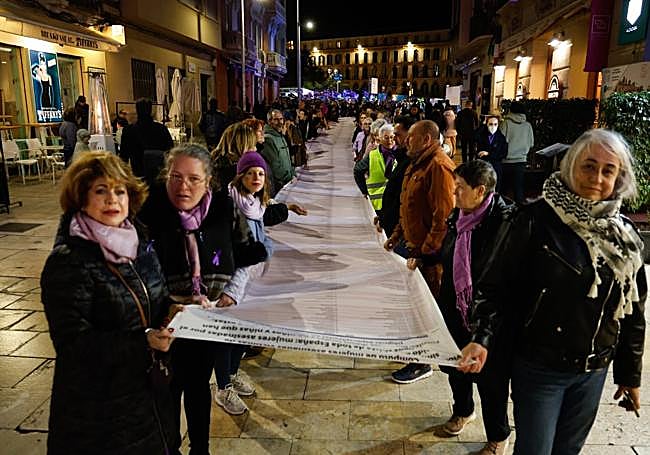
Every 25 November, Plataforma contra las Violencias Machistas 'Violencia Cero' takes out a huge banner with the names of all the women murdered in Spain by the patriarchy since the first official records from 2003. There are now more than 1,300 fatal victims.
The first in the list is Diana Yanet, whose partner threw her off the balcony in Fuengirola on the eve of Three Kings' Day. The latest victim is María Victoria, whose ex-husband stabbed her to death in Rincón de la Victoria just a few days before the match.
Malaga's prominence in the statistics is tragic. Time goes by and gender-based murders do not seem to stop. According to the police, at least 2,000 people joined the protest, while organisations claim that there were more than 4,000 people.
Moments before the demonstrators left Plaza de la Merced to march through the city centre, attendee Isabel Marín said that she has been denouncing gender-based violence on the streets for more than 30 years, since before the murder of Ana Orantes - the victim who shook the country with her death at the hands of her husband shortly after sharing her testimony on television. Her murder prompted the legislative wave of protection for women at the beginning of the 2000s. "We came with our daughters and some of them are already lawyers in Madrid, imagine that," Marín said.
Although she hasn't witnessed many changes since then, Marín doesn't let her frustration stop her from protesting. Instead, she keeps fighting. Generations of women keep attending the 25 November march.
This was the first protest of this kind for 28-year-old María Ramos, who joined just in time to see the end and hear the statement read in the Plaza de la Constitución.
"It is moving to know that the murdered women are being remembered. I like the fact that the focus is put on men, who are to blame for all this," she said. Ramos, however, was alone, although she would have had people to attend such a march with in the past. "Anti-feminist sentiment is growing," she warned.
Denial
There is a growing trend of denial of gender-based violence, which was one of the main points the demonstration addressed. President of 'Violencia Cero' Carmen Martín told SUR that the protest wanted to draw attention to the expressions of violence that take place on social media and how denialism runs through them. According to Martín, this "is doing a lot of damage, above all among young people".
"The truth is that it is a drop that is permeating society as a whole," she said. Another of Martín's concerns are the courts, which she urged to "stop boycotting the law". "We have a good legislative framework, but some people are reluctant to apply and monitor it," she said.
'We have a good legislative framework, but some people are reluctant to apply and monitor it'
Among the demonstrators, generations of women from the same family could be seen marching together, despite the weather and the strong wind. Marta Galiano Sanz was with her mother, sister and little niece. She said that she hopes the little girl "would live differently", although she often gets disillusioned. Working as a teacher, she often witnesses how the 'manosphere' shapes young men, "in school and on social media". "It seems that this is cyclical, that feminism takes a few steps forward and then back again," she said.
Protesters of the opposite sex were a glimpse of hope. Mikel Sarrionandía, 22, is just at the critical age when, according to statistics and surveys, he could be influenced by messages that deny gender-based violence and that even make men look like victims of feminism, rather than liberated by a shared goal that seeks to emancipate them from a masculinity that is also oppressive.
"People are dumbed down by technology, but my acquaintances who deny gender-based violence do so because they already lived in an environment prone to those ideas. I don't spend a lot of time convincing them otherwise. Maybe it's selfish of me, but I don't want to argue, I don't think it's going to get me anywhere," he said.
'People are dumbed down by technology, but my acquaintances who deny gender-based violence do so because they were already living in an environment prone to such ideas'
Nico Sguiglia from Con Málaga was walking alongside this young man. "Our motto is that feminism protects us, that the more feminism, the more freedoms. And this also challenges us men: we want free women and men who are not afraid. Young men connect with far-right messages. We, on the left, don't listen to them and have to start challenging them," he stated.
Secretary general of the PSOE party in Malaga Josele Aguilar was equally concerned. "Unfortunately, denialism is gaining ground and becoming contagious. Faced with this, we have to develop more feminist policies," he said. In the morning, the four administrations - the state, regional, provincial and local - held a joint institutional act in condemnation of male violence, in support of feminist associations and against denialism, which is more or less explicitly blamed on hard-right party Vox. In response to SUR's questions, Aguilar also accused the PP party: "Let them carry on like this and not endanger women's lives just to compete with Vox."
Mayor of Malaga at the demonstration
Malaga mayor Francisco de la Torre also joined the demonstration in the evening, from Calle Alcazabilla to Calle Císter. Some demonstrators used the opportunity to remind him of the PP's pacts with Vox, as well as other issues in the city, such as excessive tourism and the housing crisis. De la Torre was accompanied by councillor for social rights Paco Cantos who told SUR: "We come every year. It's not an obligation, it's how we say 'no' to gender-based violence. There can be no ideology here."
Cantos used Aguilar's presence to denounced the PSOE's approval of the 'only yes is yes' law, which led to reduced sentences for sexual aggressors. "They passed it so they could stay in La Moncloa," he said. Despite these differences, the two parties are united in their unequivocal condemnation of male violence.
Among the messages shouted by protesters were: "They are not dead, they are murdered"; "Complaint filed, woman murdered"; "Less confraternities and more mammograms."
'Men take advantage of any moment to claim their own. Today, the focus has to be on us'
Malaga residents of Palestinian origin also joined the protest, just like feminists have accompanied them so often in their protests. "We want freedom for everyone," they said when asked why they had decided to attend.
But women do not want to lose the limelight on their day. María Pérez and Rocío García denounced the focus shift to other topics when they saw a young man selling copies of an anti-fascist magazine. "Men take advantage of any moment to claim their own. I am also anti-fascist, but they always parasitise and phagocytise us. Today, the focus has to be on us," they said.
Demands of the feminist movement in Malaga
Murders are the most brutal expression of gender-based violence, but the statement that was read out in Plaza de la Constitución also emphasised other concerns: the increase in sexual violence, especially executed by young men and "voracious consumers of pornography"; Spain's leadership in the EU in terms of prostitution; births of children via surrogacy despite the practice being illegal in Spain.
The statement listed the march organisers' demands: greater resources and involvement of the state security forces to prevent gender-based violence; training in equality in the justice system and in education; free abortion in the public health system; justice and reparation for those affected by the failure of the electronic-tag system; an abolitionist law on prostitution; laws against new forms of digital violence.
This is the fourth year in which there are two different demonstrations in cities such as Madrid or Seville, due to the rift that opened within the feminist movement when the trans law was being processed, given the way the text defined gender (more as a choice than a social construct).
There was also a resurgence of disagreement regarding prostitution, since among feminists there is an abolitionist sector and another that advocates for its regulation. In Malaga, a single march that brings together all viewpoints still prevails, which women's associations in the city consider an achievement.
![[]](http://static.vocstatic.com/voc26/latest/assets/images/favicon/surinenglish/apple-touch-icon-57x57.png)