
Health
Malaga hospital gets the most advanced neurosurgery operating theatre in Andalucía
The hybrid facility allows patients to undergo MRI scans during surgery and helps doctors understand whether or not the brain tumour has been completely removed
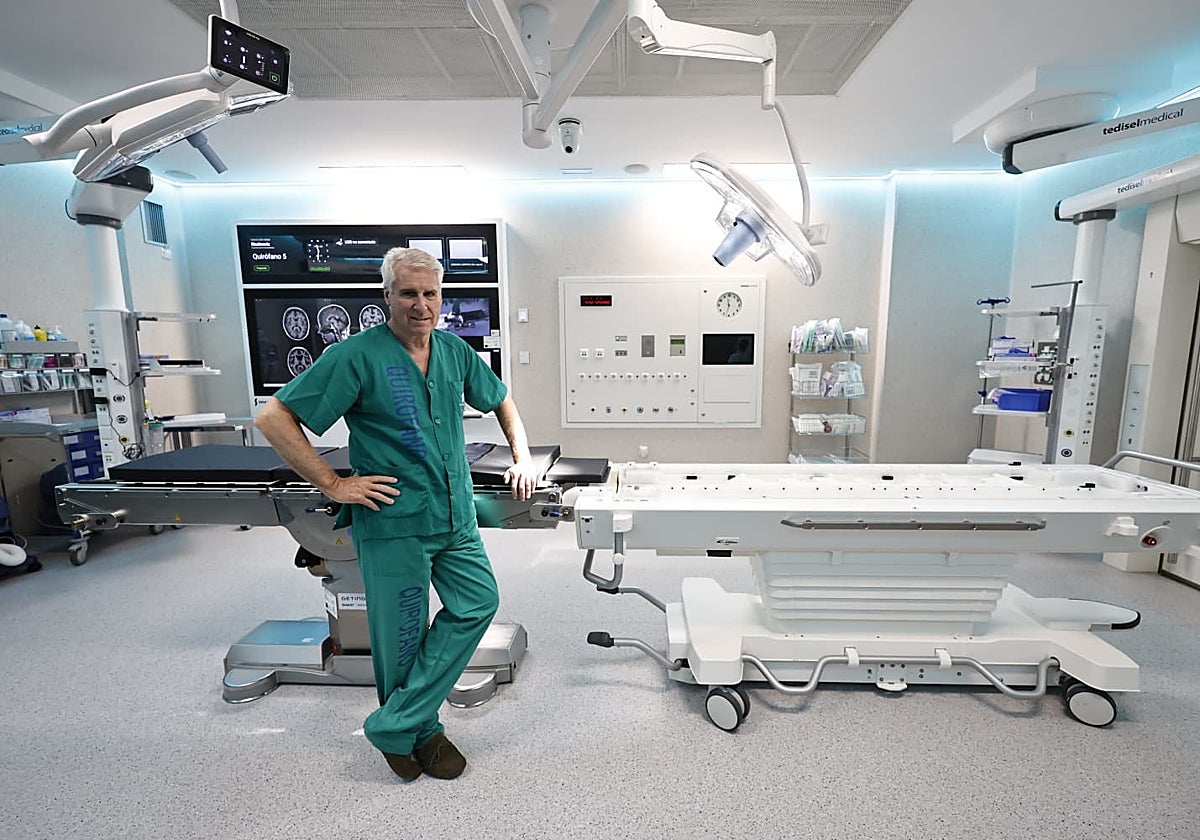

"It is a real dream for any neurosurgeon to have the most advanced operating theatre possible," says head of the neurosurgery department at Hospital Regional Universitario in Malaga Dr Miguel Ángel Arráez. His and his colleague' dream has come true with the opening of a hybrid operating theatre with intraoperative magnetic resonance imaging at Hospital Materno. The unit - the operating theatre of the future of the 21st century, as Dr Arráez likes to say - is the first of its kind in Andalucía and one of a few in the whole country. It will mainly be used for highly complex surgeries and tumours, especially brain and spinal cord tumours, but the casuistry is much broader.
The facility has cost 2.7 million euros and the refurbishment of more than 160 square metres in a semi-basement of the Materno hospital in the city. The idea first crossed Dr Arráez's mind nine years ago, when the centre's management team planned to install magnetic resonance equipment. "We saw that there was the possibility of building an adjacent surgical area. The next step was to ensure that the MRI had special features, including a motorised door that allows patients to enter and exit through a different procedure than the usual," he says. The operating theatre was built, "with some novel characteristics": the room is adjacent to the MRI so that a special mobile table can transfer the fully anaesthetised patient, with their head still open, to the MRI, where the doctors can check how much of the tumour has been removed.
Technological investment
"In certain tumours of the nervous system we can see perfectly well with the surgical microscope that the removal has been carried out completely. But in other cases concerning the brain, it is as if we were working inside a gelatinous substance, a kind of custard, a little more compact, which allows us to know very little about the area in which we are. We usually take references with a series of equipment such as intraoperative ultrasound scans, etc. But the test that really gives us confirmation that the removal has been carried out completely, in certain tumours that we call intrinsic, which come from the nervous system itself, is intraoperative magnetic resonance imaging," Dr Arráez says, highlighting the significant technological investment that has been made with this ambitious project.
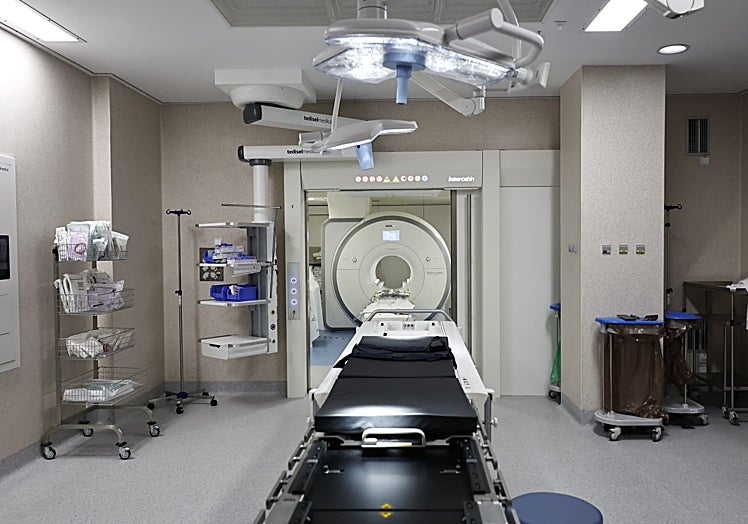
According to the head of the neurosurgery department, the Malaga unit is the best in Spain. The new operating theatre will be used for interventions in both children and adults. "The use is primarily intended for tumour lesions, although it extends to any surgical procedure in which an intraoperative image is useful. We must remember that magnetic resonance imaging is used for what we call soft tissues, such as the brain or the spinal cord, because for intraoperative analysis of other structures also familiar to the neurosurgeon, such as the skull, the cranial bone and, above all, the bones of the spine, we already have another hybrid operating room equipped with an intraoperative CT scan," Dr Arráez explains.
Reducing the rate of re-interventions
The operating theatre has state-of-the-art equipment such as a neuronavigator, a neurosurgical microscope, a surgical table, a cranial fixation system compatible with magnetic resonance imaging, as well as the motorised door that connects the operating room with the MRI room and the sliding transfer table.
Intraoperative MRI reduces complications and increases the likelihood that doctors can carry out the complete surgical removal of the tumour. If the removal is incomplete, "the patient will probably need a new surgical intervention, complementary radiotherapy or other types of treatment". The new resources that Malaga now has will reduce the need for re-interventions and advance the field of paediatric neurosurgery much further, as children must always be under general anaesthesia during MRI scans.
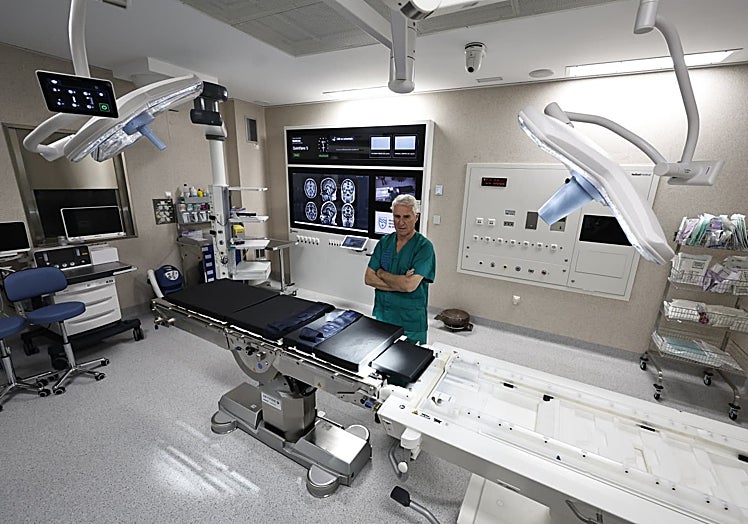
Dr Arráez acknowledged the hospital's logistical and financial effort dedicated to this project. Interventions will be performed by multidisciplinary teams of neurosurgeons, anaesthesiologists, nurses and technical specialists, all specifically trained to work in a hybrid surgical and imaging environment.
Laser ablation: a pioneering technique
Arráez added that "the use of intraoperative magnetic resonance imaging prolongs patient survival by allowing greater excision of the lesion". It also opens doors to the use of pioneering techniques, such as laser ablation, whose first intervention in Malaga is already being prepared for the start of 2026. "It consists of the introduction of an optical fibre into the patient's brain through a cut of approximately three millimetres. This fibre generates a thermal effect through the application of the laser, which is a heat source. We introduce the laser probe in this operating theatre, the patient goes to the MRI and the surgical intervention through this thermal ablation is carried out with the patient inside the MRI, so that we can observe the procedure and the extent of the lesion: it is the neurosurgery of the 21st century," Dr Arráez explains. This could be applied not only in the case of brain tumours, but also in procedures related to epilepsy.
This operating theatre opens the door to the use of pioneering techniques such as laser ablation: the first intervention of this kind in Malaga is already being prepared to take place in the next six months
The first patient to undergo an intervention in this room was operated on in July. It has been estimated that between 12 and 25 patients will pass through the new equipment in the first year. Their number will increase to between 144 and 200 interventions per year, "mainly in paediatric neurosurgery", providing service to a reference population of 1.6 million people.
The neurosurgery department of the Hospital Regional
The neurosurgery department of Hospital Regional has 21 neurosurgeons and eight residents, making it the largest in the country. The paediatric neurosurgery unit, headed by Dr Bienvenido Ros, is one of the most prestigious in Spain. The waiting list for doctors applying to join for rotations is two years. The hospital's team performs more than 2,000 surgeries a year, the most prevalent concerning brain tumour pathologies, followed by spinal pathologies. Surgeries are also performed "on peripheral nerves, cranioencephalic trauma, cerebral haemorrhage, vascular malformations, complex tumour pathology of the skull base which is carried out using endoscopic neurosurgery techniques through the nostrils" and doctors "also perform functional neurosurgery - a surgical treatment that aims to eliminate or improve processes such as Parkinson's disease or epilepsy".
![[]](http://static.vocstatic.com/voc26/latest/assets/images/favicon/surinenglish/apple-touch-icon-57x57.png)