
Rail travel
How much have ticket prices dropped due to increased competition on Malaga-Madrid high-speed train line?
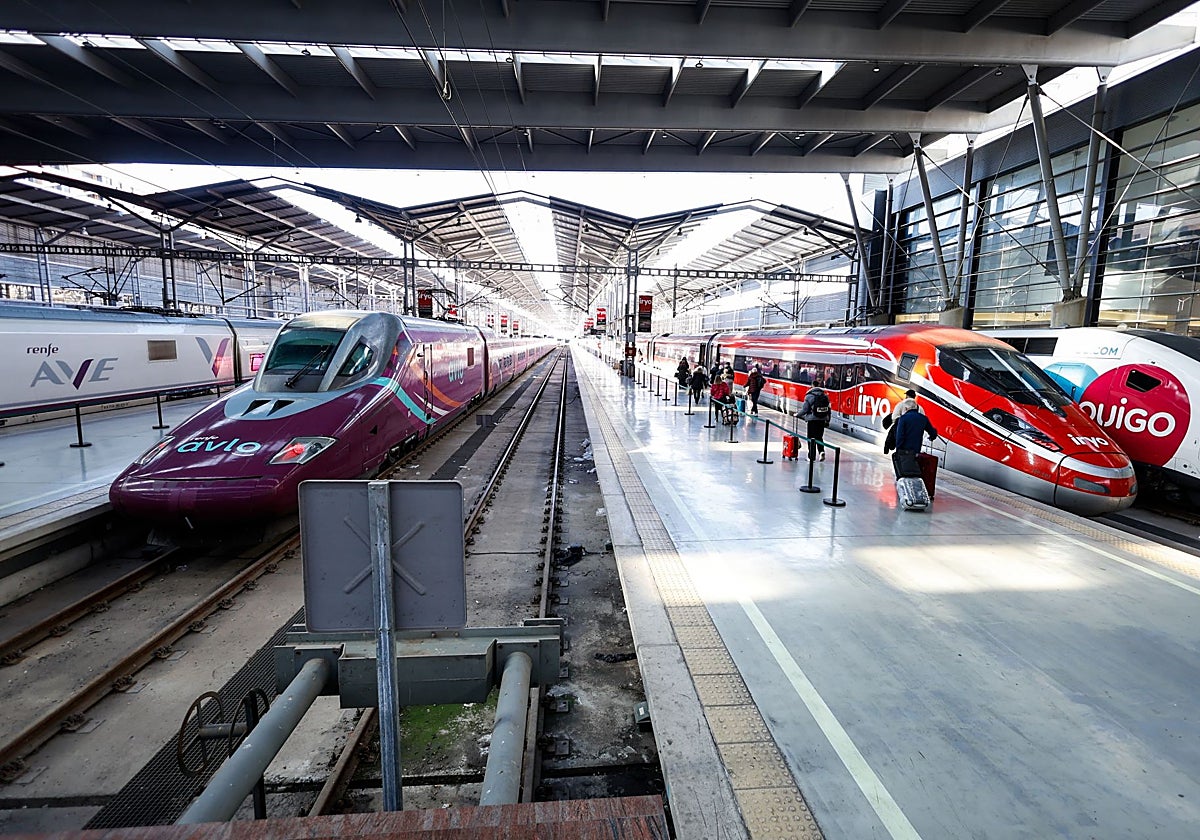
Demand for fast travel between the two cities has soared compared to before the market was freed up to private operators, thanks to an increase in the frequency of services and number of seats on offer

Malaga
Have you travelled by train between Malaga and Madrid for less than 50 euros each way this October holiday weekend? If someone had suggested that just a year ago, they would have said it was impossible. Especially when the search was made pretty last-minute on Wednesday 8 October, just two days before the start of the 'puente' bank holiday weekend.
On that Wednesday, Renfe still had tickets starting at 45 euros for departures on Friday and Saturday, also for a return trip on the holiday Monday, when previously it was almost impossible to obtain a seat at such short notice. On Ouigo, you could have made the outbound journey for a 42-euro starting price, although the return trip was much more expensive (from 79 euros). Meanwhile, on Iryo, you could have bought a one-way ticket for 52 euros and a return for 50 euros (although at peak times the price would have been over 100 euros).
In any case, this practical exercise illustrates a reality recently confirmed by the CNMC (Spain's national market and competition regulator). Its latest report on the railway sector, covering the second quarter (April-June) of this year, shows that Ouigo's entry as a third operator in this competitive market contributed to lower fares on routes into and out of Andalucía.
Up to 37% cheaper
Madrid-Malaga ticket prices for this specific quarter have only dropped by 1% compared to the same period in 2024, despite competing operators being present. However, the most outstanding change is in the average ticket price, which has fallen to 47 euros compared to the average price before liberalisation of the high-speed lines across the country by Adif (Spain's railway infrastructure public company).
20-30%
is the average price drop for high-speed trains in Malaga
Depending on the period taken into consideration, the fare reductions compared to the years of Renfe's monopoly on rail travel ranges from 16%, as estimated by the EU, to 37%, as calculated in a report by travel comparison website Trainline. This figure is quite close to that of the CNMC, which puts the average ticket at around 44 euros. In conclusion, the price reduction in rail fares has been between 20% and 30% so far through 2025.
Transport Minister Óscar Puente highlights the strong growth of the Malaga-Madrid high-speed rail corridor where, according to data from his ministry, high-speed rail use increased by 20% in August. Compared to air travel, more than 88% of journeys are made by train (excluding buses and cars). Moreover, rail passenger numbers have increased by more than 500,000 per year. According to the latest monthly data, rail use grew by 23% in August alone.
Ranking by lines
The CNMC report shows that fares have decreased less in destinations with the highest ticket demand. In fact, the Madrid-Barcelona route, which is the most sought-after, is the only one where fares have actually increased - up 15% - to an average of 63 euros. Meanwhile, a seat on the Madrid-Seville line costs 49 euros and 47 euros on the Madrid-Malaga line. Interestingly, rail fares have fallen more on the south-eastern routes, with the Madrid-Alicante line costing 36 euros (9% less) and the best price being Madrid-Valencia at 29 euros (8% less).
500,000
more rail passengers on the trains following the arrival of private operators
Overall, high-speed rail passenger numbers increased by 15% in the second quarter of the year, according to the CNMC. Logically, the fastest-growing destination was the one that came from the bottom, which was Alicante, gaining 22% more passengers. Seville also saw substantial growth, with a 21% increase, while Malaga, according to this report, remains at 14%. The difference with the data provided by the minister lies in the reference period: the second quarter from the CNMC and the month of August from Óscar Puente.
Triggering more travel
The CNMC report also devotes a section to analysing the impact of Ouigo's arrival in Malaga. In this case, it highlights that the French low-cost train operator grew by 11% in Malaga (14% in Seville). "This growth did not take passengers from Renfe or Iryo, but rather reflected additional demand generated by greater supply and lower prices," notes the report.
14%
more passengers on trains between Malaga and Madrid this year.
Overall, Renfe, with its two operating brands (AVE and Avlo) continues to be the main operator for high-speed train services across Spain, given that it also offers the largest number of daily frequencies. Its market share is above 60% on all rail corridors, except for the Madrid-Valencia route, where it fell to 50% due to competition from Iryo, which now accounts for 27% of demand on that line.
Private operators are beefing up their winter schedules
Private operators have a certain flexibility to move their rolling stock between the most popular rail corridors at any given time. The Malaga and Costa del Sol corridor tends to be among the most popular among rail users.
Therefore, it is no surprise that the low-cost operator Ouigo has decided to consolidate its summer schedule by expanding what it offers for winter. So, for the low season it will maintain three outbound services and three return options between Malaga and Madrid. According to the company's figures, this will mean 370,000 more seats annually. Keep in mind that the company only began operating from María Zambrano in January of this year, with two daily return services.
Renfe, through its AVE and Avlo brands, continues to offer the greatest number of trains, with up to 14 daily departures. Iryo, meanwhile, is currently operating with an average of five trains in each direction.
![[]](http://static.vocstatic.com/voc26/latest/assets/images/favicon/surinenglish/apple-touch-icon-57x57.png)