
Toledo train disaster 2026
Judge orders Urda train crash evidence to be sealed as focus shifts to signalling system
Magistrate in Orgaz places secrecy order on proceedings as audio recordings reveal control post authorised AVE train at 'normal speed' into occupied sector
SUR
The investigation into Spain's deadliest high-speed rail disaster, and the second this year, has this week entered a strict legal lockdown.
The investigating magistrate in charge of a court in Orgaz, Toledo province, has placed a secrecy order on proceedings surrounding Wednesday's catastrophic collision in Urda.
The tragedy had claimed 69 lives and left over 100 wounded, with 50 still in hospital. There have been no more deaths overnight.
Control room operators were forced to disconnect automatic supervision and switch to the manual system
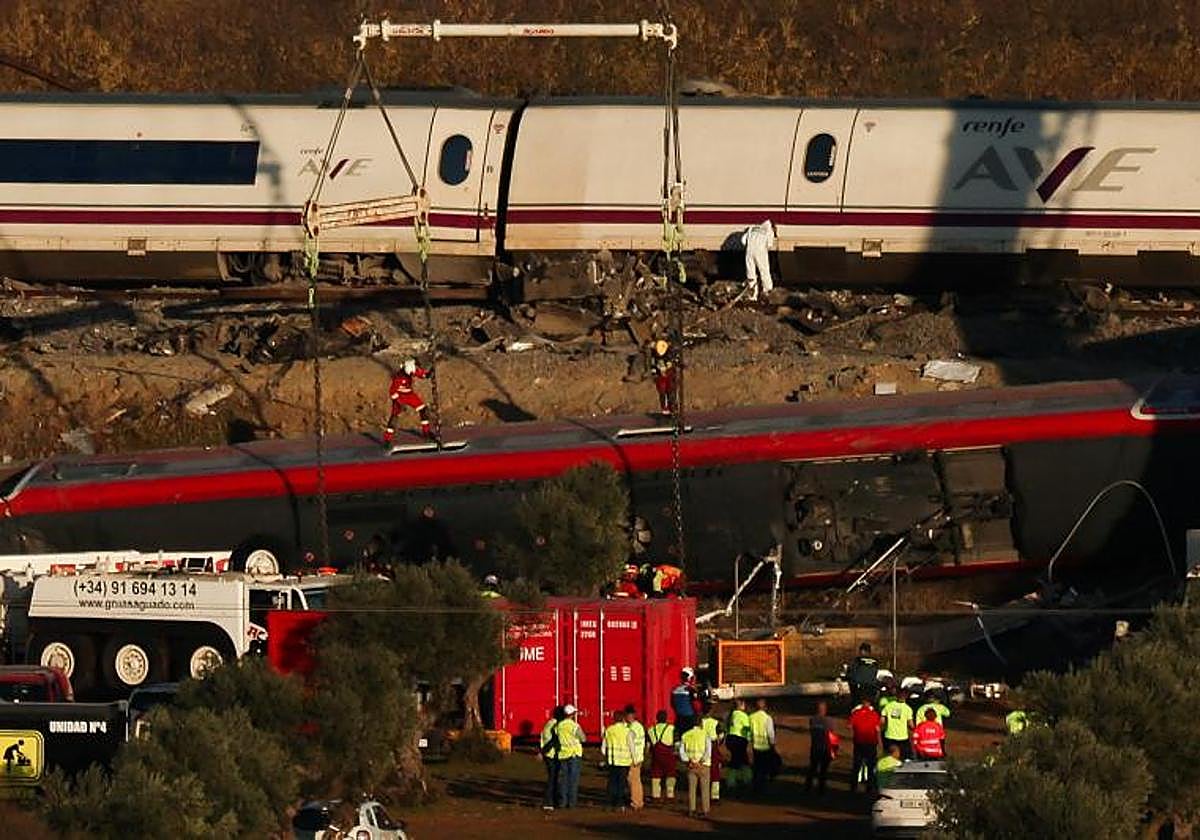
A Renfe AVE train from Madrid to Seville drove into the back of a stationary Iryo train going to the same destination shortly before 9am.
The judge's decision to seal court files aims to shield the criminal inquiry from potential interference from involved parties, including the ministry of transport and state rail entities, ensuring that technical logs, radio recordings and control room communications remain fully safeguarded.
Judicial police from the Guardia Civil's dedicated team have taken charge of gathering all physical evidence from the crash site and securing digital logs from infrastructure owner Adif's Madrid-Atocha central control post.
Recovery operations
The legal lockdown came as emergency personnel, including teams from the military emergency unit, fire crews and Guardia Civil officers, continued recovery operations at kilometre marker 118 along the Madrid-Andalucía high-speed corridor. Up to 500 people were involved at one point.Heavy machinery is clearing the remaining carriages of the Iryo and Renfe AVE services, while forensic pathologists in Toledo are still formally identifying victims.
At the heart of the judicial inquiry is the reported breakdown of the line's primary safety technology. The section of track where the collision occurred relied on the LZB automatic train protection system, which dates back to the line's original opening in 1992.
While newer high-speed lines in Spain operate on the European Rail Traffic Management System (ERTMS), the Madrid-Seville route remains dependent on the legacy LZB technology.
Planned modernisations and the installation of ERTMS Level 2 across the southern corridor have suffered repeated delays over recent years. Railway unions have long warned that maintaining 30-year-old signalling apparatus on Spain's busiest passenger corridor presented growing operational risks.
Drivers from Malaga and Seville had previously raised concerns regarding recurring technical glitches on the Toledo stretch. On Tuesday evening - less than 13 hours before the crash - an AVE driver heading to Malaga reported that the LZB system failed to recognise his train's position near Urda, forcing a temporary stop.
“The monitoring system had been malfunctioning since Tuesday evening,” the driver explained on condition of anonymity. “I was travelling on the train from Madrid to Malaga and it stopped exactly at kilometre 120, which is Urda, because the system failed to recognise the location.”
When the LZB system suffered a breakdown at 8.30am on Wednesday, control room operators were forced to disconnect automatic supervision and switch to the manual BSL block system.
This manual fallback protocol relies on visual trackside signals and direct verbal communications between traffic controllers and train drivers, placing the burden of safety verification on human oversight, experts said.
Reconstruction of the final timeline indicates that a series of critical failures appeared to occur during the 24 minutes between the initial system breakdown and the impact at 8.54am.
When the LZB failed, the Iryo 6076 service carrying 146 passengers came to a halt near Urda station. For reasons still under investigation, the Italian private operator's train was unable to resume its journey under the manual system. Meanwhile, behind it, Renfe AVE 2080 carrying 397 passengers bound for Seville was granted formal authorisation by the Atocha control centre in Madrid to proceed into the same track section under manual driving rules.
Transcripts of leaked audio reordings, obtained by SUR , expose widespread confusion among controllers who explicitly authorised the Renfe AVE train to proceed at “normal speed” despite receiving repeated warnings that a stationary Iryo service was blocked on the exact same track.
Journalist Miguel Ángel Pérez Laguna, who was travelling aboard one of the rear carriages of the AVE, recalled the horror of the impact: “It was terrible... The impact was incredibly strong,” he recounted while visibly shaken. “This is a horrific accident because of the crash I heard... We are alive by a miracle.”
When alarms finally sounded, control staff were unable to relay an emergency stop command to the AVE driver in time to prevent the rear-end crash. The AVE struck the stationary Iryo train from behind, throwing multiple carriages off the track and sending two plunging down an embankment.
Investigators from the Guardia Civil and the railway accident investigation commission (CIAF) are focusing on whether human error in traffic management, flawed authorisation protocols or secondary signal failures led controllers to dispatch the AVE into an occupied sector.
The catastrophe occurred just nine months after 46 people died in the Adamuz (Cordoba) rail disaster, on the same line. Opposition leaders have demanded immediate parliamentary appearances from transport officials. Transport minister Óscar Puente cancelled his official agenda to oversee operations from the Atocha control centre as parliamentary activity in Madrid remained suspended.
Public support call
At blood donation centres across the area, health officials issued urgent calls for public support to replenish reserves drawn during the rescue effort. Dr Elena Madrigal, coordinator of the regional blood donation network for Castilla-La Mancha, reminded citizens that “donation has to be every single day” as hospitals continued treating the severely injured.
Related story
After visiting the injured and relatives of the victims at Toledo's university hospital on Thursday alongside Queen Letizia, King Felipe VI called for measures to prevent another rail disaster: “We have once again suffered a devastating blow,” he said.
