
Guadalhorce
Alhaurín de la Torre removes first Asian hornet nest recorded in the province of Malaga
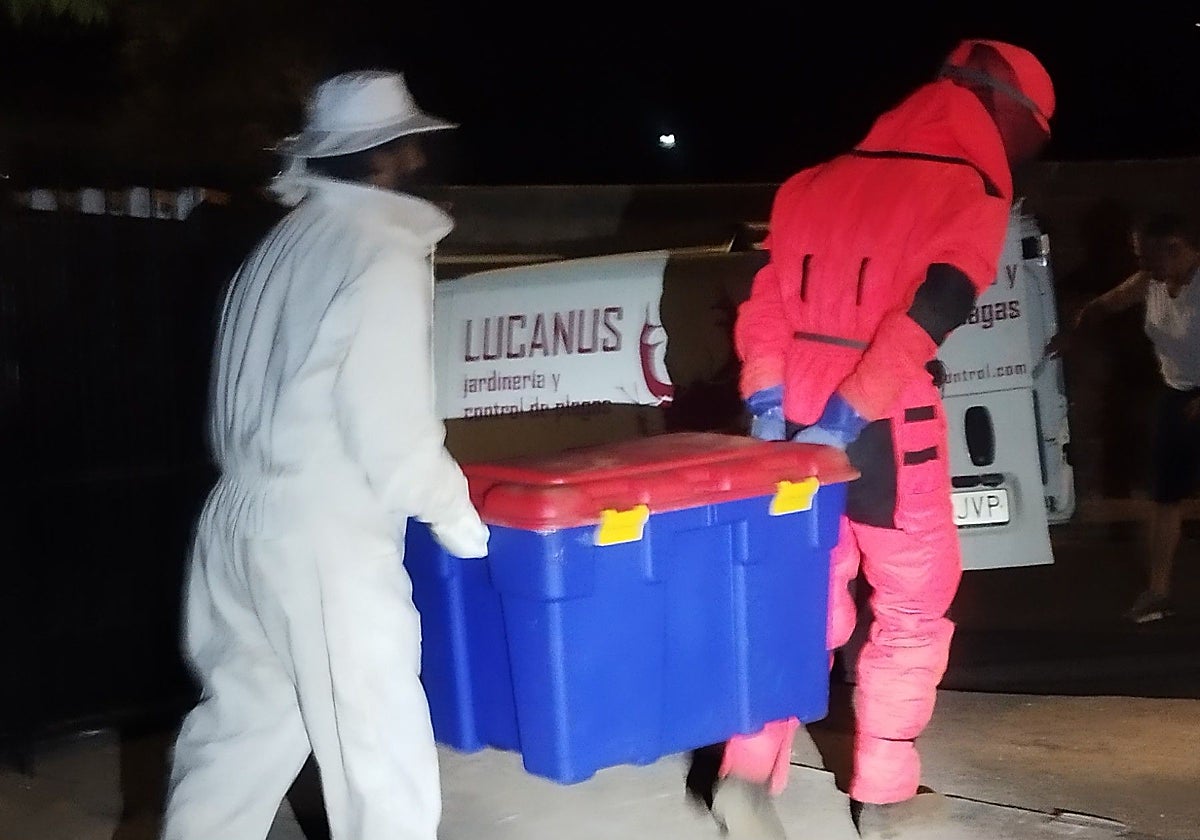
The removal of the wasps' nest mobilised a dozen technicians from the council, the fire consortium, the environmental area of the regional government and the pest control company Lucanus

Málaga
If it has been necessary to mobilise a dozen technical specialists to remove a single nest, one can imagine what a disaster it could be if the Asian or velutina hornet were to spread throughout the province. For the time being, the first wasps' nest of this invasive exotic species officially recorded in Malaga is now history: a large and complex operation, led by Alhaurín de la Torre town hall, removed it in the early hours of Wednesday morning from the Pinos de Alhaurín residential area.
The Asian hornet (Vespa velutina) should not be confused with the Oriental hornet (Vespa orientalis), which is a different species, although equally harmful, and which has already spread widely throughout Malaga. The latter is the one that has been widely seen throughout the summer on almost all the beaches of the Costa del Sol; it makes its nests under the sand or in crevices.
Velutin alert
The velutina builds its nests in the shape of a balloon, hanging from tree branches at a great height. It is precisely this circumstance that has forced the mobilisation of numerous personnel to dislodge them. The operation involved specialists from the municipal environmental departments, the fire brigade consortium, the department of environment of the regional government of Andalucía and the pest control company Lucanus, the concessionaire of this service in Alhaurín de la Torre.
The operation was carried out during the night as this is the time when most of the wasps are less active and most of them are inside the nest. The councillor for the environment, Abel Perea, said that this is the first time that a hornet's nest of this species, which is widespread in other parts of northern Spain, especially in Galicia, has been detected in the province of Malaga.
The good news is that it has probably been possible to stop the spread of the pest in time with the removal of this first colony. According to experts, this is thanks to the good temperatures in October, which would have slowed down the queens' departure to colonise other territories.
Study at the University of Valencia
The hornets' nest will now be taken to the University of Valencia, where there is a group of researchers specialising in the study of the species. The councillor thanked the work of the technicians and experts who participated in the search, location and removal, as well as the dozens of volunteers and neighbours who collaborated in the task, and the owner of the plot in question, who facilitated the work.
Asian wasps are very harmful to the environment, especially because they are predators of bees. This is also the case with the Vespa orientalis, which for years has been wreaking havoc on the province's beehives. For this reason, the town hall has also worked in coordination with the Malaga beekeepers' association, the main group affected by both pests, which is drawing up a census to document the presence and impact of invasive wasps in Malaga.
![[]](http://static.vocstatic.com/voc26/latest/assets/images/favicon/surinenglish/apple-touch-icon-57x57.png)