
Society
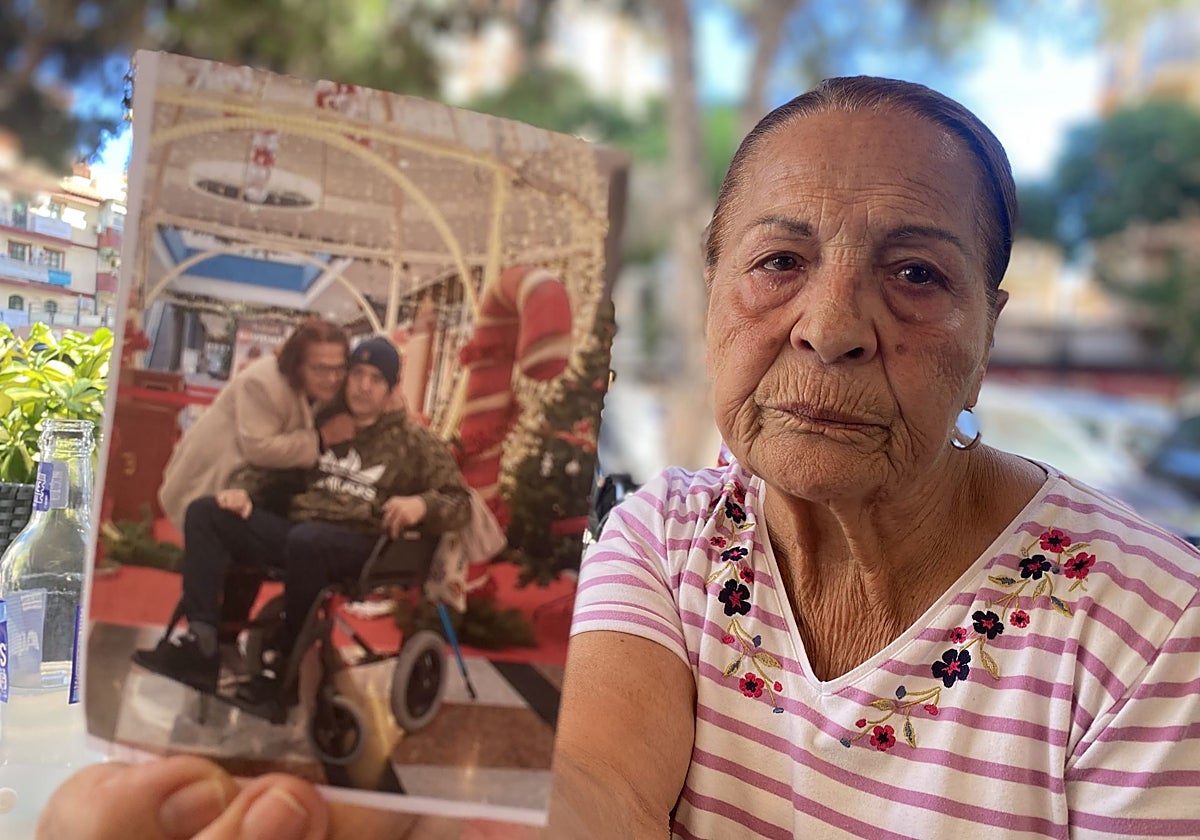
An 82-year-old Benalmádena resident's odyssey to see her terminally ill son
Dolores' son, who has suffered from Huntington's disease for decades, was transferred from a centre in Malaga to Écija almost two years ago, making her trip to see him much more challenging

Benalmádena
Every parent knows that nothing hurts more than losing their child or seeing them suffer. Benalmádena resident Dolores Carrera, 82, has been hurting for her son Sergio, who has been suffering from Huntington's disease for decades, for far too long. Sergio is now terminally ill and his mother wants to see him as much as she can, but he was moved from a care home in Teatinos, Malaga, to Écija in Seville province, almost two years ago. In the past 22 months, Dolores has been doing a long trip that is far too exhausting for a woman her age to be with her son three times a month.
Sergio, 45, was in his second year of Tourism studies at Malaga University, when he dropped out. He also stopped going out with friends and started showing signs of depression. "All he did was eat and stay in his room," Dolores says.
They took him to a psychologist and a psychiatrist and ran tests, which diagnosed Sergio with Dolores' greatest fear: Huntington's disease, from which her husband died eight years ago. It is a hereditary illness caused by a defective gene that leads to brain nerve cell damage. There is no cure and no medicine can slow down its development. Although he inherited the disease from his father, Sergio's condition is much more serious.
Sergio was admitted to a centre in Teatinos, in Malaga, which isn't too far from where Dolores lives. However, in January 2024, he was moved to the Fundación Internacional Aproni centre in Écija, in the province of Seville. The transfer was ordered by the regional government of Andalucía, according to which the reason is the number of subsidised places. However, Dolores believes that Sergio was moved because of the new management that had taken over the Teatinos centre, which led to the change of staff and the dismissal of some patients. In Sergio's case, the new board said that he had reportedly assaulted another patient. Dolores says that, even if that is true, Sergio is currently "in the last phase of his illness", which has completely limited his physical capabilities and he would not be able to do it again.
Three times a month
Since the transfer, Dolores has been able to see Sergio only three times a month due to the distance and her mobility issues. With the help of a walking stick, she gets to the train station to catch the 6.20am train to Malaga and from there to Cordoba. At 9am, she gets a bus to Écija. Dolores reaches her destination at 10am with "little luggage and a lot of gazpacho", which Sergio loves. "I have to stay in a hostel and take a taxi to the centre, another one to the hostel to come back the next day to repeat the trip. I spend money I don't have," she says.
'My son is at the end of his life and a mother has to be there. I can't stand it any more, nobody helps me or listens to me'
To make matters a bit better, Dolores bought a phone she barely knows how to use so that she can call Sergio. He cannot speak anymore, but at least she can see him.
"My son is at the end of his life, and a mother has to be there. I can't take it anymore, I don't have the strength. Nobody listens to me, nobody helps me, not even Benalmádena town hall, not even the Junta. Where is the help I need, do the institutions work?" she pleads, asking for one thing only - that her son be brought to Malaga.
![[]](http://static.vocstatic.com/voc26/latest/assets/images/favicon/surinenglish/apple-touch-icon-57x57.png)