
Drought crisis
Junta says that drought aid will 'reinforce the efforts' of the tourist industry in the Axarquía
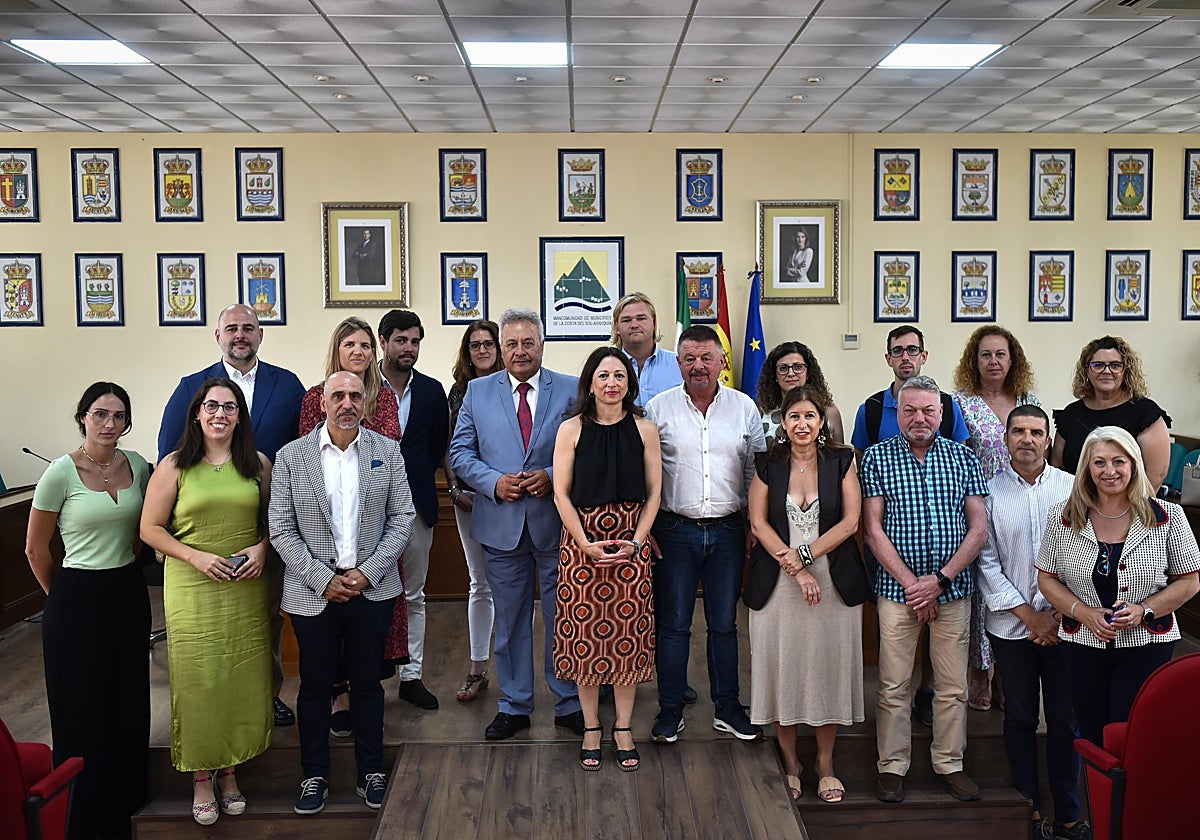
Patricia Navarro has met with tourism and business representatives from the eastern area of Malaga province to explain the two lines of subsidies from the Andalusian government, totalling 40 million euros

Axarquía
The 'miraculous' rains last Easter gave a real boost to the province's ailing water reserves . However, the situation is much more difficult now than it was a year ago, as reserves are 35 cubic hectometres lower. However, the abundant rainfall has made it possible to ward off the most serious spectre of water shortages, such as the possibility of mobilising tankers to guarantee supply, and has made it possible to fill the pools, despite the fact that night-time restrictions and pressure drops are still being maintained in many of the large municipalities.
In this context, the regional government of Andalucía continues to try to implement measures to promote the saving and responsible and efficient consumption of the liquid element. The regional government's delegate in Malaga, Patricia Navarro, announced this Thursday in Axarquía the 40 million euros in aid approved by the Andalusian government and aimed at the tourism sector to alleviate the effects of the drought , in a meeting she held with business and tourism representatives. Navarro stressed in a statement that these incentives, aimed at greater water reuse, improved energy efficiency and the adaptation of businesses to climate change, "will be an important support for the tourism sector of the Axarquía, which is already making an important effort in the face of the drought situation in the region".
In this sense, he argued that we must be prepared for future similar drought situations "so we need to give greater strength to the tourism sector of the Axarquía, which is still the main industry of our economy, as we are doing with the agricultural and agri-food sector , making available not only public investment for equipment and infrastructure to carry water, but also grants and incentives for them to be better prepared for these drought scenarios".
"In the end, it is a question of our tourism sector not only being better prepared but also improving in terms of the reputational factor that is so important when it comes to promoting our destination," continued the delegate of the Junta, who assured that these new aids will help «our tourism sector to be undoubtedly the best prepared in Spain to face this situation of climate change that is affecting us very directly with this pernicious drought". Navarro has also expressed her «conviction» that this aid will be of particular benefit to the Axarquía region, given that it is one of the areas of Andalucía most affected by the effects of the drought and where "business owners are suffering like nobody else from the lack of water".
"This region is strategic for us from all points of view and if the drought also affects in a very important way an economic pillar such as tourism in the region then we have to focus in a much more special way", explained the delegate, who has assured that the Axarquía "is a diamond in the rough and if there is someone who has been polishing it for a long time is the tourism sector, along with the food industry, and they are turning this region into a great economic locomotive of progress and development for the province and for all Andalucía".
Two lines of aid
This 40 million euro aid package has two lines, one aimed at accommodation and services linked to tourism and the other at restaurants and hotels, as explained at the meeting, which was also attended by the delegate of Tourism, Culture and Sport, Gemma del Corral, and the president of the Association of Municipalities of the Costa del Sol Axarquía, Jorge Martin, both of the PP.
The first line of aid, with amounts ranging from 100,000 to one million euros, is aimed at tourist accommodation and services, as well as activities aimed at the organisation of congresses or business events, sports, leisure or health activities; while the second line of aid, with amounts ranging from 50,000 to 300,000 euros, is available to catering and hotel establishments.
To be eligible for these subsidies, companies must carry out actions based on the reuse of water, consisting of the treatment and subsequent reuse of water from sources other than the drinking water network or similar; those which reduce the flow of water required for a specific use at the point of consumption and which, as a result, lead to a saving of water in all the installations in service in an establishment; those for the adaptation of infrastructures to prevent excess heat or cold; the installation of low water consumption green roofs or the replacement of green roofs with artificial ones; the replacement in gardens and other vegetation areas with plant species specially adapted to the restriction or absence of water; and those projects for the improvement of energy efficiency.
The companies eligible for these subsidies in the province will be around 4,000, representing 40% of the 10,000 tourist establishments in Andalucía. The typology would include bars and restaurants, golf courses, marinas, water parks, public transport companies, language and flamenco companies and also the entire hotel industry. Finally, the regional government delegate recalled all the efforts being made by the Junta de Andalucía in terms of water, stressing that "if there is one place that is benefiting especially from all these actions is the Axarquía, with more than 50 million euros invested in various infrastructures and being the great showcase of the commitment we are making for the reuse of reclaimed water". .
![[]](http://static.vocstatic.com/voc26/latest/assets/images/favicon/surinenglish/apple-touch-icon-57x57.png)