
Health
Chronic urticaria: how to live with hives and itching on a daily basis
This dermatological condition of unknown origin can linger for years with flare-ups and there's still no cure
Carmen Barreiro
Madrid
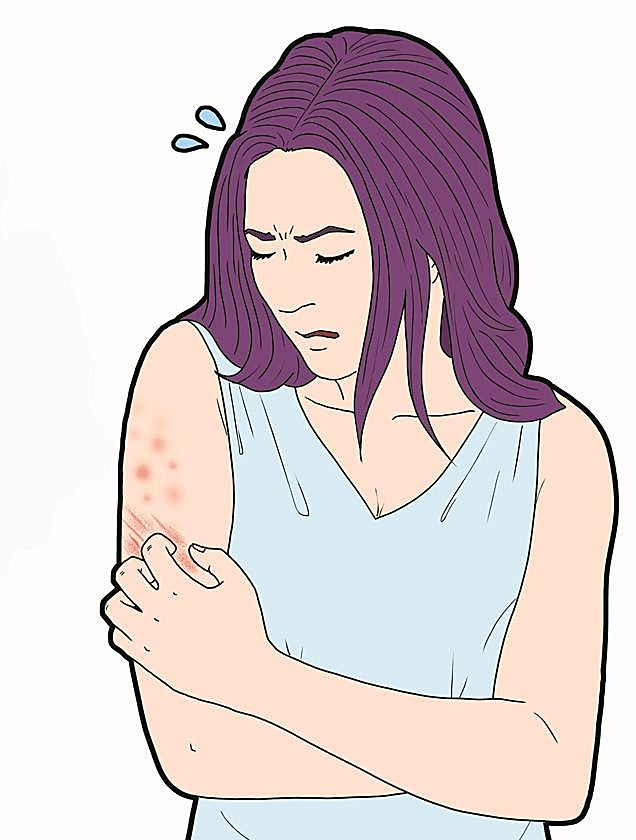
Marta woke up one day with hives covering her body and "an unbearable itching and burning sensation". She had not eaten anything different from what she would normally eat, nor had she felt unwell in the previous days. For this reason, she did not understand what could have caused such a "brutal" skin reaction. The "biggest shock" came when she looked in the mirror. "My upper lip and eyes looked as if I had been beaten up. They were swollen," she recalls.
After a few visits to different specialists and tests that went on for several more weeks, during which the hives and itching did not disappear completely, Marta was diagnosed with chronic urticaria, "a skin condition characterised precisely by the sudden appearance of wheals on different parts of the body, accompanied by intense itching and sometimes swelling of the lips and eyelids (angioedema)," as explained by the Spanish Society of Allergology and Clinical Immunology (SEAIC).
This skin condition, "of unknown origin and usually significantly affecting quality of life for sufferers," is considered chronic when the symptoms last more than six weeks. There is currently no cure, "although, in the vast majority of cases, the urticaria disappears on its own accord over the years without leaving any type of sequelae," says the teaching hospital, Clínica Universidad de Navarra (CUN).
These are the keys to a disease that is "of autoimmune origin in a significant percentage of cases," which mainly affects middle-aged women (twice as many as men). The most severe cases can lead to episodes of anxiety and depression. "It can be very frustrating, especially at the beginning, to think that you have to live your whole life with a body full of hives and constant itching, not to mention the great emotional impact of looking in the mirror every morning and not recognising yourself," says the AAUC (the Spanish association for sufferers of chronic urticaria).
Symptoms
The most frequent symptoms consist of "the almost daily appearance of hives or welts [raised bumps] all over the body, sometimes accompanied by angioedema. If the swelling is very intense, it can even lead to a complete deformation of the face, which means a significant alteration in the patient's quality of life," state the medical experts at the CUN.
Although not as common, chronic urticaria can also cause swelling of the tongue or glottis (the vocal apparatus of the larynx) and, as a result, the patient may experience breathing difficulties. "In this case, you should go immediately to emergency services," advise the specialists. In about half of the cases, it is the body itself (autoimmune defence mechanism) that causes the body's cells to release histamine and all these symptoms, which last for at least two and a half months, develop as a result. In contrast to chronic urticaria, so-called acute urticaria passes within two to three days.
The causes
Specialists - chronic urticaria is usually treated by allergists - recognise that, in most cases, it is impossible to determine the causes that trigger the disease. "There is a type of urticaria called physical urticaria that occurs in the area where the skin comes into contact with some physical stimulus (cold, vibration, pressure, water, sun exposure ...) but, in the case of chronic urticaria, as the skin lesions appear continuously, we look for factors that can trigger it, such as certain foods or stressful situations. And this lack of response often causes anxiety and emotional destabilisation in the patient. While there is still no specific treatment for this disease, what is known is that there are factors that can worsen it, such as taking non-steroidal anti-inflammatory drugs (aspirin, ibuprofen and derivatives) and antibiotics."
In any case, during outbreaks it is usually advisable "not to eat foods rich in histamine (fermented foods, canned foods, seafood and so on) or foods that release this substance such as strawberries, chocolate or nuts," is the advice from the Spanish Society of Pediatric Allergy, Asthma and Clinical Immunology (SEICAP)
Prognosis
In general, an isolated episode of acute urticaria without swelling of the lips and eyelids "has no repercussions and does not require further evaluation by a doctor. But if it does not improve or is accompanied by significant angioedema, or if a food or medication is suspected as the cause, then an examination by an allergist is necessary," the CUN explains.
Treatment
In the case of chronic urticaria, it is the symptoms that are treated, not the disease itself. The first line of treatment is antihistamines and, depending on the severity of the condition, corticosteroids may also be prescribed. Specialists recommend being consistent with the prescribed treatment for it to be truly effective.
![[]](http://static.vocstatic.com/voc26/latest/assets/images/favicon/surinenglish/apple-touch-icon-57x57.png)