
Art and culture
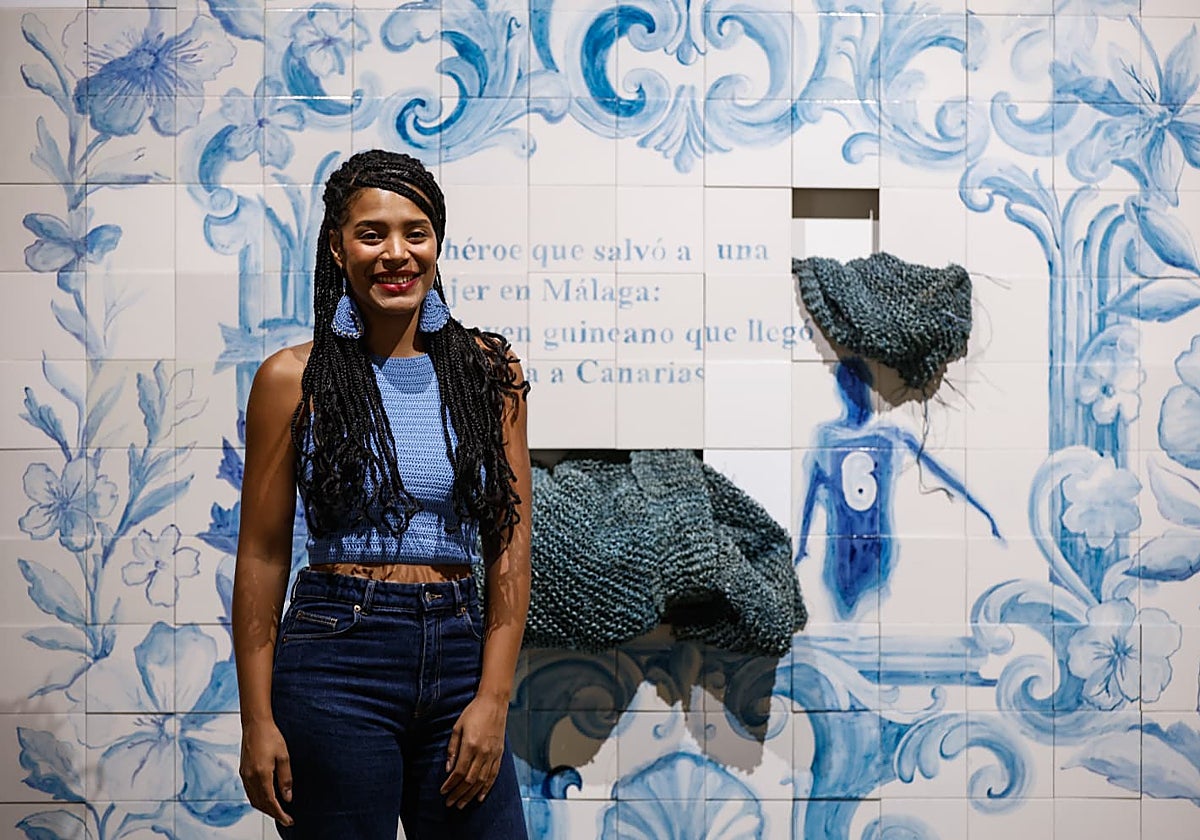
Carla Hayes in Malaga, mixed-race art that makes black bodies visible
At her solo exhibition at La Térmica, the city-born artist weaves a discourse shaped by her African-descendant identity, with the sea as a common ground and also the scene of tragedies

Malaga
Around the year 1500, in one of his best-known paintings, Gentile Bellini depicted the moment when a relic of the Holy Cross fell into the San Lorenzo canal in Venice. On the far right, a black person is preparing to jump into the water to retrieve it. He goes unnoticed among the throng of people crowding on the other side as mere spectators, but there he is, determined to save the object. Almost a year ago, a young man from Guinea made the headlines in Spain after rescuing a woman who was paralysed with shock as she tried to cross Calle Heroe de Sostoa, which was flooded by the 'Dana' storm last October. The artist Carla Hayes, a native of Malaga of African descent, connects both realities so far apart in time in an exhibition that makes the black body and all its historical significance visible through art. 'This Sea That's Called My Back' can be viewed at La Térmica in Malaga city until 22 February 2026.
Carla Hayes, born to a Spanish mother and Ghanaian father, continues her quest for her own place within the African diaspora. "It's one of my obsessions," she admits. "Even though I was born in Malaga, I will always be linked to an African context." That is why, since graduating in Fine Arts from the University of Malaga (UMA) in 2019, her work has been influenced by her mixed-race identity, both at the heart of her themes and also in the form of her art, with the use of raffia mixed with embroidery and now also with plastic and ceramics. These materials and craft techniques speak to her status as a woman of African descent and, filtered through her discourse, are elevated to the category of art. Through them, the artist questions and explores colonialism, the sexualisation of black women, migration and ecological damage.
In La Térmica, her second solo exhibition in Malaga, Hayes focuses on the sea "as a third space or common ground" of that diaspora. A meeting point between "here and there", between Africa and Europe, and also a scene of tragedies where thousands of migrants lose their lives. With embroidered raffia, she presents the Bellini painting as a triptych flanked by two current news stories: 'Mahmoud Bakhum, a street vendor in Seville, dies after jumping into the river as police chased him for working' and 'The Senegalese migrant whose embrace of a Red Cross volunteer went viral dies in Malaga'. "I connect a more historical aspect with our contemporary times. We see that the status quo back then wasn't so different from now", she reflects on the piece entitled 'After Gentile Bellini'.
-U10707725772Giz-748x524@Diario%20Sur.jpeg)
Nearby, a woven raffia net weaves between the ceramic pieces of a mural bearing the phrase: 'The hero who saved a woman in Malaga. A young man from Guinea who arrived by boat to the Canary Islands'. The tiled panel here refers to colonial expansion, transatlantic trade and the forced trafficking of bodies. It also represents the artist's connection with Lisbon, a city with a large presence of people of African descent where she conducted a research stay. "I like to link that past with the present. I'm interested in bringing the presence of black bodies into Europe's colonial past, because it's not just a current issue: black bodies have always been present to a greater or lesser extent in Europe", she stresses.
On the other side of the exhibition room, her own body is at the centre of the action. Carla Hayes embroiders raffia on a plastic sheet shaped like a mermaid's tail, which is placed on the shores of Lisbon and Malaga. In this way, she transforms herself into a kind of being who can travel across that sea between different lands and cultures. Yet, at the same time, it also serves her to analyse the perspective of the black female body transformed into a mermaid. "She is one of the epitomes of sexuality, the mermaid woman who has no desire, but is completely desired." In two performances projected at the end of the room - alongside her embroidered mermaid tail - the reaction of onlookers can be observed. "They looked, they approached, they took pictures. It was a passive gaze towards a person standing or lying down, as if dead, simulating that shipwreck."
In this piece, she introduces transparent plastic for the first time with an environmental perspective, to address the plight of many African countries due to the pollution caused by the West. "Fishermen in Senegal can't fish because the sea is polluted", she explains. This PVC appears again in the work 'Shawl Sea', the largest work of art in the entire exhibition, a choral creation together with the Biznegra Collective, where several women of African descent embroider together in a practice of healing, dialogue and shared resistance. Using raffia and plastic, they have created a garment closely linked to femininity and the female body, but also to Spain's colonial past. The large shawl on display here is spread out across the sands of the beach, a shawl to which all those women contributed "their own grain of sand".
Curators Javier Cuevas del Barrio and Ariadna Ruiz Gómez praise Carla Hayes' ability to "sublimate the colonial wound". "In cultural tradition, black bodies are the most invisible, those without a voice. She turns the sock inside out and, through her artistic practice, she makes them visible, showcases them and shines the spotlight on them to prevent the whitewashing of history", they conclude.
![[]](http://static.vocstatic.com/voc26/latest/assets/images/favicon/surinenglish/apple-touch-icon-57x57.png)