
Neil Faulkner: "Lawrence of Arabia was broken by the war"
The Arts Society welcomes Time Team archaeologist and T. E. Lawrence expert Neil Faulkner to Benahavís on Tuesday
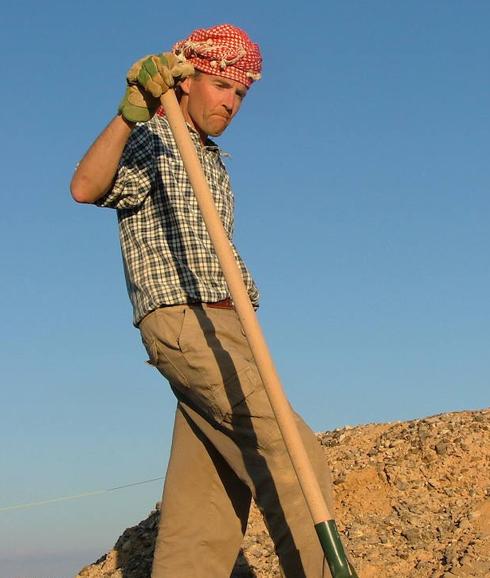
Maddy Hay
Based upon new historical evidence, the lecture on the Costa del Sol next week by Neil Faulkner (London, 1958) promises to be a fascinating uncovering of the real man behind the legend of Lawrence of Arabia.
Faulkner's interest in T. E.Lawrence was sparked during a 10-year-long archaeological project looking for evidence related to the Arab Revolt in the deserts of southern Jordan.
Lawrences war memoir, The Seven Pillars of Wisdom, was the most detailed record of the revolt, so our project meant that we inevitably had to have a very serious engagement with the biography, the character, the role and indeed the controversy surrounding Lawrence. Ive indirectly become a sort of Lawrence specialist, as a consequence of our archaeological project, Faulkner tells SUR in English in a telephone interview prior to his trip to southern Spain.
After the First World War, Lawrences story became something of a legend, made concrete in 1962 with the release of Lawrence of Arabia, David Leans Oscar-winning historical drama. However, Lawrences celebrity is surrounded by controversy, which according to Faulkner has existed since 1919.
There were those who saw him as a sort of military genius who played a major role in the outcome of First World War in the Middle East and those who think of him as a serial liar, says the archaeologist.
Based upon his findings in Jordan, Faulkners team were able to draw a conclusion which could perhaps bring some answers to this century-old debate. Hes keeping quiet for now, promising a big reveal during the upcoming lecture in Benahavís. We certainly came to a definite view as to whether The Seven Pillars of Wisdom can be considered to be a reliable account, he says.
The story of T. E. Lawrence continues to be relevant to this day. Faulkner explains that Lawrence internalised the remaining Middle East conflict post-war, something from which he never properly recovered.
Lawrence was broken by the war, primarily as a consequence of his sense that the Arabs had been betrayed by the British. The British had effectively promised the leaders of the Arab Revolt a united independent Arab state in the Middle East, if the Ottoman Empire was defeated, which obviously it was, he explains.
Faulkner continues, However, after the war, a secret agreement between the British, the French and the Russians meant that the Middle East was actually divided between the imperial powers. Over time, as the various states of the Middle East got their independence, those artificial borders that had been created were fossilised and are largely unchanged to this day.
The archaeologist states that what the imperial powers did between 1916 and 1921 continues to impact the Middle East of today.
The region is extremely dysfunctional in terms of where the boundaries are and what the nation state entities are. We can see whats happened in Iraq and whats happened in Syria - the whole thing sort of implodes into sectarian warfare.
The title of David Fromkins 1989 account captures it for Faulkner: They imposed a peace to end all peace. What was done after the war has shaped the Middle East for 100 years. This modern-day connection is what makes Lawrence such a fascinating point of study for this archaeologist.
In some respects, Faulkner himself must identify with T. E. Lawrence. Both are scholars, academics and archaeologists whose work has brought them to the same part of the world. He was somebody who was very up for it. He took himself out to the Middle East to collect information for an undergraduate dissertation on crusader castles in 1909. He then went back there after graduating to work as an excavator. Thats the kind of thing that I can identify with very strongly.
However, as an anti-imperialist, Faulkner considers Lawrence to have been too trusting. He viewed the British Empire through rose-tinted glasses. I think he was extremely naïve about their potential benevolence. The British Empire wasnt some cross between the National Trust and the United Nations, it was a rapacious system of exploitation. He puts it down to Lawrences background and the political influences that he came under. Ultimately, Faulkner believes that Lawrence was subject to ideological conditioning.
He was never able to break away and see the underlying purpose of the British Empire or the reactionary nature of the leadership of the Arab Revolt.
Although hes a regular lecturer for the Arts Society, this upcoming trip to Spain is of particular interest to Faulkner.
Im going to take advantage of my time there. The lecture is on Tuesday, but Im coming on Saturday with three mates and were going to be doing some field work in Almeria.
Most know that Almeria was a top Spaghetti Western filming location. Perhaps lesser known is that it was also the setting for a large portion of David Leans Lawrence of Arabia.
We are going to go to the site of the town of Aqaba, and well try to find where they built the railway line for the famous train ambush scene. As Faulkner puts it, what hes now interested in is the archaeology of cinema.
Faulkner is clearly passionate;his views are both fierce and incredibly well considered. Sparks will fly this Tuesday alongside insights over fifteen years in the making.
![[]](http://static.vocstatic.com/voc26/latest/assets/images/favicon/surinenglish/apple-touch-icon-57x57.png)