
9 June 1976: An important step towards post-Franco democracy in Spain
On this day in 1976 Spanish authorities made an essential step towards the country’s first democratic elections since 1931 by approving a law to authorise the existence of political parties
Debbie Bartlett
On 9 June 1976, the Spanish authorities approved a law to authorise the existence of political parties, an essential step towards the countrys first democratic elections since 1931, following the Franco dictatorship. Those elections took place in June 1977.
General Franco established his fascist government in Spain after overthrowing the democratically elected Republic government in the 1936-39 civil war, and he ruled with an iron hand until his death in 1975.
Franco had always said that the monarchy, which had been deposed in 1931, would be restored after his death, and in 1965 he named Juan Carlos de Borbón, the grandson of exiled King Alfonso XIII, to succeed him as head of state, bypassing Juan Carlos father, Juan de Borbón.
The period between Francos death and the election of a new government is known as the Transition, and it was a difficult time politically and economically although it was a key factor in Spain later joining the European Economic Community and NATO.
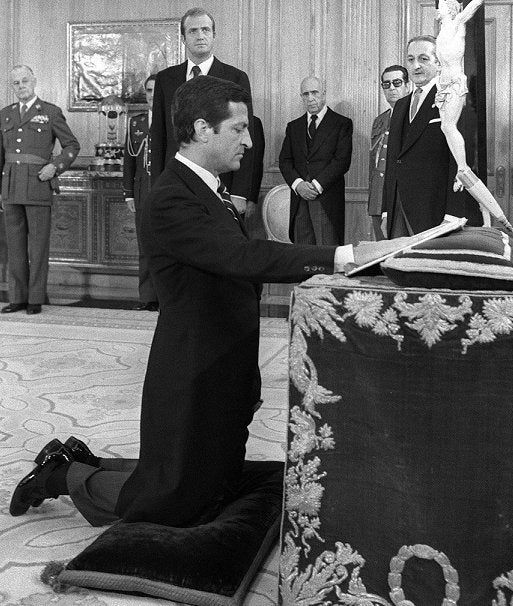
In July 1976 King Juan Carlos chose Alfonso Suárez to be the new head of government; he became the countrys 138th prime minister. The move was greeted with suspicion by many because of Suárezs links with the Franco regime, but he gained the confidence of the electorate by offering several political amnesties and dismantling elements of the dictatorship.
He introduced the right to strike and to join a trade union, and established a new law through which Spains electoral system resembled that of a liberal parliamentary democracy.
The four main parties in the 1977 elections were the Union of the Democratic Centre, Spanish Socialist Workers Party, Communist Party of Spain and the Popular Alliance. The UCD won the election but without a majority, so it was forced to form a coalition with other parties.
Parliament began to draft a Spanish Constitution in mid-1977, and it was then approved in a referendum in December 1978.
However, tensions steadily grew within the coalition and the UCD party, and as a result Adolfo Suárez resigned in 1981.
Leopoldo Calvo Sotelo was appointed to lead the government in his place. He later went on to become the leader of the party.
![[]](http://static.vocstatic.com/voc26/latest/assets/images/favicon/surinenglish/apple-touch-icon-57x57.png)