
Health
The Granada family raising 1.5 million dollars to get life-saving gene therapy for their daughter
Elenita has Neddams Syndrome, a neurodegenerative disease which means she can no longer walk and her speech is becoming slower. Her family is hoping to bring the treatment from the USA, where it has already helped children with the same condition

Sara Bárcena Hernández
Granada
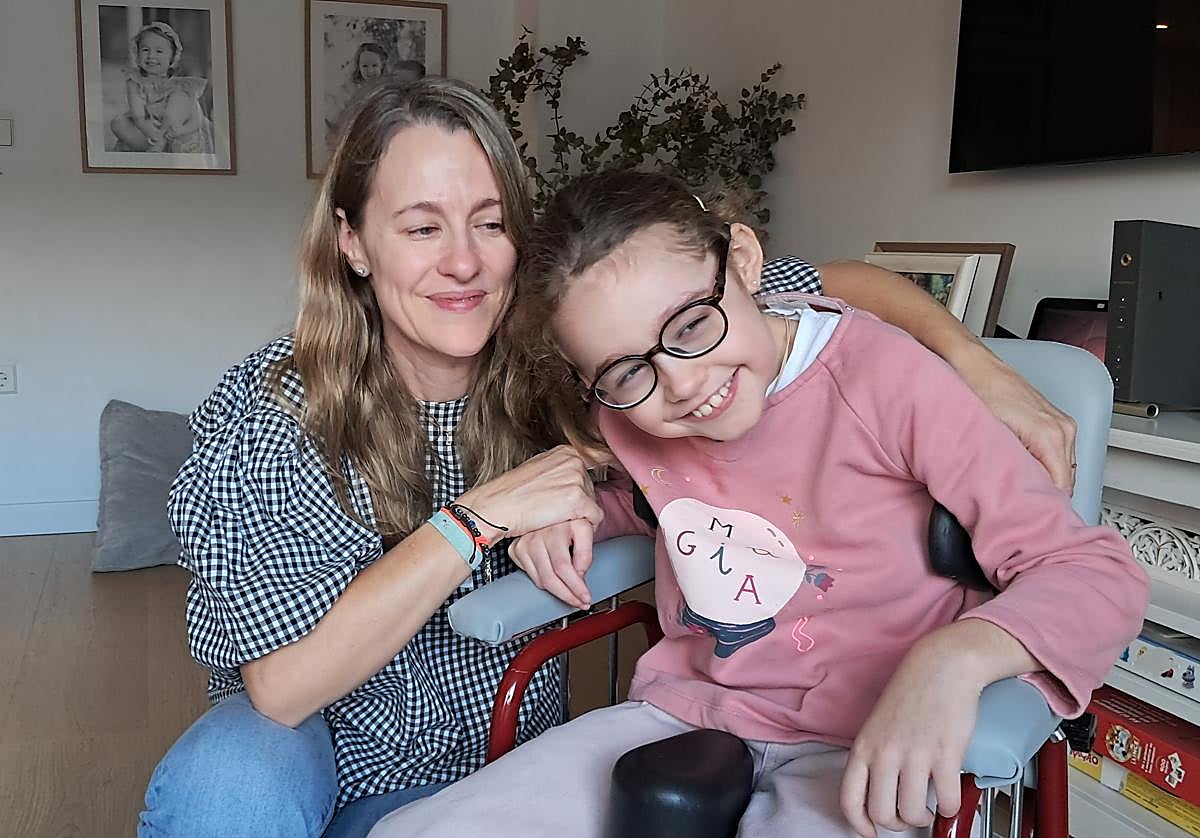
Eight-year-old Elenita from Granada can no longer walk and her speech is getting slower. These are symptoms of an ultra-rare disease called Neddams syndrome. It affects neurodevelopment with regression, that is, instead of becoming more and more independent, Elenita is regressing. There are only 13 diagnosed cases in the whole of Spain.
Her mother, Laura Hernández, gets her ready for school every morning. They live near Plaza Gracia, in the centre of Granada city. While she is looking for her backpack, Elena wriggles around on the sofa and pulls up her sweatshirt. She wants to show off her favourite T-shirt. "You're such a show-off, daughter," he mother says. The little girl laughs; she is always smiling. Her mother looks at her tenderly. She remembers when she "ran and jumped" just like any other child of her age.
"Up to the age of five she developed normally, but then she started to become more clumsy".
"Up to the age of five she developed normally, but then she started to become more clumsy. Two and a half years ago we were given the diagnosis and since then we have been doing everything possible to find a cure," Laura told IDEAL The 'Por la Sonrisa de Elenita' (for Elenita's smile) foundation was created, which today has one clear objective: to gain access to the first treatment that could save her life.
Developed in the USA in just 14 months, it aims to correct genetic problems caused by Neddams syndrome
The family hired researcher Thomas Widmann, who works at Genyo, the University of Granada (UGR) and FPS, to investigate possible cures for Neddams syndrome. He has recently joined the Elly's Team research team in the USA. In just 14 months, they have developed the first gene therapy that could slow down and even reverse Elenita's disease.
Elenita still goes to Maristas, her usual school, but also to La Purísima, where she has speech therapy, swimming and physiotherapy and in the afternoons she has various other therapies. She doesn't do extracurricular activities like the rest of the children, but that could change if they manage to raise the money needed to bring the American treatment to Granada.
"This therapy would be useful for six or eight patients, although in Spain only Elenita and one other child fit the profile"
A girl from the United States was the first to receive it in April. "First we were told we couldn't go all the way there, that it would be four months and then there would be annual check-ups. The logistics were complicated. Now it looks like we can bring it here if we pay 1.5 million dollars. It would be enough for six or eight patients, although in Spain only Elenita and another child fit the profile," explains Laura.
Donations can be made on the website Por la Sonrisa de Elenita; through a charity Bizum code (09157); through crowdfunding and also via PayPal. The challenge is to raise the money "as soon as possible" because the more the symptoms progress, the more complicated it will be to turn back the clock.
"New neuronal connections have to be created so that she can walk, talk and so on," explains Laura and Elenita knows what her plan is for when she is better: to invite all her friends over for tapas. "With this treatment, for Elena it would be like being born again. It is our hope".
![[]](http://static.vocstatic.com/voc26/latest/assets/images/favicon/surinenglish/apple-touch-icon-57x57.png)