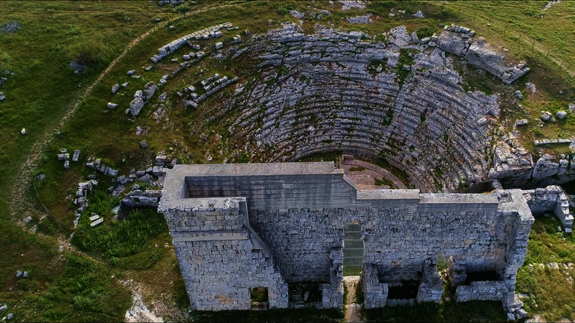
What lies ahead for Acinipo?
The archaeological site in the Serranía de Ronda has been neglected for years and is at risk of looting and deterioration, so urgent action is required
MARÍA GARCÍA
Viernes, 16 de noviembre 2018, 14:41
Just 20 kilometres away from the town of Ronda and its famous gorge is a little-known archaeological site which was once a Roman and pre-Roman town: Acinipo.
IMPORTANT POINTS
-
2013. Acinipo has been on the Hispania Nostra Red List for more than five years.
-
Plan. It is hoped that the site's future will be decided in the next couple of months.
-
Information centre. The project has been paralysed since 2004, but is a "fundamental" part of the Acinipo project.
Although its name appears for the first time in texts by Ptolomy and Pliny the Elder, the area is linked with the Celtic Beturia, and there are remains from the Copper and Bronze Age. However it reached its maximum splendour in Roman times, becoming one of the most important towns in Bética and granted the privilege of minting its own coins.
Sadly, the site has been badly neglected, but that may be about to change thanks to a new conservation project with the collaboration of the University of Malaga (UMA), the Junta de Andalucía and Ronda council.
In 2013, the Hispania Nostra Association added Acinipo to its Heritage Red List, which includes valuable sites which are at risk of disappearing, being destroyed or suffering serious alteration to their values. The association says there is a considerable risk of looting and progressive deterioration due to neglect.
The risk of looting is very real. Numerous elements have already been removed over the years due to the lack of protection of the site, and deterioration has already resulted in the loss of a domestic altar from one of the Roman houses. After being excavated, the passage of time and the rain have left it practically unrecoverable.
Words but no action
The Acinipo site belongs to the regional government, and there has been a great deal of talk about restoring it, but nothing has come to fruition. In 2004, it was announced that an information centre was to be built, but the project was paralysed after a complaint by SILVEMA that it would be on land which is protected.
For the Junta's tourism delegate, Isabel Barriga, this centre "is fundamental". She says it would be interesting to be able to hold cultural activities at the site because these would help to maintain Acinipo socially and economically and would increase its value as a tourist attraction.
For Sergio Valadez, an architect from Ronda, the situation is clear. "Right now Acinipo is in a type of no man's land, because there is no plan for its future and no regular conservation work is being carried out. Every now and then something is done if it happens to be urgent, but there is still no plan. We need to decide exactly what we want to do with the site. Do we excavate all or part of it? Do we incorporate it into the Network of Roman Theatres? What use do we want for it? The town of Acinipo was enormous, and there is still a great deal of it to be excavated. We don't know what else is there yet."
Plans and investment
Earlier this year Valadez proposed to the regional government that the area of Acinipo which contains the theatre seating should be consolidated and the impact of rainfall upon it should be reduced, and a survey is currently being carried out with that in mind. Meanwhile, UMA, the Junta and Ronda council are setting up a multidisciplinary committee to consider the site's future. "Acinipo was a very important town and until a decision is made we won't know how much investment is needed," says Valadez.
A piece of history
Some people believe that Acinipo was an ancient settlement of what today is Ronda. In fact, it is known locally as Ronda la Vieja (Old Ronda). However, this is not the case. Acinipo and the place called Arunda, which is the present Ronda, coexisted and when Acinipo began to lose importance, the territorial hegemony passed to Arunda. Research has shown that the Roman town of Acinipo was inhabited until the seventh century.
The most outstanding element of that period of glory is the Roman theatre, which had seating for 2,000 people. The construction took advantage of the slope of the hill to create the seats, which were excavated out of the rock. The materials from that excavation were then used to build the stage of the theatre.