
Art and culture
When revolution returns to the primitive: the Carmen Thyssen Museum in Malaga explores Spanish avant-garde
The city art gallery brings together works by Miró, Chillida, Tápies, Saura, Picasso, Barceló, Miralles and Juana Francés in an exhibition that seeks out the hallmarks of modern Spanish art

Malaga
To start from scratch, we must return to the origin of everything, to nature and to the first art form. Having broken the relationship with realism and figuration, the true revolution lies in connecting with the earthy and the primitive. The Carmen Thyssen Museum in Malaga traces the roots of the Spanish avant-garde, what makes it unique, and finds it buried in the earth, in its materials and forms, and in the ancestral, in a language of signs hidden in the caves that will be the source of abstraction. The art gallery takes a new look at the creations of the last century, from the 1930s to the present day, in its temporary exhibition, inaugurated this Monday by Baroness Carmen Thyssen herself. "Being here is my joy, my happiness. We've been here for almost 15 years now and it's always beautiful," she stated.
The exhibition is entitled Telúricos y Primitivos. De la Escuela de Vallecas a Miquel Barceló. It brings together a total of 64 works by 45 Spanish artists across all artistic forms, until 1 March. Miró, Picasso, Tápies, Manolo Miralles, Chillida, Saura, Benjamín Palencia, Alberto Sánchez, Maruja Mallo, Juana Francés and more. The exhibition is heterogeneous and not in chronological order, but it champions a clear discourse: to demonstrate that there is a common foundation in modern Spanish art immediately before and after the Spanish Civil War and up to the present day.
Earthy colours, the importance of material and drama are the hallmarks of modern Spanish art.
The earthy (telluric) and the primitive are in the DNA and fuel all the avant-garde experiences born in this country. They manifest themselves in a tendency “towards earthy colours, drama and expressiveness” which also has a long tradition in Spanish art, as Bárbara García, curator of the exhibition together with Alberto Gil, both from the museum’s conservation department, points out. This atavistic component is present in other European avant-garde movements, but in Spain it has become something “persistent and recurrent”.
“The inspiration will be in wild art, primitivism, children’s art; also from a yearning to escape from the modern world, from a world in crisis,” reflects Lourdes Moreno, director of the Carmen Thyssen.
A striking piece by Manolo Millares, El Homúnculo (1959), opens the exhibition’s tour as an introduction to this art form. Here, the artist uses torn burlap, a nod to the material used to wrap the Guanche mummies of his native Gran Canaria. “For abstraction, he turns to an ancestral past,” explains Moreno. This notion runs throughout the exhibition. Alongside this work, there is a space given over to the pioneers, the Vallecas School, a surrealist troupe of artists from the 1930s to which Benjamín Palencia, Alberto Sánchez and Nicolás de Lekuona belonged. “It’s the first Spanish art movement that was supposedly avant-garde, indigenous. And the great paradox it poses is to refound art with roots in the atavistic. There are references to cave art, an interest in geology and a first attempt at working with materials,” notes Gil.
Earth enters the painting, quite literally, with volcanic soil in César Manrique’s Pintura número 100 and also with straw in a piece by Josep Guinovart. In the latter artist’s work, Paisaje con Paja, the telluric and primitive coexist with ancestral symbols on the canvas. Spanish abstraction, from the 1940s onwards, has been influenced by cave art, led by the members of the so-called Altamira School. After the Civil War, with many of the artists of the first avant-garde period in exile, those who had to refound Spanish art turned to the oldest reference point in art.
These schematic drawings are echoed by the two lithographs exhibited here by Picasso and several canvases by Manolo Millares. The painter from the Canary Islands shares the space with colleagues from the El Paso group, such as Juana Francés, Luis Feito, Manuel Rivera and, of course, Saura. All of them feature another defining characteristic of this period: “the displacement of the human being from the focus”. The artist’s expression and his relationship with the material take precedence. “Painting with material is the great contribution of Spanish art to the international scene,” declares the curator..
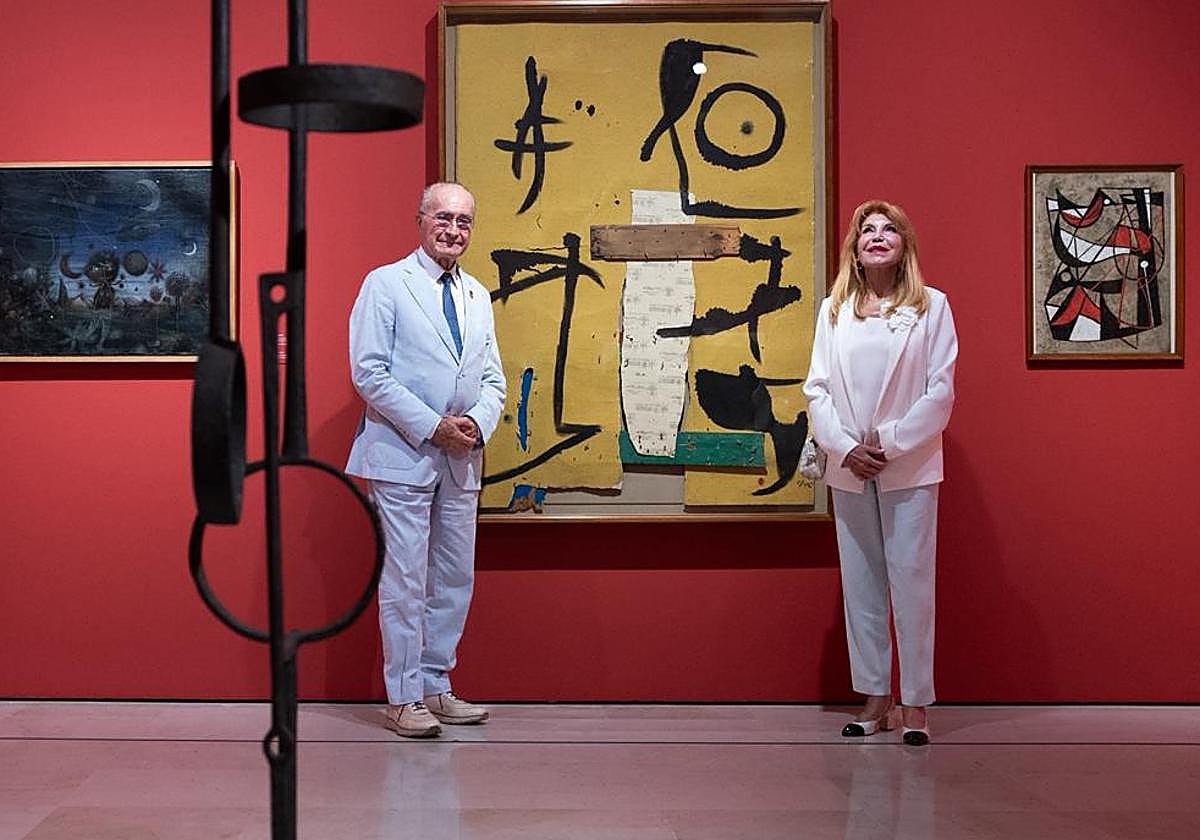
Joan Miró’s large oil painting on sandpaper, in which he embeds nails and a piece of wood from a mill he owned, certainly stands out in the room. “It’s a very earthy and primitive thing to resort to materials provided by one’s own surroundings,” say the curators. Directly opposite, Chillida’s sculpture, Hierro, rises up in stylised form. Two essential names from the avant-garde give way to the “apotheosis” of material in the final part of the exhibition, with a striking painting by Miquel Barceló with textures that protrude from the canvas: Calabazas. Joining him are Saura with Manda (one of his series of works portraying women), Tápies with Rectangles grisos and Gustavo Torner with Blanquísimo- con Chatarra.
Nearly 20 patrons of art have lent works of art to this temporary exhibition, which has benefited from the collaboration of Fundación La Caixa and Soho Boutique Hotels. Along with the baroness and Lourdes Moreno, the presentation was attended by Malaga’s mayor, Francisco de la Torre, and other representatives from the sponsoring organisations, Malaga city council and key museum staff.
![[]](http://static.vocstatic.com/voc26/latest/assets/images/favicon/surinenglish/apple-touch-icon-57x57.png)