
Crime
Spanish police identify Asturias homicide victim 34 years later
The investigation into her disappearance has been reopened and the police have concluded that she is the young woman found in October 1995, buried in quicklime in Barros
Yolanda De Luis
A young woman from Avilés (in the region of Asturias) who went missing 34 years ago has been identified as the victim of a murder that happened on Three Kings' Day (6 January) in 1991. Advances in DNA technology have allowed the Guardia Civil to confirm that the remains found in Langreo in 1995 belong to the 24-year-old woman, who had left her five-year-old daughter with her mother before vanishing. The case, linked to confessed killer José Manuel de la V., known as 'Garrincha', had remained unsolved for decades.
The woman's mother only reported her disappearance in 1995, just when it was revealed that the remains of a woman between the ages of 20 and 24 had been found buried in quicklime in Barros. However, the forensic techniques used by the National Police at the time were not advanced enough to identify her.
'Garrincha' died at the age of 62 in January 2024. As SUR reported in October 1995, he had confessed his involvement in the murder of an unidentified woman. According to his account, he had picked her up in his BMW around 3am, when she was hitchhiking outside Oviedo. He said that she had tried to mug him with a knife. In the struggle that ensued, he stabbed her in the inner thigh. He then put her in the boot where she screamed for a tourniquet, but she bled to death, which he verified when he stopped in the Riaño tunnels.
He arrived home where he and his partner María del Pilar S. J. F. decided to dispose of the body in an abandoned house in the Vega area of Barros. They stripped the young woman naked and buried her in quicklime. Six months later, in the summer of 1991, fearing that the remains could be dug up by an animal, the woman collected most of them and put them in a barrel which she then threw into the Nalón river.
Confession out of fear
María del Pilar S. J. F. went to the police in October 1995 to report 'Garrincha', who was 34 at the time and a haulier by profession, for assault. She had left their house and he had gone to search for her in her brothers' house, where he broke the door and various household items, injuring them with a bat and a knife.
Fearing for her safety, she went to the National Police station and confessed that they had buried the body of a young woman in quicklime. The police were still able to find bones and the plastic bags from the material.
The remains were said to be those of a white woman between 20 and 24 years of age, 1.60 metres tall, of slim build, with dark brown hair in a short, straight bob. She had a very thin face. In addition, she had been murdered wearing designer clothes.
Now, thanks to new DNA techniques, the Guardia Civil have managed to identify her, 34 years after her murder on 6 January 1991.
DNA samples from the victim's daughter
When the deceased's mother reported her disappearance in 1995, the police could not find any trace and her case was registered in the police files of missing persons. These files are regularly reviewed when a new clue is provided. Precisely in one of these reviews, which took place in May last year, the police contacted the family to take DNA samples and potentially match it with an unidentified corpse.
In June, the police took a DNA sample from the missing woman's daughter, as the grandmother had passed away. At the same time, they carried out a detailed study of the case by researching on social media and the internet. This led them to the murder of the woman in Barros, stabbed and buried in quicklime.
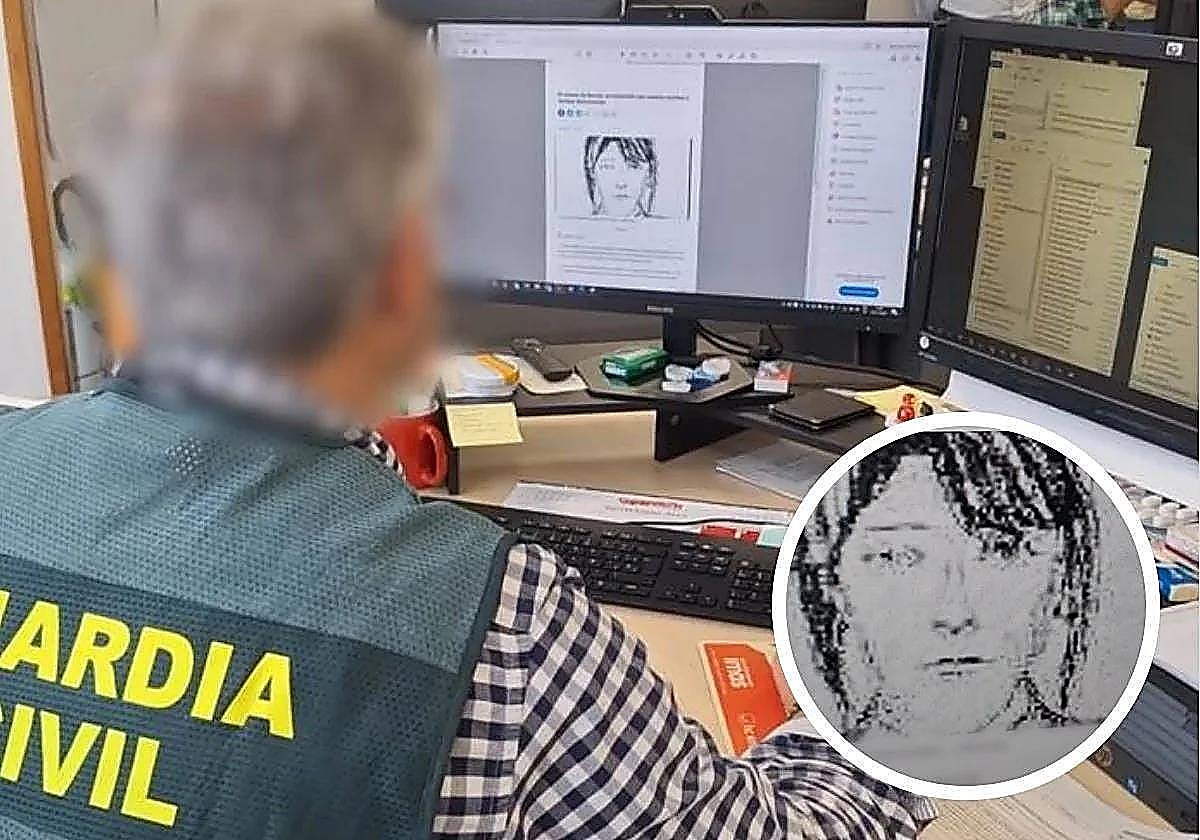
Due to the deterioration of the victim's remains when they were unearthed by the National Police in Langreo in 1995, it was not possible to identify them. However, they made a sketch.
The Guardia Civil began to connect the two events. The comparison of the sketch and a photo provided by the relatives of the woman from Avilés had certain physical resemblance that could confirm a correlation between the woman murdered on 6 January 1991 and the woman who had fled home, leaving her daughter with her mother at the end of 1990.
The National Police provided the Guardia Civil with all documentation related to the previous investigation, which made it possible to find the place where the remains of the deceased were kept - the biology department of the national institute of toxicology and forensic sciences in Madrid, where they had been sent for biological analysis, essential in the identification of human remains in cases of disappearances.
From the new DNA analyses, it was determined that the skeletal remains found in 1995 corresponded to those of the missing young woman from Avilés. The Guardia Civil put a name to the remains found in 1995 and finally told the missing woman's family what had happened to her.
![[]](http://static.vocstatic.com/voc26/latest/assets/images/favicon/surinenglish/apple-touch-icon-57x57.png)