
Animal welfare
Spain's emergency military unit to join containment operation of wild boars infected with swine flu
Rural authorities are combing the 20-kilometre confined area for carcasses and specimens with the virus

Madrid
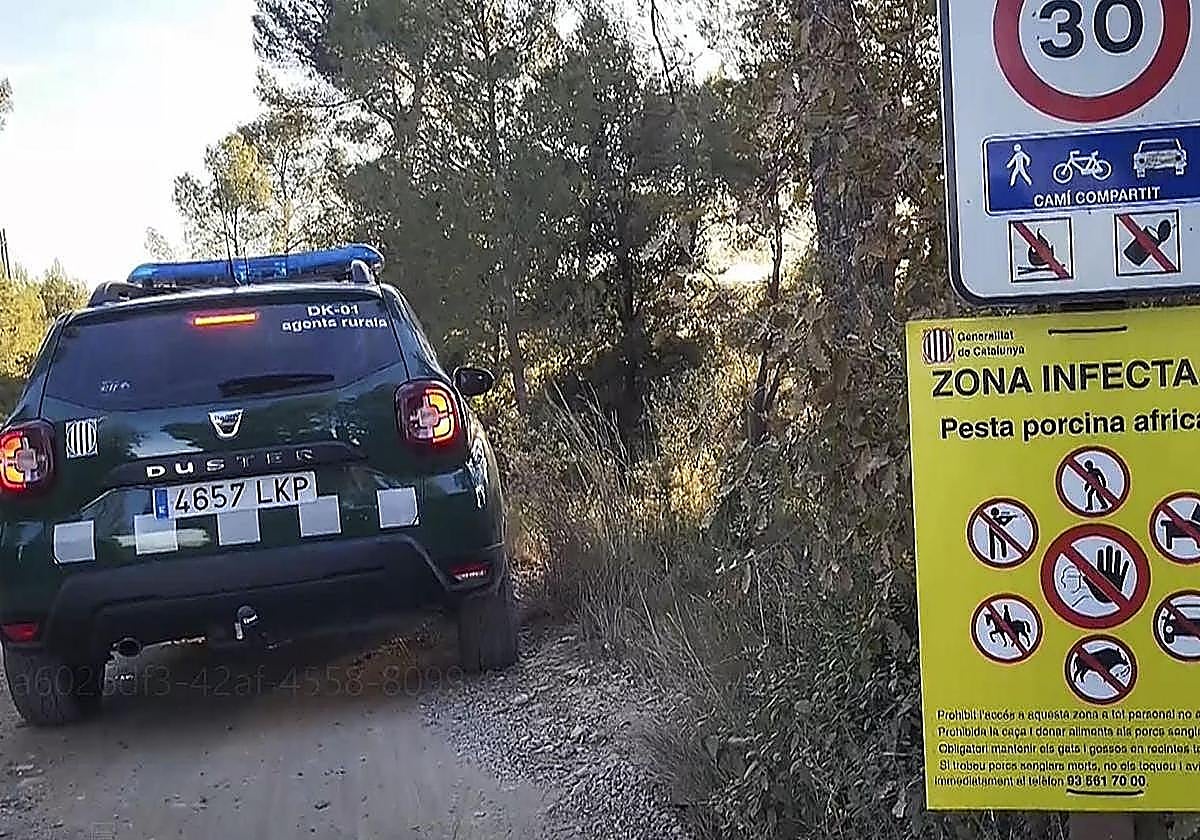
Rural officers of the Catalan regional government located eight more dead wild boars in the outskirts of the Barcelona municipality of Cerdanyola del Vallés, inside the natural park of Collserola on Sunday. A total of 14 dead animals were discovered there from Wednesday to the end of the week. Six of the carcasses have already tested positive for African swine flu, which confirms the first outbreak of this disease in Spain in the last 31 years.
Vet services are currently carrying out analyses to determine whether the eight animals found on Sunday were also infected with swine flu, as is suspected. Both the rural officers and the regional government expect the number of carcasses to increase in the coming days. The virus, although harmless to humans and other animal species, is highly contagious and has mortality rates of around 90% in the pig family.
Prior to the discovery on Sunday, the regional minister of agriculture, livestock and fisheries had said that they had started to carry out raids in the area of 20 kilometres around the point where the first contaminated remains were found. Their aim is to both remove carcasses and find other wild boars that may potentially be infected.
On Monday, the state emergency military unit (Ume) joined the efforts in Catalonia, at the request of the regional authorities, which has asked for reinforcement in the containment operation.
The inspection of the 36 quarantined pig farms in the risk area has concluded that the animals there are not infected
As regional minister of agriculture Òscar Ordeig explained, the authorities will install traps and fences to prevent the animals from moving to other areas. In addition, they will capture wild boars and recover carcasses.
Non-residents have been banned from entering the high-risk area, forests and natural sites. Non-essential activities, including hunting and leisure activities, have been suspended. Areas from which wild boars could escape have been cordoned off. The 39 pig farms in the area have been quarantined. The good news is that their animals have tested negative for swine flu.
The aim of this operation is to prevent the virus from leaving the security perimeter and the outbreak becoming an epidemic, as it did more than 30 years ago. This would cause devastating economic damage to an industry in which Spain is the third largest producer and exporter in the world and which accounts for 40% of all the revenue generated by national livestock farming.
The origin of the virus is still unknown
In an interview for Cataluña Radio, Ordeig asked for the cooperation of the public and urged people to comply with the restriction of not accessing the natural park of Collserola, which remains closed. A shoe sole or a tyre treading on debris can bring the virus out of the perimeter.
According to Ordeig, the park couldn't be closed on Saturday due to its size -Collserola can be accessed from 100 main and 400 secondary entrances, which makes its closure a long and difficult process.
The regional governmennt has asked the Mossos d'Esquadra, Guardia Civil, Local Police and civil protection volunteers to join the efforts. The aim is to prevent access to Collserola, "especially to the main radius of six kilometres".
The recovery and capture process will be coordinated by rural officers, together with the regional ministry of agriculture and staff from public company Forestal Catalana. "Any animal that is found must be disinfected and taken to the animal health research centre. This must be done under very advanced technical conditions," Ordeig said.
The exact origin of the outbreak is under investigation. The analyses will determine the exact variant of the virus present in Catalonia, which will then be compared to those in the other 13 EU countries where the disease is present. This will help detemine the origin. Possible hypotheses point to contaminated food leftovers or transmission from other EU countries via transport.
'We will do whatever it takes'
The regional minister said that, in order to ensure the success of the outbreak containment work, everything necessary will be done. "What we have to see is whether there are more cases," he said, adding that, so far, all infected animals located were within the radius of the municipality of Cerdanyola del Vallès (Barcelona).
For the moment, the Catalan regional government has not considered suspending classes at the Bellaterra campus of Universidad Autónoma de Barcelona (UAB), which is very close to the isolated radius of the outbreak. The activities of homes, businesses and university centres close to the perimeter zone "will be maintained until further notice".
![[]](http://static.vocstatic.com/voc26/latest/assets/images/favicon/surinenglish/apple-touch-icon-57x57.png)