
Ceuta migration crisis 2026
Spain puts security forces on high alert in Ceuta over online calls for mass border crossing
Interior Ministry deploys 300 riot police as social media messages target Wednesday crossing to coincide with Moroccan election day
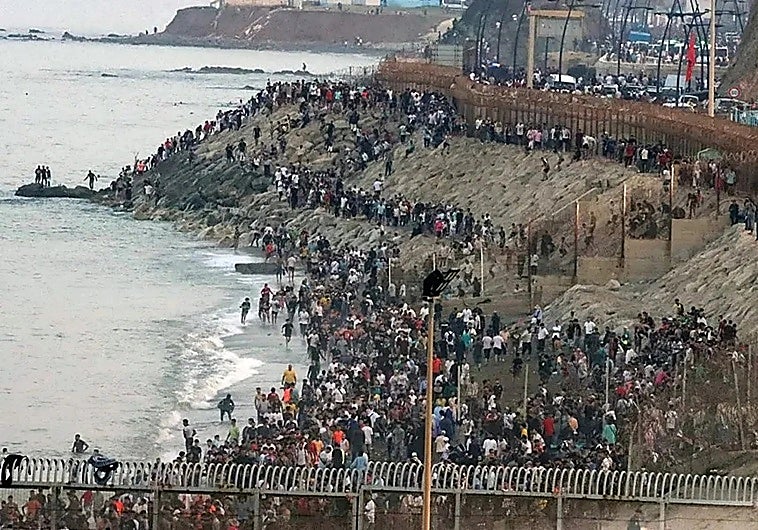

Spain's Ministry of the Interior does not know how many people might respond this Wednesday to the calls that have been circulating for weeks ... on social media and messaging apps, urging a new mass attempt to enter Ceuta.
Nor does it know whether the call will actually result in a significant gathering at the border.
However, following the precedent of 30 and 31 July, this time the ministry has decided to go on high alert before the situation unfolds.
Since last Saturday, the security forces have deployed more than 300 law enforcement officers (riot police) in Ceuta, ready to step in immediately should the situation escalate or should Morocco, as happened in July, refuse to cooperate.
The call was not originally scheduled for 23 September. In fact, it is a follow-up to an initial call to attempt another mass crossing on 15 August , barely two weeks after the July surge.
During the first few days of August, WhatsApp, Facebook and Instagram groups began to proliferate, highlighting that date and discussing routes and entry points. However, the increased police presence deployed by Morocco and Spain, coupled with doubts about the success of the attempt, led some of those same groups to start suggesting a postponement.
A new date was set: 23 September. The idea, according to some of these online groups, is to capitalise on the Moroccan parliamentary elections, considering that part of the security forces will be responsible for the smooth running of polling day.
Some groups that had initially referred to 15 August changed their names. Several messages even urged people not to publicise the new date too widely, to prevent the authorities from being able to prepare their security arrangements.
In recent days, the call has once again gained prominence. A poster is circulating, with a green background and a message in Arabic calling for a "collective migration" to Ceuta on 23 September.
One of the private Facebook groups where this type of content is shared has over 91,000 members. That figure, however, does not allow to gauge the actual capacity for mobilisation: being part of a group does not necessarily mean that a member has seen the message, supports it or is willing to travel to Castillejos.
There is no reliable estimate of the number of people who might take part, nor is there any public information about a specific time for the gathering, a specific meeting point or a centralised organisation behind the attempt. Spain's intelligence services have been trying for days to separate the noise on social media from any indications that might foreshadow actual movements towards the border.
Related story

Minister of the Interior Fernando Grande-Marlaska admitted on Monday during his visit to Ceuta that there is "concern" and stated that the information is subject to ongoing assessment.
The Spanish security operation is not limited to physical reinforcements. The security services are monitoring both open and closed sources, tracking the development of messages and exchanging information with Morocco.
On 30 July, some 72,000 people entered Ceuta illegally, according to official figures. Thousands remain in the city. The subsequent declassification of documents confirmed that the day before, the CNI had warned of calls for people to attempt to enter by sea and over the fence and had passed this information on to both the Spanish authorities and the Moroccan services.
That incident turned any new mass mobilisation into a threat that the Interior Ministry can no longer treat as mere online agitation. Since then, the security services have been receiving frequent alerts and must assess which ones have the actual capacity to move people towards the perimeter.
The call for action on 23 September is one of those that has attracted the most attention due to its persistence, the number of groups involved and the fact that it coincides with the Moroccan elections.
Morocco has also stepped up surveillance at the access points to Castillejos and Bab Sebta. Road checks and the deployment of security forces intend to prevent large groups from approaching the border. Cooperation from the neighbouring country is crucial: any significant gathering can be contained before it reaches Tarajal if the Moroccan authorities decide to halt the movements.
On 15 August, it became clear just how much that control depends on Rabat's will. Two weeks after the July surge, the Spanish authorities detected another call for a mass attempt to enter Ceuta. This time, Morocco deployed its security forces and military units in advance to the approaches to Castillejos and the surrounding border area. The attempt did not even come close to the perimeter.
That incident showed that, when the Moroccan authorities decide to close access routes and halt movements before they reach Bab Sebta, they have the capacity to neutralise a gathering of this kind.
That experience is one of the benchmarks Spanish security services are now using in the run-up to 23 September: rather than the number of messages circulating on social media, the decisive factor will be to ascertain what movements Morocco permits in the hours leading up to the event and how vigorously it acts to prevent large groups from forming near the border.
![[]](http://static.vocstatic.com/voc26/latest/assets/images/favicon/surinenglish/apple-touch-icon-57x57.png)