
Migrant crisis
Ceuta migrant crisis leaves nearly 100 people dead and dozens missing
The vast majority of those who crossed the border have returned to their country of their own accord and voluntarily
Luis López
The old military hospital in Ceuta is being used to identify the bodies of the 72 people who, as of late on Sunday 2 August ... had been recovered from the sea, according to central government sources. However, the mortuary has reported that it currently has 88 bodies, two of whom are women and between 13 and 16 children.
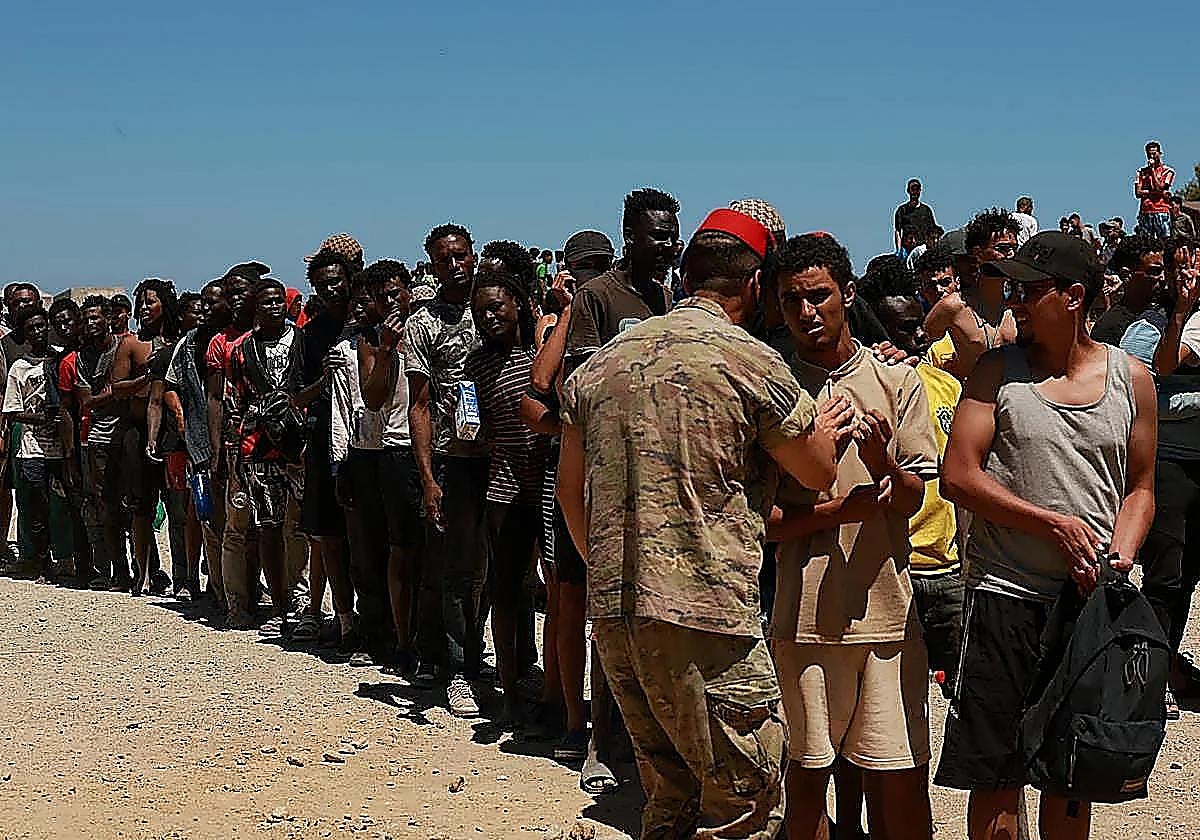
Outside the building, dozens of young migrants who entered Ceuta between Thursday 30 and Friday 31 July were waiting to find out whether among the bodies was a sibling, friend or cousin of whom they had heard nothing since they came out of the water. On the other side of the border, dozens of Moroccan families were waiting for news of their loved ones.
The true scale of the humanitarian crisis that occurred last week is still unknown. The Spanish authorities have recovered the bodies, which are now in the Ceuta mortuary awaiting identification. Meanwhile, the Moroccan authorities put the figure at eleven bodies found in their waters. In total, around a hundred lives have been lost and dozens of people are still missing. There have been several accounts from those who swam to Ceuta that they were surrounded by bodies as they swam.
Criminal gangs
Between Thursday and Friday between 50,000 and 60,000 people entered Ceuta, a figure that Morocco revised downwards on Sunday, in its first official statement on this crisis, to 40,000. Most arrived by swimming. A human avalanche that the Spanish government blames on criminal gangs, but which experts believe is more consistent with an attempt by the country to put pressure on Spain for as yet unknown purposes.
In line with the version put forward by the Spanish government, a spokesperson for the Moroccan Ministry of the Interior attributed what had happened to a combination of "the malicious exploitation of the digital space, the activities of human trafficking networks" and "misleading information and misinterpretations" regarding the Spanish supreme court's ruling against the 'immediate returns' of migrants arriving by sea, which "reinforced the belief among some that it was possible to avoid immediate return".
Related story

The vast majority of those who crossed the border have returned to their country of their own accord and voluntarily. None of the promises of legalisation that had been circulating on WhatsApp groups and social media, encouraging the "invasion'" were true.
However, the crisis is still far from over. Ceuta is heavily guarded by 3,000 soldiers, police officers and Guardia Civil officers who are working to maintain calm in an atmosphere that remains tense. This is partly because people wishing to enter Spanish territory irregularly are still arriving, albeit very sporadically. But, above all, because there are still hundreds or even thousands of migrants in Ceuta waiting for the current upheaval to subside so they can continue their journey. Most are young people, but there are also many families and women with young children.
Uncertainty
This situation is likely to continue for some time. The government's representative in Ceuta, Miguel Ángel Pérez, said on Sunday that "we are going to speed up the processing of cases and carry out returns to the country of origin as soon as possible". But it will not be a quick process. The Ministry of the Interior has confirmed that police and military personnel will remain in the city for as long as necessary.
Although the city centre is gradually returning to normal (shops are opening, outdoor terraces are filling up, people are going to the beach), there are still many uncertainties. There are also fears that security issues will increase, which have even led to tensions amongst residents. Some local residents and NGOs are helping the migrants: they are providing them with food (some have not eaten for days), water and clothing.
But, above all, they are letting them use their phones so they can call their families, despite some members of the local population pressuring others not to help them, in the hope that necessity will force them to return to Morocco.
The influx of people has also overwhelmed health centres and hospitals. In two days, more than 1,600 migrants were treated, one of whom remains in intensive care and two newborn babies have been admitted.
Far-right reaction
Against this backdrop, far-right groups travelled to Ceuta to stir up even more tensions; these have ranged from Vox's calls to "hunt down" migrants to the presence of agitators such as Alvise Pérez and Vito Quiles, as well as the neo-Nazis of Núcleo Nacional.
Meanwhile, the installation of the floating barrier at the Tarajal breakwater was completed on Sunday. The aim is not so much to prevent new migrants from swimming across, but rather to provide a physical barrier that will enable "immediate returns" to the other side of the border for administrative purposes.
Meanwhile, Morocco is transporting its returning nationals back to their places of origin by bus, while confining sub-Saharan Africans to industrial warehouses.
![[]](http://static.vocstatic.com/voc26/latest/assets/images/favicon/surinenglish/apple-touch-icon-57x57.png)