
Ceuta migration crisis
Spain's government does not know the exact number of undocumented migrants still in Ceuta, one month following their arrival
Interior Minister Marlaska put the figure at 5,000 migrants on 28 August, while president of the regional government Vivas estimated twice that number just two days later
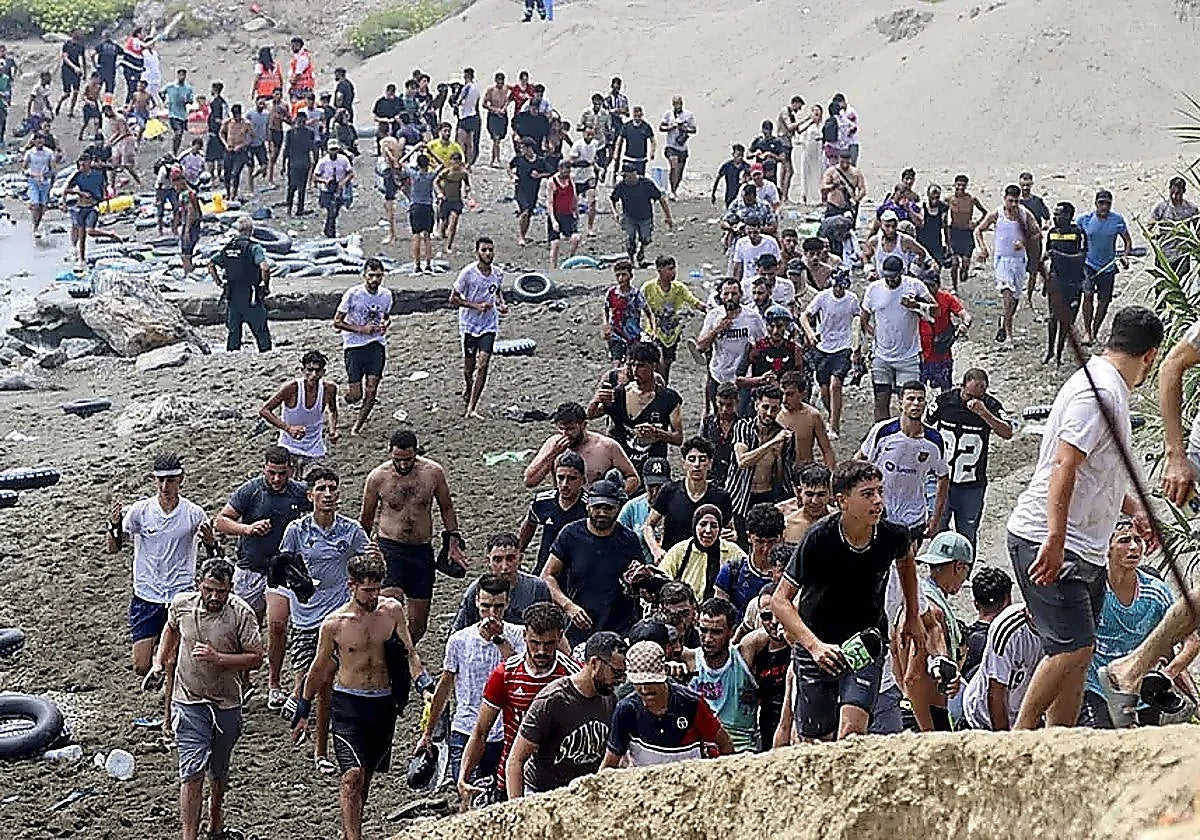

More than a month after the migrant influx on 30 and 31 July, the government is still unable to determine how many of those ... who entered the Spanish territory illegally remain in Ceuta.
Minister for Territorial Policy and head of the single command centre Ángel Víctor Torres acknowledged in an interview on Cadena Ser on Monday that it is "impossible" to pinpoint the exact number, given that the processes for identification, return and international protection are still under way.
This announcement comes after more than five weeks of fluctuating official figures regarding the three key aspects of the crisis: how many have entered, how many have returned to Morocco and how many remain in the city.
Related story

The National Police's CENIF centre for immigration and borders stated on 26 August that there were no "reliable figures" available.
The Guardia Civil reported 49,200 arrivals on 31 July. President of the regional government of Ceuta Juan Jesús Vivas later raised the estimate to 78,000. On 11 August, the Interior Ministry put the figure at 72,000.
CENIF, after reviewing aerial and satellite imagery and the length of time the border control was out of operation, put forward an even higher number: between 75,000 and 85,000 people.
There has been no consistency in the figures for returns. The Guardia Civil recorded 73,514 voluntary returns in its report of 1 August. Interior Minister Fernando Grande-Marlaska estimated 70,000 on 4 August, while Vivas put the figure at 73,000 the following day.
The police report subsequently revised the estimated range down to between 65,000 and 75,000.
PM Pedro Sánchez updated the figures again during his appearance in Parliament last Thursday. He said that, of the 70,000 migrants, 50,000 had returned within 24 hours and that, after 72 hours, the number had reached 63,000, "more than 90 per cent" of those who had crossed the border.
The biggest question remains how many people are currently in Ceuta. Marlaska stated in Parliament on 28 August that there were "around 5,000". Two days later, Vivas estimated that the figure could be around 10,000 and pointed out that Marlaska had told him on 1 August that there were barely 2,500 left.
On 25 August, the CENIF put the figure at between 5,000 and 10,000.
As of 19 August, CENIF has recorded 148 migrants who arrived from Ceuta on the coasts of Cadiz and Malaga in 29 boats. The Interior Ministry acknowledged on 27 August that there were still people who had not undergone the mandatory identification process, which is why it stepped up the police presence and requested support from Frontex.
On Monday, Torres acknowledged that they have not yet confirmed the final number. He did, however, provide a new figure: since 10 August, around 4,000 people have voluntarily returned to Morocco. He also put the number of identified minors at 2,000, although he warned that the figure would rise because there are still minors "on the streets".
According to Torres, the government has set up some 3,500 reception places and is preparing accommodation for a further 6,000. The minister stated that strengthening the teams would speed up return procedures, but insisted that it is essential to complete the triage and identification process first.
The lack of reliable figures is nothing new. The CENIF report highlights that the breakdown of border controls, the simultaneous influx and outflow of people on 31 July and the need to provide humanitarian aid has made any attempt at quantification "extremely complex".
![[]](http://static.vocstatic.com/voc26/latest/assets/images/favicon/surinenglish/apple-touch-icon-57x57.png)