
Politics
Spain hardens stance towards Morocco: 'Its claims over Ceuta and Melilla damage bilateral relations'
Morocco's persistent claims over the two Spanish territories are forcing PM Pedro Sánchez's team to adjust their stance towards the neighbouring country
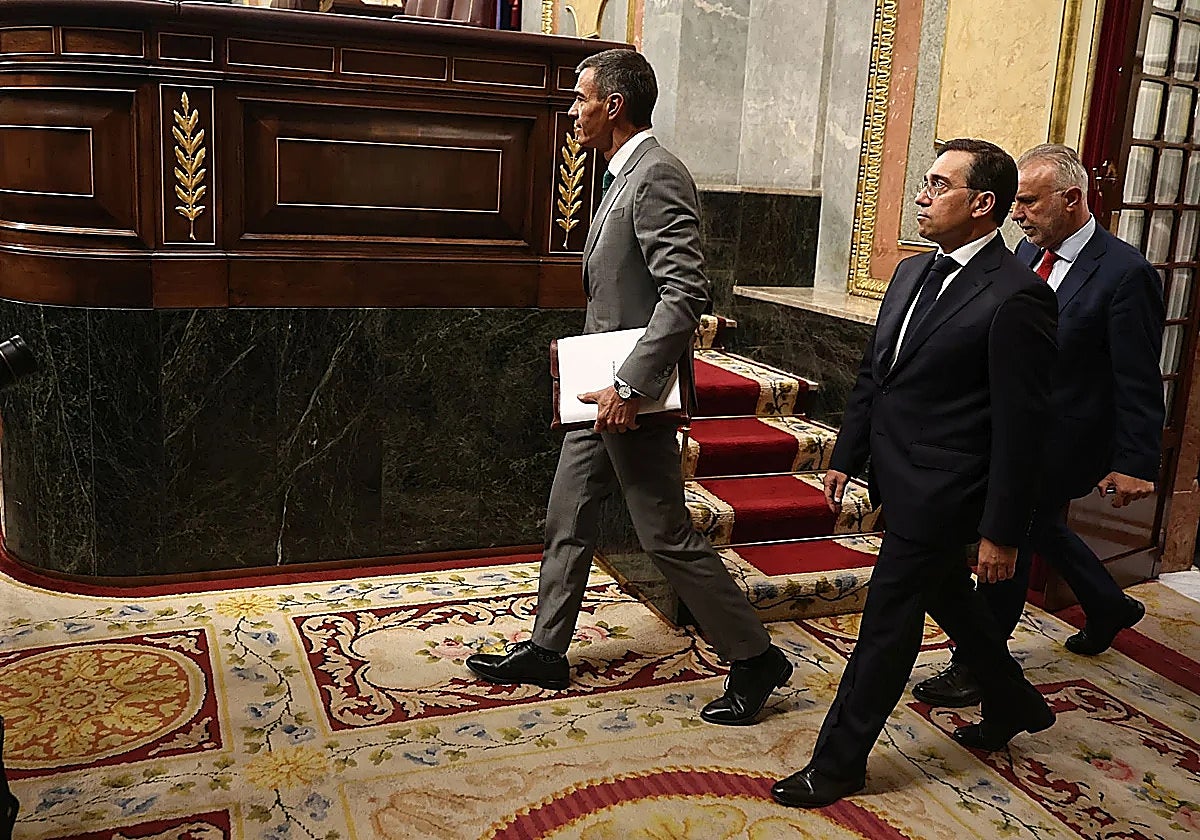

The Moroccan government has claimed sovereignty over Ceuta and Melilla on three occasions since more than 70,000 people crossed illegally into Ceuta at the end of July ... .
The claims have come within the space of a month and have prompted PM Pedro Sánchez's government to begin recalibrating its position towards Rabat and adopt a more robust tone in its responses.
Spain's Foreign Ministry has told SUR that the latest remarks by Moroccan minister Nizar Baraka do nothing but "damage" bilateral relations between the two countries.
Related story

"The territorial integrity of Spain has never been, is not and will never be a subject of discussion with Morocco. Statements by Moroccan ministers damage our bilateral relationship and were the reason why Morocco's ambassador to Spain was formally summoned on 21 August," Spain's foreign ministry said.
During his appearance in Congreso last Thursday, the prime minister said that they had summoned the Moroccan ambassador to convey the Spain's rejection of the Moroccan ministers' statements. The meeting ultimately took place with the chargé d’affaires because ambassador Karima Benyaich was not in Spain.
The government's tougher tone marks a significant shift in the way it has addressed Morocco since the migration crisis. Repeated claims to Ceuta and Melilla from members of the Moroccan government have made it increasingly difficult for Moncloa to maintain the conciliatory approach it had sought to adopt towards Rabat after the mass arrival of migrants on Ceuta's beaches.
The first statements along these lines came just days after the events, when Morocco's justice minister, Abdelatif Ouahbi, declared: "They are our lands." He also pointed out that Moroccans live in the two Spanish cities in North Africa and said Rabat had "patience" when it came to addressing the issue with Spain.
Another member of the Moroccan government, religious affairs minister Ahmed Toufiq, reiterated Morocco's sovereignty claims over Ceuta and Melilla a week ago in front of King Mohammed VI during a religious ceremony. He referred to the "holy struggle to liberate the occupied cities".
"We say this quite frankly: Spain is an essential partner for us, but we will not give up a single inch of our national territory," Baraka said, ignoring Sánchez's warning.
The prime minister had already begun adjusting his position towards Morocco during Thursday's parliamentary session. This was not only because of Morocco's repeated sovereignty claims, but also because several intelligence reports are beginning to suggest that the neighbouring country may have played a role in the wave of people who crossed illegally into Ceuta.
The opening of Sánchez's speech was a clear statement of intent. He referred to the bronze lions guarding the entrance to Congreso, which have stood there since 1872. The bronze came from cannons captured by former PM General Leopoldo O'Donnell from Riffian-Moroccan forces at the Battle of Wad Ras during the 1859-1860 War of Africa between Spain and the Sultanate of Morocco.
Although Sánchez once again ruled out blaming Morocco for what happened in Ceuta at the end of July, saying the government had neither "proof" nor "solid evidence" that Moroccan authorities were behind the events, he also sought to reject accusations from both opposition parties and government allies that he had been too accommodating towards Morocco.
The prime minister also moved away from emphasising the cooperation of Moroccan authorities in returning migrants and acknowledged that Spain needed to "review the coordination and alert mechanisms" it shares with its neighbour, as well as "build additional safeguards" to ensure that the events of 30 and 31 July are not repeated.
"We want to have good relations with Morocco, but it is clear that, after what happened, that cooperation has to be different," Sánchez said.
He also reiterated his description of what happened in Ceuta as a "hybrid attack".
![[]](http://static.vocstatic.com/voc26/latest/assets/images/favicon/surinenglish/apple-touch-icon-57x57.png)