
Ceuta migration crisis 2026
Declassified documents show Spanish government received multiple warnings ahead of Ceuta border crisis
National intelligence and police reports flagged high risk of mass border crossings three days before security forces suffered total collapse in enclave
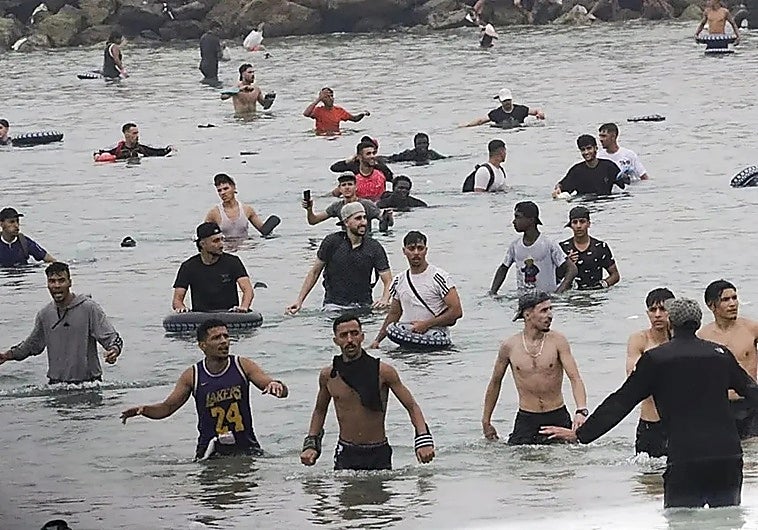

The Spanish government had received warnings prior to the mass influx of migrants in Ceuta on 30 and 31 July.
The Guardia Civil had ... reportedly warned of increasing migratory pressure and requested security reinforcements. The police had tracked calls to storm the border and the CNI (national intelligence centre) had reported attempts to enter by sea and over the fence in preparation.
According to these sources, the government received seven reports and numerous messages. Part of the timeline was already public knowledge.
Related story

Other key events have just come to light as part of 22 documents, alongside statistics and other communications. A thorough examination of the declassified documents reveals the existence of a further 18 documents dated 30 and 31 July, including military analyses.
None of the documents anticipated 72,000 or 80,000 arrivals. Concern, however, had been mounting for weeks.
Prime Minister Pedro Sánchez stated that "none of them went beyond a description of the data or a routine alert ". He denied that there had been any forecast of "the scale" and "the probability" of the outcome.
The CNI acknowledged on Wednesday that it had also not anticipated "the magnitude and nature" of the border crossing, but that it did have concerns.
The first substantive warning is dated 8 July. The Guardia Civil were analysing the implications of the Supreme Court ruling that requires the authorities to order the return of migrants who arrive by sea on a case-by-case basis, instead of immediately repatriating everybody.
"This is likely to increase migratory pressure," the Guardia Civil document states. It calls for strengthening the Ceuta maritime service, the underwater specialists service in Melilla and coastal surveillance. It also warns of a possible "pull factor". That was 20 days before the attack on the Spanish border.
The Interior Ministry was also aware of the deterioration in reception conditions. Minister Fernando Grande-Marlaska acknowledged concerns as early on 10 or 11 July regarding the arrivals of minors.
Meanwhile, reports from the Guardia Civil were reaching the secretary of state's office. They were statistics setting the scene against which the subsequent warnings were to be issued.
On Monday, 27 July, president of the regional government of Ceuta Juan Vivas rang Moncloa. He spoke to Sánchez's chief of staff, Diego Rubio. The PM later confirmed that the call had taken place and that the information had been immediately passed on to the Ministry of the Interior.
An urgent meeting with representatives from Ceuta, the police and the Guardia Civil took place that day.
At 12.30pm, the police recorded another figure: a cumulative total of 1,240 arrivals. The CNI document bears the subject line "mass entry by swimming". It detailed arrivals that had already taken place and triggered a risk assessment by the CENIF (national centre for immigration and borders).
"Migration pressure on Ceuta and Melilla is on the rise," the CNI wrote in a report on 27 July. Its forecast warned that the Supreme Court ruling could encourage attempts to cross by swimming.
On Tuesday, 28 July, Vivas requested that the Interior Ministry declare a state of emergency, according to his account. They replied the following day that there was no legal basis for doing so.
Vivas described the sudden surge in the number of children taken into care: "In the space of a single week, we had gone from caring for 180 children to 800." During those same days, he claimed, 1,500 people had swum ashore.
The internal CENIF memo dated 28 July contains an unequivocal call to action: "On 30 July, we are going to launch an attack (avalanche) near Ceuta." Analysts described the signs as still in their early stages, with an increased maritime risk but insufficient indicators of a massive and violent land-based crossing.
The document adds that the sea conditions and the fog forecast for 30 July favoured crossings by swimming.
The assessment changed on 29 July. An update to that report details communications regarding the organisation of mass crossings that night, both by land and by swimming, "to cause as much disruption as possible". The risk was classified as "very high".
Moroccan festival Día del Trono on 30 July appeared to be linked to a possible easing of surveillance. In addition to references to wetsuits, flippers and videos of swimmers, there were plans to combine different routes of entry.
At 1.52pm, the CNI wrote to the delegation's office: "There is a call on social media for a storming of the fence and the sea tomorrow at 8pm." It added that the Fiesta del Trono would be used as a pretext and that two groups had a combined total of 180,000 followers.
At 9.34pm, there was an eleven-minute phone call.
One minute after the first alert, another message reached the Guardia Civil: "We have information about an attempt to swim across and scale the fence tomorrow."
After two unsuccessful calls, there was one successful attempt at 2.41pm for seven minutes and 38 seconds. Moncloa has now questioned whether a WhatsApp message sent to a junior officer constitutes a formal alert. The documentation contains the records of both telephone conversations.
At 6.26pm, the CNI sent an "early warning" note to the Moroccan secret services, the DGST and the DGED, regarding the "planning of several crossings". This communication is not included in the subtotal of seven domestic documents and messages. The note specifically identifies the groups encouraging people to enter the country.
At 9.09pm, the CENIF issued an alert to the border posts in Ceuta and Melilla. It identified 30 July as a high-risk date and anticipated people swimming across the border and coordinated attempts to scale the fence. It assigned "medium-low" probability and an "extreme" risk.
The report warns that similar calls to action have, in the past, resulted in such incidents actually taking place.
By 30 July, reports were already describing the situation as having got out of hand. At 12.06pm, the armed forces intelligence centre received a warning that a mass influx was "highly likely".
At 1.20pm, the Guardia Civil wrote: "The situation is extremely serious." That night, the CNI described a "total collapse" of the security forces and emergency services. On 31 July, border alerts and requests for reinforcements continued.
The examination of that response is now before the National High Court. In her ruling of 7 September, Judge María Tardón noted the alert issued on 29 July and ordered an investigation into Spain's actions in relation to the information available and the resources deployed.
The police report included in the case file specifically refers to the form dated 27 and that initial warning to the border authorities.
![[]](http://static.vocstatic.com/voc26/latest/assets/images/favicon/surinenglish/apple-touch-icon-57x57.png)