
Economy
Spain to extend anti-crisis measures under pressure from soaring prices
The Ministry of the Economy is negotiating with trade unions and employers' organisations over aid schemes with less than two weeks to go before the latest ones expire
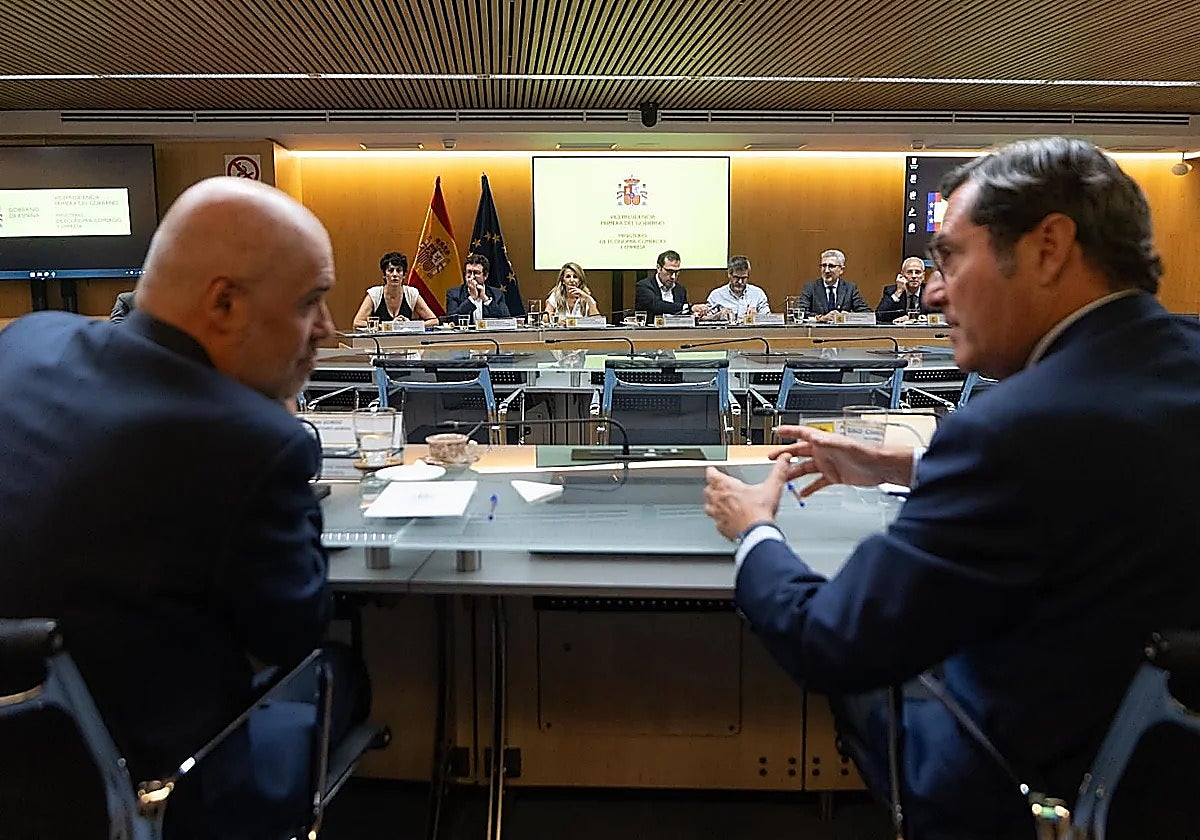

The Spanish government is negotiating how to extend financial support to household and businesses beyond 30 September, when the current measures to counter the economic ... impact of the war in Iran are due to expire.
Inflation is picking up again and fuel prices are rising. For this reason, the Ministry of the Economy has opened discussions with trade unions and employers' organisations on which support measures to retain and which new measures to introduce from October.
The negotiations are beginning, however, with a warning from the Airef: the scope for further increases in spending has been reduced to a minimum.
Related story

The relevant authorities met on Thursday to discuss the possibility of extending measures.
The ministry confirmed that the government would build on current measures to continue "standing by and supporting" households in the face of rising prices. It is placing particular emphasis on transport and the agri-food sector due to their impact on the rest of the supply chain. Further sector-specific meetings will be held next week to assess what support may be required.
Minister of Labour and Social Economy Yolanda Díaz's department arrived at the meeting with a package of five measures which it considers to be "the bare minimum": extending the provisions of royal decree-law 18/2026, which are due to expire at the end of September; introducing a temporary levy on the refining sector; capping rent; taking action on purchasing power and the cost of groceries; and reinstating the exemption against extraordinary increases in gas prices.
Aelec (Asociación de Empresas de Energía Eléctrica), however, rejects the idea of reinstating the Iberian exemption. The electricity employers' organisation stated that the situation is different from that during the Ukraine crisis: gas now determines the price of electricity for less than 15% of the time, compared with around 75% at that time.
It also warned that three out of every four consumers are already on fixed-price contracts and that reactivating the mechanism could increase costs for a significant number of them. According to Aelec, any support should be "specific and targeted" and should not disrupt the functioning of the electricity market.
The CEOE called for an assessment of whether the support measures should continue and for them to be targeted at the sectors and consumers most affected, with particular attention to energy-intensive and gas-intensive industries. The employers organisation called for action on structural energy costs, ranging from taxation and transmission charges to gas and renewable fuels.
The government has not, as yet, adopted these measures. The Economy Ministry proposed to analyse and adjust support measures according to the sectors most affected.
The Labour Ministry is committed to extending the wage protection scheme and also taking action on prices, housing and business profit margins.
The pressure to take action is mounting. Inflation reached 4.3% in August, 0.7% higher than in July and the highest rate since February 2023. Fuel and lubricants for private vehicles rose by 23.8% year-on-year.
The situation threatens to get worse. Funcas forecasts that inflation will rise to 4.9% in September and remain above 4% over the coming months, driven in particular by energy prices. Its estimate puts the average inflation rate for 2026 at 3.6%.
Prices are also continuing to rise at petrol stations. In just 15 days, 95-octane petrol has risen from 1.774 to 1.911 euros per litre, an increase of 7.7%, while diesel has risen from 1.773 to 1.895 euros, an increase of 6.9%. Diesel prices have even wiped out the relief the extension of the tax cut brought at the start of September.
The government mechanism provided for a gradual reduction in taxation over the summer, but included an automatic clause to increase it should prices rise particularly sharply. That safeguard led to the reduction in diesel prices reaching 20 cents per litre in September. Two weeks later, the price has already risen above the level before that increase.
Trade unions are also pressing for a broader response. The general secretary of CC OO, Unai Sordo, called for the reinstatement of the Iberian exception and a payment of at least 300 euros for some ten million people on below-average incomes. Sordo made any further tax cuts on petrol and diesel conditional on the savings being passed on to consumers rather than simply boosting corporate profit margins. CC OO called on the CNMC to monitor the entire value chain, from refining to retail.
The UGT took the same line. Pepe Álvarez considers it "essential" to maintain the current measures and introduce new ones if prices remain under pressure. Ahead of the meeting, he pointed the finger directly at the refining industry.
The Labour Ministry's proposal to impose a temporary levy on refining ties in directly with that debate. The ministry maintains that rising energy costs and corporate profit margins cannot be passed on in full to households.
The scope for financing a new package is becoming increasingly limited. The chair of Airef, Inés Olóndriz, admitted on Thursday that further measures to combat inflation "are likely to be necessary", but warned that these would have to be offset by cuts in other areas or by new sources of revenue.
The fiscal authority will raise its deficit forecast for this year to 2.7% of GDP and considers that the government has already reached the limit of its spending commitments. Reported expenditure is rising by 6.6% and has accumulated a 16.8% increase since 2024, exceeding the 13% committed.
"We are already on the verge of being unable to meet our commitments," Olóndriz said. Airef does not dispute that further measures may be necessary, but warns that extending the relief scheme without providing funding for it will increase the risk of fiscal non-compliance.
The government now has less than two weeks to finalise its response. The current measures expire on 30 September and the Economy Ministry intends to assess over the coming days which support measures to extend. The Labour Ministry is pressing for their scope to be broadened. The Airef believes that any additional measures will have to be funded.
![[]](http://static.vocstatic.com/voc26/latest/assets/images/favicon/surinenglish/apple-touch-icon-57x57.png)