
Government proposes direct aid to end the hauliers' strike in Spain
The National Road Transport Committee calls on the government to increase fuel subsidies to one billion euros
clara alba
The Spanish government wants to close a deal with the striking hauliers this week to minimise the impact which rising fuel prices has had on their activity. In a meeting with the National Road Transport Committee on Thursday morning, they outlined plans for direct aid which would reduce fuel prices.
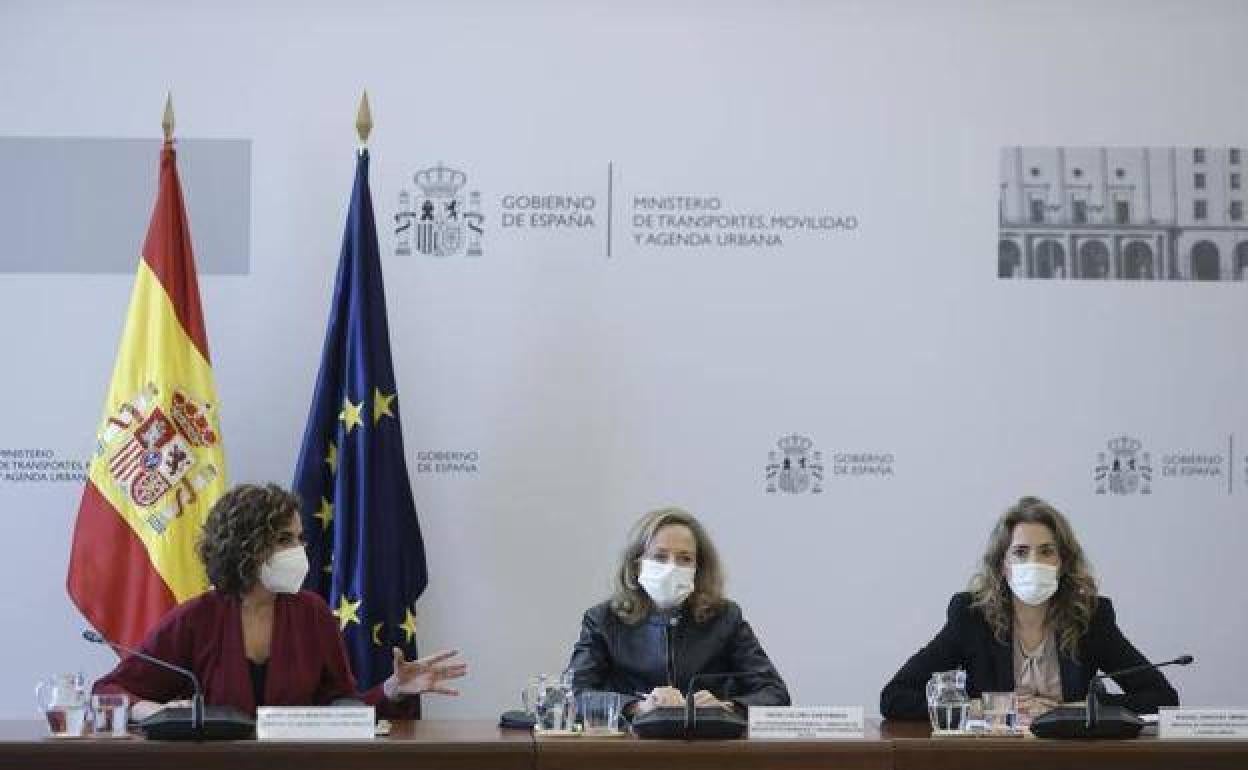
The negotations were led by Nadia Calviño, the Minister for Economic Affairs, Raquel Sánchez, the Minister of Transport, and María Jesús Montero, the Minister of Finance. The focus was on how the 500 million euros proposed to subsidise commercial fuel will be distributed. According to Europa Press, the hauliers want the subsidy increased to one billion euros.
The goal is to develop a programme similar to that in France, where Macron's government has approved a reduction of 15 cents per litre of fuel, which will come into effect on 1 April.
Pedro Sánchez said yesterday that they won't give up until an agreement has been reached. The problem is that the deal may not be enough to stop the blockade, which has caused serious supply problems over the past few days due to slowed production in various industries, especially food.
Strikers led by the Platform for the Defence of the Transport Sector didn't attend the meeting on Thursday. They have been striking for ten days, and their main representative, Manuel Hernández, announced that they wouldn't stop until they could negotiate with the government, even though many of their demands are the same as the National Road Transport Committee, who the government consider to be the legitimate partner with whom to resolve the issue.
On Thursday morning Spain's Finance Minister, María Jesús Montero, insisted that “the rules of the game have to be respected”. Regarding the actions of certain picketers in this conflict, Montero said that she is aware that there are hauliers who feel “coerced” when it comes to taking their lorry out, and she assured that “since the first day” of the strikes, the Ministry of the Interior deployed over 24,000 officers.
Rachel Sánchez condemned the violence used by some of the picketers, who she accused of belonging to far-right groups. This is a position which Yoland Díaz, the second vice-president and Employment Minister, preferred to distance herself from. She said that the striking hauliers are “the most vulnerable” in the transport chain.
Divided
“I hope that what is agreed today will be respected, and that violent methods won't be resorted to,” said Montero before the meeting.
The division within the sector makes the situation even more complicated. There are also differences between the transport of merchandise and that of people – the taxi industry in particular demand that the subsidies are extended to cover gas and electricity.
Montero also stated that in meetings with electricity and oil companies over the past few days, they have asked them to lower their prices, especially the price of fuel for professional use.
With regards to electricity companies, they discussed the windfall benefits system, so that electricity prices are real and not fabricated according to the price of gas.
![[]](http://static.vocstatic.com/voc26/latest/assets/images/favicon/surinenglish/apple-touch-icon-57x57.png)