
Toledo train disaster2026
Spain train crash first official report: AVE collided with Iryo train while going at between 160 and 200 kilometres per hour
Transport accident investigators reject the Transport Minister's claim that a single human error was to blame and cite a "chain of faults, instructions and actions" at the root
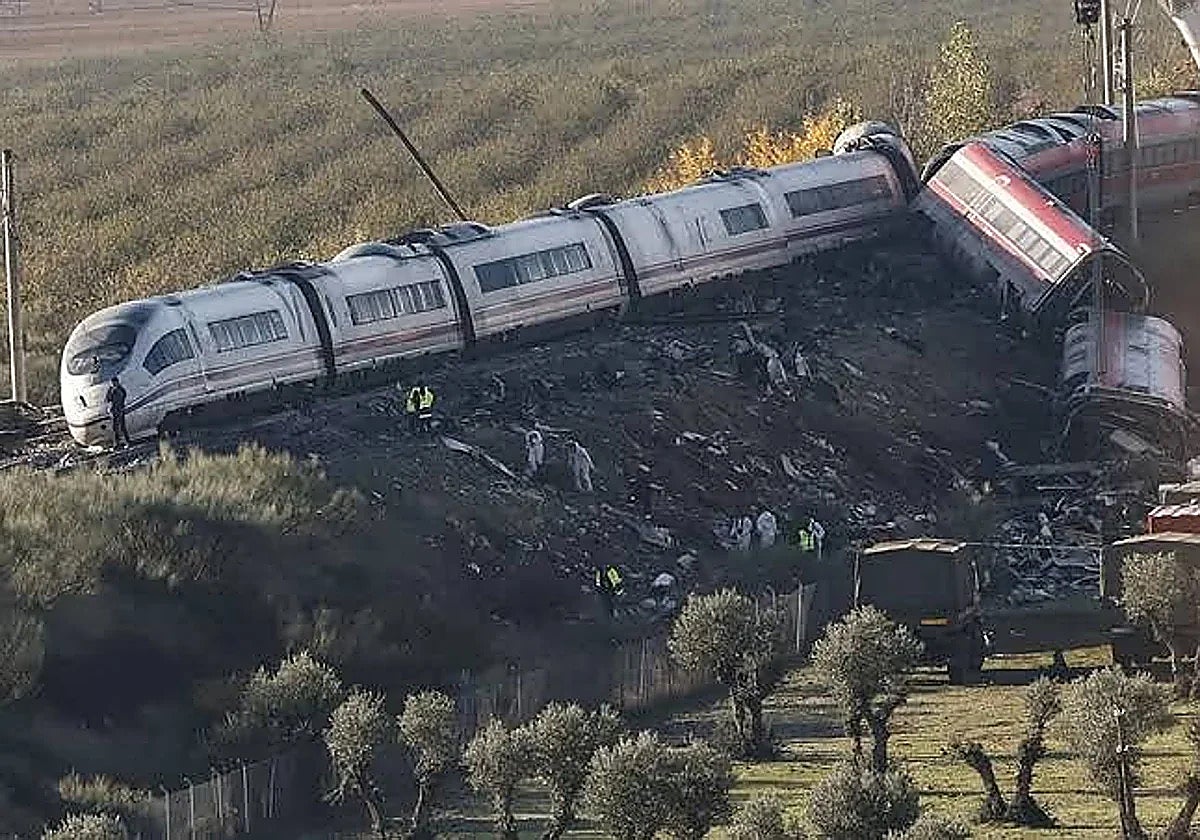

The collision of the Urda trains was devastating. The Renfe AVE that crashed into the rear of the Iryo, which had come to a halt ... on the track due to a fault in the safety systems, was travelling at an estimated speed of between 160 and 200 kilometres per hour.
This is the main conclusion of the first, still very preliminary, report by the Aitat (independent administrative authority for the technical investigation of railway accidents and incidents, maritime and civil aviation) on the Toledo rail accident, which has so far claimed the lives of 69 people and left 200 injured.
This first official report also deals a severe blow to Transport Minister Óscar Puente's theory that human error was the cause of the accident. Despite the preliminary nature of this initial analysis, the technical investigation already points to a series of failures and decisions as the cause of the accident.
Related story
-
Toledo train crash 2026
Melchor Sáiz-Pardo
"The chain of faults, instructions and actions would eventually have led to the collision, had the necessary safety measures not been in place," the document states. It stresses that the infrastructure also failed, not just the staff at the Atocha control centre.
Aitat dates the start of the sequence of events that led to the tragedy at 8.31am on Wednesday, when a fault in the LZB protection system forced a change to the trains' operating conditions. The AVE caught up with the Iryo 22 minutes later.
The investigation is now examining the communication exchange between the train drivers and the Adif control room at Atocha, as well as the safety mechanisms designed to prevent one train from colliding with another that had come to a halt. It will also investigate the organisational factors and procedures that may have exacerbated the situation.
The black boxes from the two convoys are now in the custody of the Guardia Civil, who have not yet downloaded the data. The damage the two vehicles have sustained has made it difficult to recover some of the devices, according to the investigating body.
The investigators have not yet been able to interview those directly involved in the incident. At the time this report was written, the train drivers and traffic controllers were not "in a position to be interviewed".
All hypotheses
For Aitat, "all possibilities regarding the potential causes and factors that may have contributed to the incident remain open". The organisation considers it premature to draw definitive conclusions about the decisions taken in the minutes leading up to the crash.
According to the official figures, the accident occurred at 8.53am on Wednesday at kilometre marker 118+800 on track 2 of the Madrid-Seville high-speed line, on the approach to Urda. The Iryo 6076 was stationary at signal E242 when it was struck by the AVE 2080, which was travelling in the same direction.
The first train, an eight-carriage Hitachi ETR1000, was carrying 147 passengers and five crew members. The AVE, a Siemens Series 103, also comprising eight carriages, was carrying 379 passengers and seven crew members. In total, 538 people were travelling on both trains.
The force of the impact left the AVE carriage, identified as number 8 in the train formation, embedded in the rear carriage of the Iryo train, number 1. Both ended up "overturned and twisted at the foot of the track embankment", according to the report.
The rest of the Renfe train also derailed. Six carriages remained on the track, while the seventh fell down the embankment. A section of track, warped by the impact, pierced carriage number 3, the third from the rear in the direction of travel.
The document states that the destruction also affected almost the entire Iryo train. Only the two carriages at the front of the train, numbered 7 and 8, remained on the tracks. The rest derailed and the last three carriages (numbers 1, 2 and 3) plunged down the embankment.
Two parallel investigations
The investigators have focused their initial work on two locations: the scene of the accident and Adif's high-speed regulation and control centre at the Atocha station. The documentation from both locations will enable them to reconstruct the orders and the operation of the railway systems.
Three Aitat technicians arrived in Urda at around 12.15pm on Wednesday. They inspected the wreckage of the trains, the damage to the infrastructure and the exact point of the collision. They also took photographs and gathered whatever information was available.
They then went to the Urda local operations centre, where they examined the railway interlocking system and collected its event logs. This data will enable them to determine what information the signalling systems were providing during the incident.
A second team travelled to the Atocha control room. There, they inspected the workstation of the traffic controller responsible for the section of track where the accident occurred.
The investigators examined the call log, viewed the CCTV footage and listened to the recordings of communications prior to the collision. They also gathered information from the staff present and obtained copies of all these materials.
The recordings released so far show that, at 8.36am, the control centre instructed the AVE driver to switch the LZB off and on again and to resume travel at normal speed.
At 8.41am, the Iryo train driver also received a message, but her train remained stationary. Seven minutes later, at 8.48am, she again reported to Atocha that she couldn't start the train due to system problems.
The investigation should clarify what information the traffic controllers had regarding the position of both trains, what conditions were imposed for them to resume movement and why the available safety measures failed to prevent the collision.
The official statement confirms that, following the failure of the LZB, trains continued to run under the BSL system. To manage this situation, control centre staff and train drivers exchanged instructions via telephone calls.
A "hazardous situation"
The LZB is a system that continuously monitors train speed and can activate automatic emergency braking. Its failure meant that traffic had to be managed using a different signalling system, the use of which during the incident is currently under review.
Aitat will also investigate the LZB's own malfunctions, which, as it expressly acknowledges, "led to the hazardous situation that culminated in the accident". Its analysis will cover possible "environmental, organisational and procedural" factors that may have influenced the sequence of events.
The three technicians deployed to Urda worked until just after 9pm on Wednesday. They returned on Thursday with two additional investigators to continue inspecting the vehicles and their safety features.
The next stages will involve interviews, further technical checks and, if necessary, inspections of other facilities and maintenance reviews. Aitat has, in principle, one year to publish its final report.
The collision has also caused significant damage to the railway infrastructure. Services on the Madrid-Seville high-speed line remain suspended and, according to Thursday's official statement, there is still no estimated date for its reopening.
