
Motoring
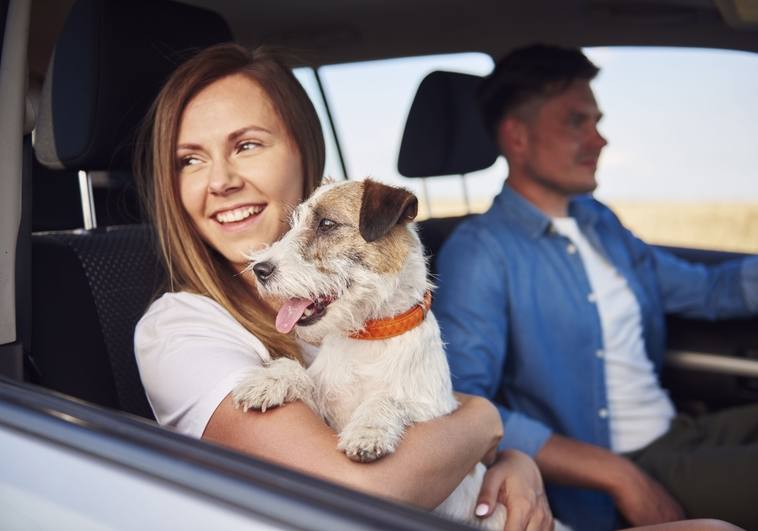
A fine of up to 500 euros and six penalty points on your licence if your pet travels like this in the car
Be careful because in the event of sudden braking or an accident, an unsecured animal can be thrown around, causing considerable injury to the pet and the occupants of the vehicle
Motor Channel
Madrid
How a pet should not travel in a vehicle is obvious: on the lap of the passengers, unrestrained, or disturbing the driver... but are we clear about how exactly it should be transported? It is very important to do it correctly, both for the protection of the animal and for the safety of the passengers. Especially because it is not the same to travel in the car with a 5kg dog as with a 20kg dog. Their needs and protection measures are not the same.
Particularly, in the event of sudden braking or an accident, a pet that is not properly restrained can be thrown around the passenger compartment, with its weight multiplying with the momentum according to the speed. For example, in an accident at 50 km/h, a dog weighing 20kg would hit the passengers as if its real weight were 700kg. If the pet is not properly restrained, this impact can cause the occupants serious harm, in addition to the injuries the pet would suffer.
In addition, it is mandatory. The DGT road traffic regulations in Spain state that the motorist must take special care to ensure that animals being transported are properly restrained so that there is no interference between the driver and them. Therefore, they should never travel loose or be carried on the laps of passengers. The fines are 80 euros when the pets are loose, and between 200 and 500 euros, plus the loss of six points from the driving licence, when they occupy the driver's space.
Therefore, the safest way to travel will depend on the size of the pet. In particular, for small and medium-sized dogs, the best solution is a harness with a strap, which is attached to the vehicle's seat belt. It is recommended that it be a two-point harness to avoid possible breakage in the event of sudden braking or collision. Another option is to fit a pet carrier in place with the seat belt, although this is less safe than the first option.
In the case of bigger dogs, a larger carrier which is placed in the luggage compartment of the vehicle across the direction of travel is an option. If there is no physical separation between the luggage compartment and the occupants of the vehicle, the carrier should be supplemented with a dividing grid. Another option for transporting dogs, especially hunting dogs, is to use a trailer.
![[]](http://static.vocstatic.com/voc26/latest/assets/images/favicon/surinenglish/apple-touch-icon-57x57.png)